

Harriet Tubman
Historical Profile
The Woman Who Walked Back Into Slavery
“There was one of two things I had a right to, liberty or death; if I could not have one, I would have the other.”
— Harriet Tubman
Introduction
Few individuals have come to symbolise the struggle for freedom as completely as Harriet Tubman. Born into slavery in the United States during the early nineteenth century, she escaped bondage only to return, again and again, into slaveholding territory, risking her own freedom to guide others to safety. Those extraordinary journeys transformed an enslaved labourer into one of the most respected abolitionists in American history, while her later service during the American Civil War revealed talents that extended far beyond the Underground Railroad for which she is best remembered.
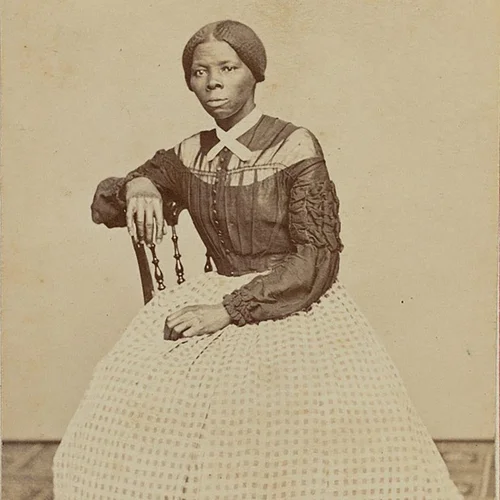
Yet Harriet Tubman's significance cannot be measured simply by the number of people she helped to freedom.
She served as a military scout, intelligence operative, nurse, humanitarian and campaigner for women's suffrage at a time when both her race and her sex denied her almost every legal right. She achieved these things without formal education, political office or wealth. Her authority came instead from practical intelligence, careful planning, remarkable resilience and an unwavering conviction that freedom was worth every risk.
Today, Harriet Tubman is recognised throughout the United States as one of the nation's defining historical figures. Schools, museums, memorials and national parks preserve her legacy, while proposals to place her portrait on the United States twenty-dollar bill reflect the transformation of her place in American memory. Yet much of that recognition came only long after her death. During her lifetime, many of her achievements became surrounded by legend, obscuring the remarkable historical reality beneath.
Modern scholarship has painted a richer picture.
Rather than diminishing Harriet Tubman, careful historical research has revealed a woman whose influence reached far beyond the popular image of the Underground Railroad. Her rescue missions were only one chapter in a lifetime devoted to the service of others. She gathered military intelligence, guided Union operations during the Civil War, cared for the sick, established a home for elderly African Americans and continued campaigning for equality decades after slavery itself had been abolished.
Her life unfolded against one of the greatest contradictions in American history.
The United States celebrated itself as a nation founded upon liberty while millions of African Americans remained enslaved. Families were separated through sale, education was denied, movement was restricted and violence enforced every aspect of the system. Harriet Tubman understood those realities not as historical abstractions but through personal experience. Every decision she later made was shaped by the world into which she had been born.
Against that backdrop, her repeated journeys back into the South become almost impossible to comprehend.
Each return exposed her to capture, imprisonment or death. Newspapers published descriptions of escaped enslaved people, rewards were offered for fugitives, and after the Fugitive Slave Act of 1850 even the northern states became increasingly dangerous for those seeking refuge. Nevertheless, Harriet continued to return because she believed that freedom gained for herself alone could never be enough while others remained in bondage.
Her story is therefore about far more than escape.
It is the story of leadership under extraordinary pressure, of moral conviction translated into action, and of a life spent expanding the possibilities of freedom for others. Whether guiding frightened families through forests under cover of darkness, gathering intelligence behind Confederate lines or caring for vulnerable people in old age, Harriet Tubman consistently placed the welfare of others before her own.
More than a century after her death, her life continues to remind us that history is not shaped only by presidents, generals and lawmakers. Sometimes its course is changed by individuals who refuse to accept injustice as inevitable.
America Before Harriet Tubman
To understand Harriet Tubman's achievements, it is first necessary to understand the society into which she was born.
Slavery in nineteenth-century America was not simply an economic system but a legal institution that shaped every aspect of life across much of the country. Millions of African Americans were regarded not as citizens but as property. They could be bought, sold, inherited or used to settle debts. Families could be separated without warning, children sold away from parents, and husbands from wives according to the financial decisions of enslavers.
By the time Harriet Tubman was born around 1822, slavery had become deeply embedded within the economy of the southern United States. Cotton plantations in the Deep South depended upon enslaved labour, while border states such as Maryland, where Harriet was born, maintained mixed agricultural economies that also relied heavily upon slavery.
Maryland occupied a unique geographical position.
Although it remained a slave state, it bordered Pennsylvania, where slavery had already been abolished. That proximity offered hope, but not safety. Every road, river crossing and nearby settlement represented both a possible route to freedom and a potential place of capture.
The law overwhelmingly favoured enslavers.
Enslaved people could not vote, own property, enter legally recognised marriages or testify against white citizens in many courts. Education was often prohibited, reflecting widespread fears that literacy might encourage resistance or escape. Physical punishment formed an accepted part of the system, while attempts to flee could bring severe reprisals not only upon the individual but upon family members left behind.
Yet even within this oppressive society, resistance endured.
Religious groups such as the Quakers condemned slavery on moral grounds, while abolitionists gradually developed informal networks to assist those seeking freedom. This loose alliance of safe houses, trusted guides and sympathetic communities eventually became known as the Underground Railroad.
Despite its name, it was neither underground nor a railway.
Instead, it relied upon secrecy, trust and cooperation. Conductors guided freedom seekers between safe locations, while stationmasters provided food, shelter and information before the next stage of the journey. Spiritual songs, coded language and carefully arranged signals helped communicate vital information without attracting attention.
The dangers increased dramatically after the Fugitive Slave Act of 1850.
The new law required authorities in free states to assist in the capture of escaped enslaved people and imposed severe penalties upon anyone who offered them protection. As a result, many freedom seekers—including Harriet Tubman herself—began travelling beyond the northern states to Canada, where American law could no longer reach them.
It was into this divided nation that Harriet Tubman was born.
The obstacles she faced were immense, but so too were the opportunities for courage and leadership. The world she inherited had been constructed to deny freedom. The life she chose would become one of history's clearest demonstrations that determined individuals can challenge even the most deeply rooted systems of injustice.
Early Life
Harriet Tubman was born Araminta Ross, known to her family as "Minty," around 1822 in Dorchester County on Maryland's Eastern Shore. Like many enslaved people, the exact date of her birth was never recorded with certainty, and historians generally place it between 1820 and 1822. The absence of accurate records reflects one of slavery's cruellest realities: enslaved people were documented primarily as property rather than as individuals.
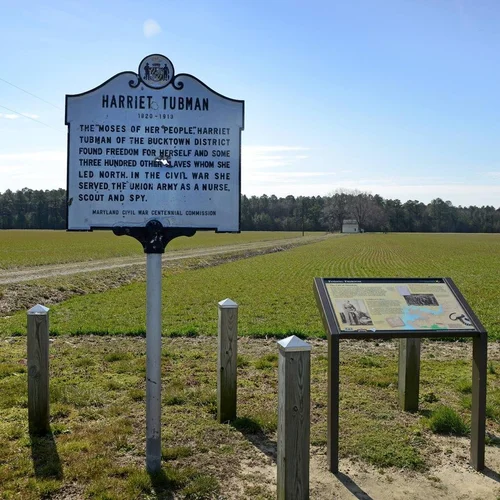
Her parents, Harriet "Rit" Green and Ben Ross, were themselves enslaved, although for much of Harriet's childhood they belonged to different owners. Such divisions placed enormous strain on enslaved families. Husbands and wives could be separated through sale, while children might be hired out or sold without warning. Family life existed not because the law protected it, but despite a system that constantly threatened to destroy it.
Even within those circumstances, Harriet grew up in a close-knit family whose resilience left a lasting impression upon her. Her parents instilled a strong sense of dignity, mutual responsibility and faith—qualities that remained central throughout her life. Years later, when Harriet repeatedly risked everything to return south, she did so not only for strangers but also to rescue members of her own family. Those early bonds never weakened.
Like many enslaved children, Harriet's childhood ended almost as soon as it began.
By the age of five or six she had been hired out to neighbouring households, where she cared for infants, cleaned homes and performed whatever work was demanded of her. She later recalled being beaten when exhausted babies cried through the night, regardless of circumstances beyond her control. Such punishments were intended to enforce obedience from an early age and reflected the harsh realities faced by many enslaved children.
As she grew older, her work became increasingly demanding.
She trapped muskrats in freezing marshes, hauled timber, drove oxen and laboured in the fields alongside adults. Although only around five feet tall, Harriet developed exceptional physical strength and endurance. Skills acquired through years of hard labour—moving confidently through forests, marshes and farmland—would later prove invaluable during her rescue missions along the Underground Railroad.
Alongside physical resilience, another influence shaped Harriet's character.
Faith.
Her parents were deeply religious, and biblical stories became both a source of comfort and a framework through which she understood the world. Like many enslaved African Americans, Harriet identified particularly with the story of Moses leading the Israelites out of bondage. Those narratives offered more than spiritual consolation; they affirmed that oppression was neither permanent nor inevitable.
Throughout her life Harriet spoke openly about dreams, visions and what she believed were moments of divine guidance. Modern historians have suggested that these experiences may have been influenced by a severe head injury she suffered as a teenager, while others emphasise that such experiences were entirely consistent with the religious culture in which she lived. Whatever their origin, Harriet herself never doubted their significance. She believed God had preserved her for a purpose and that faith would guide her through the dangers that lay ahead.
One event during her adolescence changed her life forever.
Around the age of thirteen, Harriet was sent to a local store where an overseer was attempting to capture another enslaved man who had left the fields without permission. When Harriet refused to help restrain him, the overseer threw a heavy iron weight towards the fleeing man. It missed its intended target and struck Harriet directly on the head.
The consequences were devastating.
Her skull was fractured, and she remained unconscious for days, receiving little medical treatment. For the rest of her life she endured severe headaches, dizziness, sudden periods of sleep and recurring seizures. Modern medical historians have suggested that the injury may have caused traumatic epilepsy or narcolepsy, although no diagnosis can be confirmed with certainty.
Rather than breaking Harriet's spirit, however, the injury appears to have deepened her sense of purpose.
During her long periods of unconsciousness she experienced vivid dreams and visions that strengthened her belief that God was directing her life. Whether viewed through the lens of medicine, psychology or faith, these experiences became inseparable from the courage and conviction that later defined her leadership.
The injury also revealed the brutal economics of slavery.
Believing Harriet's medical condition reduced her value, her owner attempted to sell her. Prospective buyers examined her as they might inspect livestock but declined to purchase her because her unpredictable seizures made her a less profitable investment. The episode laid bare the system's dehumanising logic: a person's worth was measured not by intelligence or character but by the labour they could produce.
Ironically, the injury that diminished Harriet's value in the eyes of enslavers may have helped shape one of history's greatest champions of freedom.
Years before she became famous as a conductor on the Underground Railroad, Harriet Tubman had already survived physical hardship, chronic pain and profound uncertainty. Those experiences forged the resilience, compassion and practical judgement that would later allow her to lead others through some of the most dangerous journeys in American history.
Choosing Freedom
By the late 1840s, Harriet Tubman's future had become increasingly uncertain.
Her owner, Edward Brodess, was experiencing financial difficulties, and rumours circulated that enslaved people from his estate might soon be sold. For those living in Maryland, the prospect carried particular dread. Although slavery was brutal throughout the United States, being sold to the expanding cotton plantations of the Deep South often meant even harsher conditions and, perhaps more devastatingly, permanent separation from family.
Harriet had already witnessed loved ones disappear through sale during her childhood. She knew that once people were sent south, the chances of ever seeing them again became vanishingly small.
The death of Edward Brodess in 1849 heightened that uncertainty. Estates were frequently settled by selling enslaved people to satisfy debts, and Harriet believed her own sale had become increasingly likely. Faced with the prospect of lifelong bondage and separation from those she loved, she made a decision that would transform not only her own life but the lives of countless others.
She would escape.
The decision demanded extraordinary resolve.
Escape required careful planning, trusted contacts, knowledge of the landscape and a willingness to accept enormous risk. Slave patrols watched roads and river crossings, newspapers published descriptions of runaways, rewards encouraged ordinary citizens to report suspicious travellers, and those who were captured often endured brutal punishment intended to discourage others from attempting the same.
Harriet did not initially intend to flee alone.
Together with two of her brothers, Ben and Henry, she set out under cover of darkness. Before long, however, fear overtook the group. Convinced they would eventually be captured, her brothers turned back and persuaded Harriet to return with them.
For many, such a failed attempt would have marked the end of the dream.
For Harriet, it became only a delay.
Soon afterwards, she resolved to try again—this time alone.
The decision demanded immense emotional strength. It meant leaving behind her parents, brothers, sisters and friends without knowing whether she would ever see them again. Nor could she be certain that freedom awaited her at the end of the journey.
Reflecting upon that moment, Harriet later explained her choice with characteristic clarity:
"There was one of two things I had a right to, liberty or death; if I could not have one, I would have the other."
These words were not rhetorical flourish. They captured the impossible choices imposed by slavery itself. Remaining meant accepting a lifetime in bondage. Attempting escape meant risking death. Faced with those alternatives, Harriet chose uncertainty over submission.
Travelling mainly by night and hiding during the day, she began the long journey north. She relied upon an informal network of abolitionists, free Black communities and Quaker families who offered food, shelter and guidance along the way. Safe houses, later known collectively as the Underground Railroad, allowed freedom seekers to move gradually from one place of refuge to the next while avoiding slave patrols and heavily travelled roads.
The journey demanded endurance as much as courage.
Harriet crossed forests, marshes and rivers, often navigating by the North Star. Food was scarce, exhaustion constant and every unfamiliar voice or distant sound carried the possibility of discovery. Success depended not only upon determination but upon trusting strangers whose assistance could mean either salvation or betrayal.
Eventually she crossed into Pennsylvania.
Years later she recalled the moment with remarkable simplicity:
"When I found I had crossed that line, I looked at my hands to see if I was the same person. There was such a glory over everything; the sun came like gold through the trees, and over the fields, and I felt like I was in Heaven."
Freedom transformed more than her legal status.
For the first time in her life, Harriet could decide where she would go, where she would work and how she would live. Yet the joy remained incomplete. Her parents, brothers, sisters and countless others continued to live under the same system from which she had escaped.
Many freedom seekers understandably chose never to return south.
Harriet chose differently.
Within little more than a year, she was planning the first of many return journeys.
Her escape had taught her the dangers of the route north. Now she intended to use that knowledge not simply to preserve her own freedom, but to help others secure theirs.
In doing so, Harriet Tubman transformed a single act of personal liberation into a lifetime devoted to the liberation of others.
The Underground Railroad: Becoming "Moses"
Freedom brought Harriet Tubman safety, but not peace.
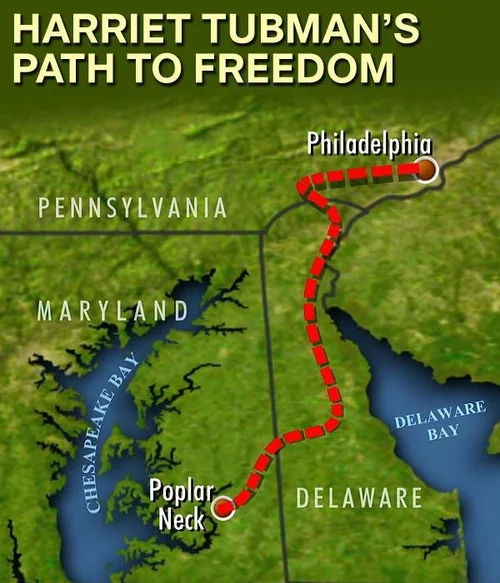
Having reached Pennsylvania, she could have begun a new life among the growing communities of free African Americans in the North. Many who escaped slavery understandably chose exactly that path. After years of hardship and fear, few could be blamed for seeking only security.
Harriet could not.
Although she had crossed into freedom, those she loved remained enslaved. Her parents, brothers, sisters, relatives and friends still lived under the same system from which she had escaped. Every day she spent in safety was another day they remained in bondage.
Rather than asking how she might protect her own freedom, Harriet asked a far more dangerous question:
How could she help others achieve theirs?
Within little more than a year of her escape, she quietly returned to Maryland.
It was an extraordinary decision.
By crossing back into slaveholding territory, Harriet transformed herself from a fugitive seeking liberty into an active opponent of slavery itself. Every journey increased the likelihood of recognition. Slave owners circulated descriptions of escapees through newspapers and reward notices, while professional slave catchers searched relentlessly for those who had fled.
Capture would almost certainly have meant severe punishment before being sold into the Deep South, where escape would become even more difficult.
Harriet accepted those risks.
Her earliest missions focused on rescuing members of her own family. She successfully guided her niece and the niece's children to freedom before later returning for several of her brothers and their families. Eventually, she also succeeded in bringing her elderly parents, Ben and Harriet Ross, safely north after years spent living under the constant threat of discovery.
Each successful journey strengthened both her confidence and her reputation.
Stories spread quietly through enslaved communities of a mysterious woman who appeared unexpectedly, led people north through forests and marshes, and always seemed to know the safest route to freedom.
It was during these years that Harriet earned the name by which history would remember her:
"Moses."
The comparison carried profound significance.
Just as the biblical Moses had led the Israelites out of bondage in Egypt, Harriet was leading enslaved African Americans towards freedom. Within the deeply religious communities she served, many believed she had been called to that purpose.
Harriet herself never claimed special status.
She consistently attributed her success to careful preparation, practical judgement and faith in God's guidance.
Planning Every Journey
Popular accounts often portray Harriet Tubman's rescue missions as spontaneous acts of daring.
In reality, they depended upon meticulous planning.
She studied the changing seasons, recognising that winter offered longer hours of darkness and fewer travellers upon country roads. She carefully selected meeting places known only to trusted contacts and relied upon an extensive network of abolitionists, Quaker families, free Black communities and sympathetic households willing to provide temporary shelter.
Communication demanded equal care.
Open discussion of escape could easily attract suspicion, so coded language became essential. Spiritual songs sometimes carried hidden meanings, while carefully chosen phrases signalled whether routes were safe or whether slave catchers had been seen nearby. Messages often passed quietly between trusted individuals for weeks before an escape even began.
Timing also mattered.
Harriet frequently chose to begin journeys on Saturday evenings, knowing that newspapers generally did not publish runaway notices until Monday. Those two days often provided a crucial advantage before organised searches could begin.
Her success was never the product of recklessness.
It rested upon patience, preparation and an exceptional understanding of risk.
Leadership Under Pressure
Guiding frightened families across hundreds of miles demanded far more than bravery.
Those travelling with Harriet included elderly people, young children, pregnant women and individuals exhausted by years of forced labour. Many had never travelled beyond the plantations where they had been born. Every barking dog suggested pursuit. Every unfamiliar sound threatened discovery.
Harriet understood that uncertainty could endanger everyone.
If even one member of a group abandoned the journey and returned home, they might reveal the identities or locations of those still attempting to escape. Whether through fear, interrogation or punishment, a single decision could place many lives at risk.
For that reason, Harriet insisted upon absolute commitment once a journey had begun.
Several contemporary accounts suggest that she carried a pistol. Popular retellings often emphasise this dramatically, but historians generally agree that its principal purpose was not confrontation with slave catchers. Instead, it served as a final safeguard against anyone attempting to turn back and jeopardise the entire group.
Seen in that context, her determination reflected the harsh realities of the Underground Railroad rather than personal severity.
Leadership sometimes demanded impossible choices.
A Master of the Landscape
Harriet possessed an extraordinary instinct for navigation.
Travelling mainly by night, she followed the North Star while using rivers, forests, marshes and little-used paths to avoid slave patrols. During daylight hours, groups sheltered in carefully chosen safe houses, abandoned buildings or secluded woodland until darkness returned.
The knowledge she relied upon had been acquired years earlier through forced labour.
Childhood spent trapping muskrats in marshes, working in forests and travelling between farms had taught Harriet how to move confidently through landscapes that many regarded as inhospitable. The very work imposed upon her by slavery had unintentionally prepared her for the rescue missions that would later define her life.
She also possessed a keen understanding of human behaviour.
Rather than always avoiding settlements, Harriet sometimes passed directly through towns when doing so attracted less suspicion than obvious concealment. On other occasions she altered routes entirely after learning of new patrols or reward notices.
That willingness to adapt made her exceptionally difficult to predict.
The Numbers Behind the Legend
Harriet Tubman's reputation grew rapidly during the 1850s, but the precise number of people she rescued has long been debated.
Nineteenth-century newspapers and later biographies often claimed that she personally led more than three hundred enslaved people to freedom. Harriet herself occasionally referred to similarly large numbers during public appearances later in life.
Modern historians have approached those claims more cautiously.
Most now conclude that Harriet personally conducted around thirteen rescue missions, directly leading approximately seventy people to freedom while providing guidance, financial assistance or logistical support that enabled many dozens more to escape independently.
Rather than diminishing her achievement, this distinction highlights its true scale.
Even rescuing seventy people required repeated expeditions into hostile territory over almost a decade, each carrying the constant possibility of capture.
What ultimately matters is not whether the number was seventy, one hundred or three hundred.
It is that Harriet chose to return.
Again.
And again.
Unlike celebrated military commanders, she sought neither conquest nor glory. Unlike politicians, she exercised no formal authority. Unlike many leading abolitionists, she possessed almost no wealth.
Her greatest strength was trust.
People followed Harriet because they believed she would never abandon them.
Remarkably, no one under her direct leadership is known to have been recaptured during one of her rescue missions. Although every detail of that tradition cannot be verified with absolute certainty, contemporaries consistently recognised her extraordinary success.
Among those who admired her was Frederick Douglass, himself one of the leading voices of the abolitionist movement. Writing to Harriet, he observed that while his own work had largely been conducted in public, hers had taken place "in the night," with little recognition and constant personal danger.
His words captured the uniqueness of Harriet Tubman's contribution.
Many campaigned against slavery.
Harriet walked back into it.
War and Freedom: Harriet Tubman and the American Civil War
When the American Civil War began in 1861, Harriet Tubman had already spent more than a decade fighting slavery through the Underground Railroad. The conflict transformed that personal struggle into a national war over the future of the United States. For Harriet, however, the war represented something more immediate: an opportunity to strike directly at the institution that had shaped every moment of her own life.
Rather than supporting the Union cause from a distance, she travelled south once again.
This time she returned not as a fugitive guiding small groups through forests and marshes, but as a trusted civilian working alongside the Union Army.
The transition was remarkably natural.
Everything Harriet had learned during her years on the Underground Railroad—moving unnoticed through hostile territory, earning the confidence of local communities, gathering information quietly and navigating unfamiliar landscapes—proved equally valuable in military operations. Skills developed in resistance to slavery became powerful assets in the wider campaign to defeat the Confederacy.
Her contribution would extend far beyond the battlefield.
Nurse and Humanitarian
Harriet's earliest wartime service focused upon caring for others.
As Union forces advanced through the South, thousands of formerly enslaved people sought refuge behind Federal lines. Many arrived exhausted, malnourished and suffering from diseases such as dysentery, malaria and smallpox. Military camps struggled to provide adequate medical care, while overcrowding and poor sanitation created ideal conditions for epidemics.
Drawing upon traditional herbal knowledge learned from her mother and other members of Maryland's Black communities, Harriet cared for both soldiers and civilians. She prepared remedies using local plants, tended the sick, distributed food and clothing, and offered comfort to families attempting to rebuild lives shattered by slavery.
Unlike dramatic military victories, such work rarely generated official reports or public recognition.
Yet it reflected the same principles that had guided Harriet throughout her life. Freedom meant little if those who gained it could not survive to enjoy it.
Before long, Union commanders recognised that her abilities extended far beyond nursing.
Scout and Intelligence Operative
Every successful military campaign depends upon information.
Union commanders needed reliable intelligence about Confederate troop movements, supply routes, hidden fortifications and the geography of unfamiliar territory. Conventional scouts often struggled to obtain accurate information, particularly in regions where local communities distrusted outsiders.
Harriet offered something different.
Having spent years travelling secretly through the South, she understood how to move without attracting attention. More importantly, she had earned the trust of enslaved communities whose knowledge of the landscape far exceeded that of many military officers.
Enslaved men and women working on plantations, docks and roads observed troop movements, overheard conversations and knew which rivers, bridges and tracks remained passable. Harriet quietly built networks through these communities, gathering information that Union commanders could never have obtained alone.
She compared reports from multiple sources, identified the most reliable details and transformed scattered observations into practical intelligence.
Today, we might describe such work as intelligence analysis.
For Harriet, it was simply another way of helping people achieve their freedom.
The value of her reports soon became apparent, and Union officers increasingly relied upon her judgement when planning operations along the South Carolina coast.
The Combahee River Raid
Harriet Tubman's most significant military contribution came on the night of 2 June 1863.
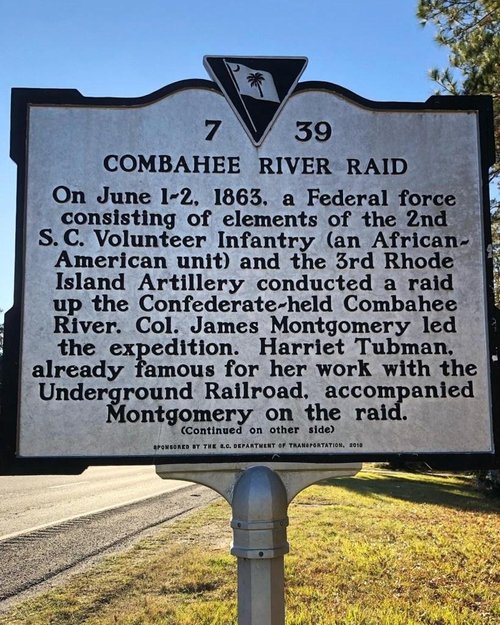
Working alongside Colonel James Montgomery, she helped plan and guide a Union expedition along South Carolina's Combahee River. Confederate forces had mined sections of the waterway with underwater explosives while nearby plantations continued supplying food and resources to the Southern war effort.
The operation required detailed local knowledge.
Union gunboats needed safe channels through unfamiliar waters, while commanders also required accurate intelligence regarding Confederate positions and the locations of enslaved communities likely to seize any opportunity for escape.
Harriet's reconnaissance proved invaluable.
Drawing upon the information gathered through her network, she identified navigable routes through the river and helped determine where Union forces could land most effectively. Her understanding of the surrounding plantations also enabled commanders to anticipate where large numbers of enslaved people might seek freedom once the raid began.
As Union forces advanced, Confederate resistance quickly collapsed.
Warehouses, bridges, rice mills and plantations supporting the Confederate economy were destroyed, disrupting supplies throughout the region.
Yet the raid achieved something even more significant.
As news spread that Union gunboats had arrived, hundreds of enslaved men, women and children fled the plantations and rushed towards the river. Many carried little more than the clothes they wore. Some held infants in their arms. Others helped elderly relatives across fields under cover of darkness. Families separated for years suddenly found the opportunity to escape together.
Contemporary reports estimated that more than seven hundred people secured their freedom during the operation.
Many later enlisted in the Union Army, strengthening the very force that had liberated them.
The Combahee River Raid therefore achieved several objectives simultaneously. It damaged Confederate infrastructure, weakened the Southern economy, gathered valuable supplies, strengthened Union manpower and liberated hundreds of people from slavery.
Harriet Tubman had played an essential role in making it possible.
Although Colonel Montgomery formally commanded the expedition, Harriet's intelligence, planning and local expertise were so important that historians today recognise her as the first American woman known to have planned and participated directly in a major military operation.
Recognition Long Delayed
Despite her remarkable wartime service, Harriet Tubman received little immediate recognition from the United States government.
Unlike commissioned officers, she worked largely as a civilian attached to Union forces. Intelligence work was rarely documented in detail, while the combined prejudices of race and gender further limited official acknowledgement of her contribution.
After the war, Harriet spent decades petitioning the federal government for compensation.
Former officers testified to the importance of her service, yet bureaucratic delays, missing documentation and political indifference meant that many years passed before she received even limited financial assistance.
Ironically, a woman who had repeatedly risked her life in service of her country spent much of her later life struggling financially.
The pension eventually awarded to Harriet came primarily through the military service of her second husband, Nelson Davis, a Union veteran. Only after further appeals was it increased to acknowledge some of her own wartime contributions.
Modern historians generally regard this as a significant injustice.
The United States benefited enormously from Harriet Tubman's courage, leadership and intelligence, yet the nation she served proved slow to recognise the full extent of her achievements.
That imbalance has gradually begun to change.
Military historians today increasingly recognise Harriet Tubman not simply as an abolitionist who assisted the Union Army, but as a skilled intelligence operative whose work contributed meaningfully to Union success along the South Carolina coast.
Her wartime service demonstrates that leadership is not always defined by rank.
Sometimes it belongs to the person who understands the landscape better than anyone else.
Sometimes it belongs to the individual whom others trust without hesitation.
And sometimes, as Harriet Tubman showed, it belongs to someone whose character had already been tested long before history called upon them.
Life After the Civil War
For many Americans, the end of the Civil War in 1865 marked the beginning of peace.
For Harriet Tubman, it marked the beginning of a different kind of service.
Slavery had been abolished, but freedom alone could not erase generations of injustice. Millions of formerly enslaved people faced poverty, discrimination and uncertainty as they attempted to build new lives. Harriet believed that liberation carried responsibilities as well as rights, and she remained committed to helping others long after the fighting had ended.
Rather than seeking recognition for her wartime achievements, she quietly returned to the work that had defined much of her life: caring for people in need.
Building a Home in Auburn
Harriet eventually settled in Auburn, New York, where she purchased land with the support of her friend and fellow abolitionist William H. Seward, who would later serve as United States Secretary of State.
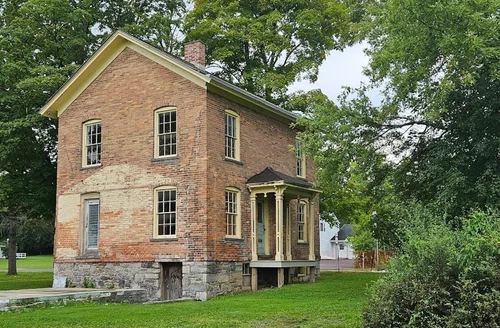
The property became far more than a private home.
Family members, friends, travellers and those struggling to establish themselves after emancipation regularly found shelter there. Harriet's house reflected the same values that had shaped the Underground Railroad years earlier: generosity, practical support and an open door for those who needed help.
In 1869 she married Nelson Davis, a former Union soldier who had served during the Civil War. Together they adopted a daughter, Gertie, creating a family life that slavery had once threatened to make impossible.
Although Harriet had become nationally respected within abolitionist circles, financial security remained elusive.
Much of what she earned was given away to support others, while years of unpaid wartime service and delayed government pensions left her with limited resources. Friends frequently organised fundraising events to help meet her basic expenses, a striking contrast to the immense contribution she had made to the nation.
A Voice for Women's Suffrage
Harriet understood that equality did not end with the abolition of slavery.
As the nineteenth century progressed, she increasingly lent her support to the growing movement for women's voting rights. Speaking at suffrage meetings across the United States, she argued that women deserved the same political voice as men and that freedom could never be fully realised while half the population remained excluded from public life.
Her own experiences gave those arguments unusual authority.
Unlike many campaigners, Harriet spoke not only of political principles but of a life shaped by enslavement, resistance and war. She had lived through circumstances that few others could imagine, and audiences recognised that her calls for equality were grounded in lived experience rather than abstract philosophy.
Among those with whom she shared platforms were leading suffragists such as Susan B. Anthony and Emily Howland. Although the movements for abolition and women's suffrage did not always agree on priorities after the Civil War, Harriet remained committed to both causes throughout her later life.
For her, justice was never a single issue.
The principles that had led her to challenge slavery also led her to support greater equality for women.
The Harriet Tubman Home
As Harriet grew older, her concern increasingly turned towards those who had been left behind by society.
Many elderly African Americans had survived slavery only to spend old age in poverty, often without family support or adequate care. Recognising this need, Harriet established the Harriet Tubman Home for the Aged on land adjoining her property in Auburn.
The project reflected everything she had stood for throughout her life.
She had once guided people towards freedom.
Now she sought to ensure they could live their final years with dignity.
Although financial difficulties delayed the home's opening, Harriet continued raising money, overseeing its development and supporting residents whenever possible. Eventually the home became one of her most enduring humanitarian achievements, demonstrating that her commitment to service had not ended with the abolition of slavery or the conclusion of the Civil War.
Her life's work had always extended beyond moments of dramatic heroism.
It was equally defined by quiet acts of compassion carried out over many decades.
Final Years
Advancing age and the long-term effects of the head injury she had suffered as a teenager gradually limited Harriet's strength.
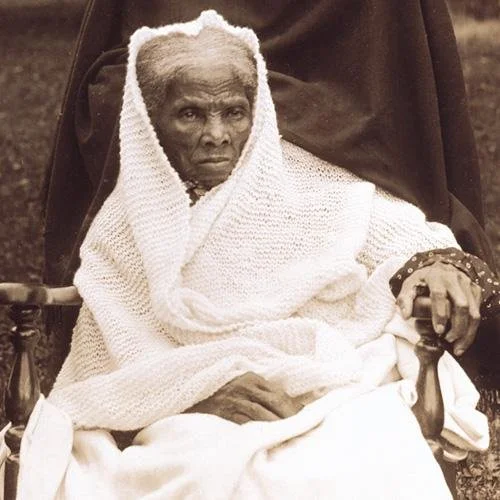
The headaches, seizures and sudden periods of sleep that had accompanied her throughout adulthood became increasingly difficult to manage. Even so, she remained active for as long as her health allowed, welcoming visitors, supporting charitable causes and continuing to inspire those who sought her advice.
By the early twentieth century, Harriet Tubman had become one of the most respected figures associated with the abolitionist movement.
Former soldiers, reformers, church groups and ordinary citizens travelled to Auburn hoping to meet the woman whose courage had become legendary.
Harriet herself rarely spoke of heroism.
She preferred to discuss faith, perseverance and the importance of helping others whenever the opportunity arose.
In 1911, declining health led her to enter the very home she had founded for elderly African Americans.
Two years later, on 10 March 1913, Harriet Tubman died there at approximately ninety years of age, surrounded by people who admired and cared for her.
She was buried with military honours at Fort Hill Cemetery, a fitting tribute to a woman whose service had extended from the Underground Railroad to the battlefields of the Civil War.
The nation she left behind was profoundly different from the one into which she had been born.
Slavery had ended.
Yet many of the broader struggles for racial equality and civil rights still lay ahead.
Harriet had not lived to see those victories.
She had helped make them possible.
Legacy
Harriet Tubman's influence extends far beyond the remarkable events of her own lifetime.
She is remembered not simply because she escaped slavery, nor solely because she guided others to freedom. Her enduring significance lies in the way she demonstrated that one individual, acting with conviction and perseverance, can alter the course of history without holding political office, commanding armies or possessing wealth.
During her lifetime, much of Harriet's work remained necessarily hidden. Rescue missions took place under the cover of darkness, intelligence gathering depended upon secrecy, and many of those whose lives she changed left few written records of their own. As a result, her achievements often became surrounded by legend, making it difficult for later generations to distinguish historical fact from popular memory.
Modern scholarship has helped restore that balance.
Historians continue to examine contemporary documents, military records, personal correspondence and eyewitness accounts, allowing Harriet Tubman's life to emerge with greater clarity than ever before. While some traditional stories have been refined or corrected, the overall picture has only strengthened appreciation for what she accomplished. The historical Harriet proves every bit as remarkable as the legendary one.
Recognition has steadily grown throughout the twentieth and twenty-first centuries.
Schools, museums, historical sites and national parks across the United States now preserve her memory. Statues honour her in cities where she once travelled in secret, while countless books, documentaries and academic studies continue to explore her life and achievements.
One of the most symbolic moments in that growing recognition came in 2016, when the United States Treasury announced plans to place Harriet Tubman's portrait on the twenty-dollar bill. Although implementation has been repeatedly delayed, the proposal itself reflected a profound shift in national memory.
A woman once regarded as property had become a figure considered worthy of appearing on the nation's currency.
That transformation says as much about changing understandings of history as it does about Harriet herself.
Today, historians recognise Harriet Tubman in many different ways.
She is remembered as an abolitionist.
A conductor on the Underground Railroad.
A military scout and intelligence operative.
A humanitarian.
A campaigner for women's suffrage.
A woman of deep religious conviction.
Each description is accurate, yet none captures the whole person. Harriet's life cannot be reduced to a single title because her achievements crossed boundaries that society itself sought to impose.
Perhaps her greatest legacy lies not in any individual accomplishment, but in the example she set.
Again and again, Harriet chose responsibility over safety, service over recognition and action over comfort. She understood that freedom carried obligations as well as rights, and she spent the rest of her life acting upon that belief.
Why Harriet Tubman Matters Today
More than a century after her death, Harriet Tubman's story continues to speak to new generations because the questions it raises remain deeply relevant.
What does courage look like?
Who deserves freedom?
What responsibilities do we owe to one another?
Harriet answered those questions not through speeches or political theory, but through the choices she made.
She reminds us that history is shaped not only by those who hold power, but also by those who refuse to accept injustice as inevitable.
Her life also challenges us to think more carefully about how history itself is remembered.
For many years, Harriet Tubman was celebrated primarily as the courageous "conductor" of the Underground Railroad. While that achievement alone would have secured her place in history, it represented only part of her contribution. She was also an intelligence operative, a military planner, a humanitarian and an advocate for women's rights. Recovering those overlooked aspects of her life reminds us that historical figures are often far more complex than the simplified stories passed from one generation to the next.
That lesson extends well beyond Harriet herself.
History is filled with people whose contributions have been overlooked, simplified or forgotten altogether. Recovering those stories does not diminish the achievements of others. Instead, it gives us a fuller and more accurate understanding of the past.
Harriet Tubman never sought fame.
She sought freedom.
She never asked whether the work would make her famous.
She asked whether it was the right thing to do.
That distinction continues to define her legacy.
Conclusion
Harriet Tubman's life cannot be measured simply by the number of people she guided to freedom, the military operations she supported or the causes she later championed.
It is measured by the lives she changed.
Families who remained together because she returned.
Communities strengthened because she shared her knowledge.
Soldiers who benefited from intelligence she gathered.
Elderly men and women who found dignity in the home she established.
Generations who inherited a broader understanding of what leadership can look like.
She began life with almost every opportunity denied to her.
She finished it having expanded the possibilities available to countless others.
That is why Harriet Tubman remains one of history's most enduring figures.
Not because she sought greatness—
but because, whenever confronted with injustice, she chose to act.
Key Achievements
Key Achievements
- Escaped slavery in Maryland in 1849 and repeatedly returned to slaveholding territory to help others reach freedom.
- Conducted around thirteen documented rescue missions and directly guided approximately seventy people to freedom.
- Provided guidance, money and logistical assistance that helped many others escape independently.
- Served the Union during the American Civil War as a nurse, scout and intelligence operative.
- Helped plan and guide the Combahee River Raid of 2 June 1863, during which more than seven hundred enslaved people gained freedom.
- Campaigned for women’s suffrage and spoke alongside leading reformers.
- Established the Harriet Tubman Home for the Aged in Auburn, New York.
- Demonstrated that leadership can emerge without formal rank, wealth or political authority.
Key Dates
Born Araminta Ross in Dorchester County, Maryland.
Suffers the severe head injury that affects her for the rest of her life.
Escapes slavery and reaches Pennsylvania.
Conducts repeated rescue missions through the Underground Railroad.
The Fugitive Slave Act increases danger for freedom seekers throughout the northern states.
Purchases property in Auburn, New York.
Serves the Union during the American Civil War.
Helps guide the Combahee River Raid in South Carolina.
Marries Union veteran Nelson Davis.
The Harriet Tubman Home for the Aged formally opens.
Dies in Auburn, New York.
Did You Know?
Did You Know?
- Harriet Tubman was born Araminta Ross and was known as “Minty” during childhood.
- Her exact birth date is uncertain because enslaved people’s births were rarely recorded accurately.
- She was only around five feet tall but developed exceptional strength and endurance through years of hard labour.
- Modern historians generally credit her with around thirteen rescue missions and approximately seventy people personally guided to freedom.
- No one under her direct leadership is known to have been recaptured during a rescue mission.
- She used intelligence gathered from enslaved communities to support Union military planning.
- The Combahee River Raid liberated more than seven hundred enslaved people.
- She spent decades seeking fair compensation for her Civil War service.
- She supported women’s suffrage as well as abolition.
- In old age she became a resident of the home for elderly African Americans that she had helped establish.
Further Reading
- Kate Clifford Larson — Bound for the Promised Land: Harriet Tubman, Portrait of an American Hero
- Catherine Clinton — Harriet Tubman: The Road to Freedom
- Jean M. Humez — Harriet Tubman: The Life and the Life Stories
- Sarah H. Bradford — Scenes in the Life of Harriet Tubman
- National Park Service — Harriet Tubman Underground Railroad National Historical Park
- National Park Service — Harriet Tubman National Historical Park, Auburn
- Library of Congress — Harriet Tubman collections and portrait records
Image Credits
Harriet Tubman portrait (1868 or 1869): Photograph by Benjamin F. Powelson, Auburn, New York. From the Emily Howland photograph album, jointly owned by the Library of Congress and the Smithsonian National Museum of African American History and Culture. Library of Congress record states no known restrictions on publication.
Childhood and Early Life landscape: National Park Service imagery of the Maryland Eastern Shore and Blackwater landscape associated with Harriet Tubman’s childhood. NPS photographs credited without a copyright symbol are public domain.
Underground Railroad image: Source image supplied through the website media library. Original creator or institutional attribution has not yet been confirmed.
Civil War and Combahee River Raid image: Source image supplied through the website media library. Original creator or institutional attribution has not yet been confirmed.
Harriet Tubman’s Auburn home: National Park Service photograph, Harriet Tubman National Historical Park. NPS photographs credited without a copyright symbol are public domain.
Final Years image: Source image supplied through the website media library. Original creator or institutional attribution has not yet been confirmed.
Explore Related Profiles
Help Keep These Stories Alive
If you enjoyed reading this profile and believe more forgotten voices deserve to be heard, you can help fund future research, writing, and free educational resources.
Every contribution—whether a one-off donation or monthly support—helps create new historical profiles, downloadable materials, and articles that remain freely available to everyone.
Thank you for helping history reach more people.
