

Joseph Marshall III
Historical Profile
The Historian Who Carried Memory Forward
Introduction
History is often preserved in documents.

Governments leave laws, military reports, census records and official correspondence. Institutions maintain archives. Victors commission monuments and publish accounts explaining why events unfolded as they did.
But not every civilisation has preserved its past primarily through paper.
For countless generations, the Lakota carried history through spoken memory: stories shared within families, accounts repeated by respected elders, place names connected to particular events, and lessons woven into the lives of ancestors. These were not casual tales passed from one generation to the next. They formed a living archive, maintained through careful listening, faithful retelling and a deep sense of responsibility.
Joseph M. Marshall III belonged to that tradition.
Born on the Rosebud Indian Reservation in South Dakota in 1945, Marshall was raised by his maternal grandparents in a traditional Sicangu Lakota household. Lakota was his first language. English came later, while his understanding of history, community and identity grew from the stories, values and practical knowledge entrusted to him by his elders. Those foundations shaped a remarkable career that would span teaching, historical writing, storytelling, craftsmanship, tribal education, film consultation and public speaking.
Across more than twenty books, Marshall introduced readers around the world to Lakota history and philosophy. His work explored traditional values, leadership, oral tradition and some of the defining events of nineteenth-century North American history. In books such as The Lakota Way, The Journey of Crazy Horse and The Day the World Ended at Little Bighorn, he placed Lakota voices at the centre of narratives that had long been dominated by military reports, government records and later popular mythology.
His contribution, however, reached beyond writing history.
Marshall challenged assumptions about what counts as historical evidence.
For many years, oral traditions were often treated as secondary to written documents. Yet written records are not neutral. Every report, newspaper article or official letter reflects the knowledge, priorities and limitations of the people who created it. Government records preserve the concerns of governments. Military reports preserve the experiences of soldiers. Entire communities can remain almost invisible within those archives.
Lakota oral tradition preserved something different.
It remembered families, relationships, motives, landscapes and consequences. It carried voices that rarely appeared in official records while preserving the cultural knowledge needed to understand them. Marshall never argued that oral history should replace documentary evidence. Instead, he demonstrated that both deserved careful examination, each illuminating aspects of the past that the other could not fully reveal.
Nowhere was this clearer than in his writing about Crazy Horse.
For generations, Crazy Horse had often been remembered simply as the warrior associated with the Battle of the Little Bighorn. In The Journey of Crazy Horse, Marshall presented a far richer portrait: a son, hunter, leader and defender of his people whose life could only be understood within Lakota society itself. Rather than asking how Crazy Horse influenced American expansion, Marshall asked what his life meant to the people whose history he shared.
History changes when the people once treated as background become the narrators.
Marshall carried the same perspective into his study of the Little Bighorn. Many histories centre upon George Armstrong Custer and the destruction of the Seventh Cavalry. Marshall instead explored what the battle meant for the Lakota and Cheyenne communities whose victory was soon followed by intensified military campaigns, dispossession and the destruction of their traditional way of life. The event was not simply the day Custer died. It was part of a much larger historical tragedy whose meaning depended entirely upon where one stood.
His work extended beyond books.
In 1971, Marshall became a founding board member of Sinte Gleska College, later Sinte Gleska University, on the Rosebud Reservation. He later taught there, helping develop Native American studies programmes that reflected Indigenous knowledge alongside academic scholarship. At a time when education had so often been used to encourage assimilation, tribal colleges represented something profoundly different: institutions where higher education could strengthen cultural identity rather than replace it.
Marshall's work as a craftsman, cultural adviser and public speaker reflected the same purpose. Whether making traditional Lakota bows, advising filmmakers or addressing audiences across the United States, he remained committed to carrying Lakota knowledge into places where it had too often been misunderstood or overlooked.
Recognition followed gradually. His books earned major literary awards, including the PEN/Beyond Margins Award, while his lifetime contribution to Western literature was recognised with the Owen Wister Award and induction into the Western Writers Hall of Fame.
Yet his greatest achievement cannot be measured through honours.
It lives in students who discovered that their history belonged in the classroom, readers who encountered Lakota perspectives for the first time, and communities whose stories were preserved with dignity and care.
Joseph M. Marshall III died on 18 April 2025 on the Rosebud Indian Reservation, ten days after his eightieth birthday.
He left behind far more than books.
He showed that preserving history is not simply about recording the past.
It is about ensuring that the people who lived it are allowed to speak for themselves.
Rosebud: A Childhood Shaped by Language and Memory
Joseph Marshall III was born on 8 April 1945 on the Rosebud Indian Reservation in south-central South Dakota. He was the eldest of eleven children born to Hazel Two Hawk and Joseph Marshall Sr., and an enrolled member of the Sicangu Lakota Nation.
Much of his childhood was spent in the Horse Creek community near White River, known in Lakota as Maka Izita Wakpa—often translated as "Smoking Earth River." He was raised primarily by his maternal grandparents in a household where Lakota language, traditions and values remained part of everyday life rather than subjects learned later through formal study.
Lakota was Marshall's first language.
That fact shaped far more than the words he spoke.
Languages carry distinct ways of understanding relationships, responsibility and the natural world. When Marshall later wrote in English, he was not merely translating vocabulary. He was interpreting ideas formed within one cultural tradition for readers shaped by another.
His grandparents became his earliest teachers.
They taught through observation, repetition and example. History emerged through accounts of relatives and ancestors. Moral lessons appeared naturally within stories of courage, generosity, patience and humility. Practical skills were learned by watching experienced hands before attempting them oneself.
Within this world, storytelling carried responsibility.
Oral history is sometimes misunderstood as a chain of stories that changes with every retelling. In cultures built upon spoken memory, however, careful storytelling demands remarkable discipline. Names, relationships, places and sequences of events matter. Listeners are expected not only to remember what happened but also to understand why each story has been preserved.
Marshall would later become known internationally as a storyteller.
For the Lakota, however, that title meant far more than someone who entertained an audience.
A storyteller stood between generations.
The stories had been entrusted to one generation.
They now had to be carried faithfully to the next.
Alongside language and history, Marshall also learned traditional skills, including the construction and use of Lakota bows and arrows. His grandfather taught him that craftsmanship required patience, observation and respect for natural materials. Marshall continued making traditional bows throughout his life, preserving practical knowledge that formed another important part of Lakota cultural memory.
These early experiences shaped the remarkable breadth of his later career.
History, philosophy, craftsmanship and education were never separate subjects in Marshall's mind. A bow preserved engineering knowledge. A place name preserved history. A story preserved ethics. Language connected them all.
Yet this rich intellectual inheritance had survived despite enormous pressure.
For generations, United States policies had sought to assimilate Indigenous peoples into mainstream American society. Children were removed from their families and placed in boarding schools where Native languages and cultural traditions were frequently discouraged or punished. Land was taken, tribal governance disrupted and Indigenous knowledge often dismissed as folklore rather than recognised as history.
Marshall grew up within the consequences of that history.
But he also witnessed something equally important.
The language still survived.
The stories were still told.
The skills were still practised.
The elders still remembered.
His life's work would ensure that those voices reached far beyond the Rosebud Reservation while remaining rooted in the community that first entrusted them to him.
Education Between Two Traditions
Growing up on the Rosebud Reservation gave Joseph M. Marshall III an education unlike that offered in most American classrooms.
Long before he entered formal schooling, he had already begun learning Lakota history, ethics, language and practical skills through observation, conversation and storytelling. His grandparents did not separate education from everyday life. Every task, every journey across the prairie and every story shared within the family became an opportunity to learn.
This traditional education valued patience.
Children were expected to observe before acting, listen before speaking and understand not only how something should be done, but why it mattered. Knowledge was earned gradually through experience rather than delivered as isolated facts to be memorised.
Marshall would later describe this approach as one of Lakota culture's greatest strengths.
Stories were never simply entertainment.
Each carried lessons about courage, generosity, humility, responsibility or leadership. Some preserved historical events, while others explained relationships between families, places and communities. Together they taught both identity and responsibility.
When Marshall entered American schools, he encountered a very different educational tradition.
Formal education relied upon textbooks, written examinations and standardised curricula shaped largely by European and American historical perspectives. Native American history often appeared only briefly, and usually through the experiences of explorers, settlers, soldiers and government officials rather than through Indigenous communities themselves.
Like many Native students of his generation, Marshall therefore learned within two parallel traditions.
One relied primarily upon written records preserved in archives.
The other drew upon knowledge carried by living people.
Rather than rejecting either approach, Marshall came to recognise that each offered something the other could not.
Written records preserve dates, legislation, census data and official correspondence with remarkable precision.
Oral traditions preserve motives, relationships, family histories, local knowledge and the lived experience that official documents often overlook.
Marshall believed responsible historical research required both.
Throughout his career he argued that oral history should neither replace documentary evidence nor be dismissed because it was spoken rather than written. Instead, both should be examined critically, compared carefully and understood within the cultures that produced them.
That balanced approach became one of the defining characteristics of his scholarship.
He neither romanticised oral tradition nor assumed written records possessed unquestioned authority.
Instead, he encouraged readers to ask a simple but powerful question:
Who created this source—and why?
That question would shape everything he later wrote.
University Education
Marshall continued his studies beyond school, pursuing history, education and related subjects while remaining closely connected to the Rosebud Reservation.
Unlike many Indigenous scholars whose careers took them permanently away from their communities, Marshall remained deeply rooted in the people whose history he sought to preserve.
His university education strengthened skills that complemented rather than replaced his traditional upbringing.
Research methods.
Historical comparison.
Critical evaluation of sources.
Scholarly writing.
These became additional tools for interpreting Lakota history without abandoning the knowledge entrusted to him by his grandparents.
The combination proved unusually powerful.
Marshall could move comfortably between academic scholarship and conversations with tribal elders. He could study nineteenth-century military reports while also understanding the oral traditions describing the same events from a Lakota perspective.
Rather than treating these sources as competitors, he recognised that they often illuminated different parts of the same historical reality.
His education therefore became more than a personal achievement.
It prepared him for a role few people were equally qualified to fulfil.
He could introduce Lakota history to wider audiences while remaining accountable to the community from which that history came.
That responsibility would shape every stage of his career.
Learning Beyond the Classroom
Marshall often reminded audiences that education does not end with graduation.
Some of his most important teachers were not university lecturers but elders, relatives, craftspeople and community members whose knowledge could never be found in textbooks.
Listening remained central to his philosophy.
History was not something to conquer through research.
It was something to approach with humility.
Every elder represented another archive.
Every conversation offered the possibility of preserving knowledge that might otherwise disappear.
This understanding shaped his writing.
Readers often remark upon the calm, reflective quality of Marshall's books. Rather than building dramatic arguments or seeking controversy, he allowed historical understanding to emerge gradually. Individuals appear first as members of families and communities before becoming participants in famous events. Conclusions grow naturally from accumulated evidence rather than rhetorical flourish.
It was, in many ways, the way he himself had learned.
Patiently.
Respectfully.
By listening before speaking.
Bridging Two Worlds
Looking back, Joseph M. Marshall III's education appears less like a journey from one world into another than the construction of a lasting connection between them.
On one side stood Lakota language, oral tradition and community memory.
On the other stood universities, historical scholarship and academic methodology.
Many people spend their lives entirely within one of those traditions.
Marshall belonged comfortably to both.
That rare perspective enabled him to become more than a historian of the Lakota people.
He became an interpreter—someone able to help readers from many backgrounds understand why Indigenous perspectives are indispensable to a fuller understanding of North American history.
It was a role he would carry into classrooms, universities, books, documentaries and public life for more than half a century.
Teaching, Tribal Education and the Founding of Sinte Gleska University
By the late 1960s, Indigenous communities across the United States were increasingly seeking greater control over their own education.
For generations, Native children had often been educated in institutions designed not to preserve their cultures but to replace them. Federal boarding schools and wider assimilation policies encouraged—or compelled—students to abandon their languages, traditions and identities in favour of mainstream American society. In many schools, speaking Indigenous languages was discouraged or punished, while Native history appeared only briefly, if at all, and usually through non-Indigenous perspectives.
The consequences reached far beyond the classroom.
When a language weakens, stories disappear with it. When stories disappear, communities lose not only memories of the past but also ways of understanding the present. Cultural identity becomes increasingly difficult to pass from one generation to the next.
Marshall understood these dangers through personal experience.
Having grown up in a household where Lakota language and storytelling remained central to daily life, he recognised that education could either strengthen cultural continuity or contribute to its erosion.
The question was never whether Indigenous students should receive higher education.
It was who would shape that education.
A New Vision for Tribal Education
In 1971, that question began to find an answer with the establishment of Sinte Gleska College, later renamed Sinte Gleska University, on the Rosebud Reservation.
Marshall became one of its founding board members, helping create an institution that represented a turning point in Native American higher education.
Named after the Sicangu Lakota leader Spotted Tail (Sinte Gleska), the college reflected a simple but transformative idea.
Students should not have to leave their culture behind in order to succeed academically.
Instead, Lakota history, language and philosophy could stand alongside established academic disciplines, enriching rather than competing with them.
History could be studied without abandoning oral tradition.
Science could be explored alongside traditional ecological knowledge.
Lakota language could be strengthened rather than replaced.
For Marshall, this was not merely educational reform.
It was an act of cultural continuity.
Teacher and Mentor
Marshall later taught at Sinte Gleska University, where he became respected not only for his knowledge but for the way he shared it.
Students frequently described him as thoughtful, patient and approachable.
Rather than presenting history as a fixed sequence of dates and events, he encouraged discussion about evidence, perspective and interpretation.
His teaching reflected the methods through which he had learned as a child.
Questions often mattered more than immediate answers.
Stories invited reflection rather than dictating conclusions.
Students were encouraged to think critically while remaining respectful of the people whose lives they were studying.
Marshall believed education should produce understanding rather than memorisation.
Knowing the date of a battle mattered far less than understanding why it happened, how different communities experienced it and how its consequences continued long after the fighting ended.
History, in his classroom, was never distant.
It remained connected to people.
Preserving Knowledge Through Institutions
Marshall recognised something that historians sometimes overlook.
Books matter enormously.
But institutions matter just as much.
A book can preserve knowledge for one generation.
A university can preserve it for centuries.
By helping establish Sinte Gleska University, Marshall contributed not simply to one educational programme but to the long-term future of Lakota scholarship.
The university created opportunities for Lakota students to study their own history within an academic environment that respected Indigenous knowledge rather than treating it as secondary to European historical traditions.
Research increasingly emerged from within Native communities themselves.
This represented a profound historical shift.
For much of American history, Indigenous peoples had often been treated as subjects of research.
Marshall helped create the conditions in which they became the researchers, historians and educators.
Education as Cultural Continuity
Throughout his career, Marshall challenged the assumption that education should separate students from their cultural roots.
He argued instead that genuine education strengthens identity by helping people understand both where they come from and how they relate to the wider world.
This reflected traditional Lakota teaching.
Knowledge carried responsibility.
Learning was never pursued solely for personal advancement.
Its purpose was to benefit family, community and future generations.
Marshall therefore viewed teaching as another form of storytelling.
Whether standing before university students, addressing conferences or writing books for international audiences, he remained engaged in the same essential task:
Passing knowledge forward.
He understood that every generation inherits history only temporarily.
Its responsibility is not simply to remember it, but to preserve it faithfully before passing it to those who follow.
Building Understanding Beyond the Reservation
Although deeply rooted within Lakota culture, Marshall never believed that Indigenous history should remain known only within Indigenous communities.
Throughout his career he lectured at universities, museums, historical organisations and public events across the United States.
Many audience members encountered Lakota history seriously for the first time through his lectures.
Marshall possessed a rare ability to explain complex cultural ideas without oversimplifying them.
He neither accused nor apologised.
Instead, he invited listeners to reconsider familiar historical narratives from another perspective.
His lectures, like his books, encouraged curiosity rather than confrontation.
Rather than replacing one historical narrative with another, he demonstrated that history becomes richer when more voices are allowed to contribute.
An Enduring Educational Legacy
Marshall's contribution to education cannot be measured simply by the number of students he taught.
Thousands encountered Lakota history through his lectures.
Many thousands more discovered it through his books.
Others continue to benefit through the work of Sinte Gleska University, the institution he helped establish at a pivotal moment in Native American educational history.
Together, these achievements reveal an educator whose influence extended far beyond the classroom.
He helped ensure that future generations of Lakota students could study their own history not as outsiders examining a vanished culture, but as participants in a living tradition that continues to evolve.
For Joseph M. Marshall III, education was never simply about transmitting information.
It was about ensuring that memory remained alive.
Preserving Lakota History Through Writing
Although Joseph M. Marshall III spent many years teaching, mentoring and helping shape Indigenous education, it was through his writing that his influence reached its widest audience.
Books allowed him to accomplish something that spoken tradition alone could no longer guarantee.
For centuries, Lakota history had been preserved primarily through memory, conversation and storytelling. These traditions had carried knowledge across generations, but Marshall recognised that the modern world presented new challenges. Elders passed away. Languages declined. Communities changed. Stories that had survived for centuries could disappear within a single generation if they were not carefully preserved.
Writing offered another way to carry those voices forward.
Marshall never regarded books as replacements for oral tradition.
Instead, he saw them as companions to it.
The spoken word remained the heart of Lakota culture, while carefully researched books could ensure that its history and philosophy reached readers far beyond the communities in which those traditions first lived.
His work therefore served two purposes.
It preserved knowledge for future Lakota generations.
It also invited non-Indigenous readers into a history they had rarely encountered from within.
Writing From Within the Culture
Many histories of Indigenous peoples have been written by observers.
Anthropologists.
Military historians.
Government officials.
Missionaries.
Travellers.
Many produced valuable scholarship.
Yet all inevitably viewed Lakota society from the outside.
Marshall wrote from within it.
He was not describing an unfamiliar culture.
He was writing about his own people, his own language and the traditions that had shaped his own life.
That perspective gave his work a distinctive voice.
His books possess neither the detached tone of conventional academic history nor the romantic language that sometimes characterises popular accounts of Native America.
Instead, they combine careful scholarship with lived experience.
Historical evidence sits naturally alongside cultural understanding.
Readers learn not only what happened, but why those events mattered within Lakota society itself.
The Lakota Way
Among Marshall's most widely read books is The Lakota Way: Stories and Lessons for Living.
Rather than presenting a chronological history, the book explores traditional Lakota values through stories carried across generations.
Themes such as courage, generosity, humility, perseverance, compassion and respect emerge naturally through narrative rather than abstract philosophy.
Marshall never suggested that these values belonged exclusively to one culture.
Instead, he showed that while their expression was distinctly Lakota, their importance was deeply human.
The result is one of the most accessible introductions to Lakota philosophy available to general readers.
It also illustrates one of Marshall's central beliefs.
History is not simply about remembering events.
It is also about preserving wisdom.
The Journey of Crazy Horse
If one book established Joseph M. Marshall III as a major historical interpreter, it was The Journey of Crazy Horse: A Lakota History.
Published in 2004, it represented far more than another biography of one of North America's best-known Indigenous leaders.
Drawing upon Lakota oral tradition, family memory and documentary evidence, Marshall created a portrait unlike earlier biographies.
Rather than beginning with famous battles, he first introduced Crazy Horse as a child growing up within Lakota society.
Readers encounter his family, education, responsibilities and values long before military conflict enters the story.
The effect is profound.
Crazy Horse is no longer remembered simply as the warrior who defeated Custer.
He becomes a complete human being whose leadership can only be understood within the community that shaped him.
The book received widespread critical acclaim and remains one of the most respected studies of Crazy Horse published in recent decades.
More importantly, it demonstrated how Indigenous perspectives can reshape familiar history without abandoning careful scholarship.
The Day the World Ended at Little Bighorn
Marshall returned to one of the defining events of nineteenth-century American history in The Day the World Ended at Little Bighorn.
Traditional histories often focus on Lieutenant Colonel George Armstrong Custer and the destruction of the Seventh Cavalry.
Marshall deliberately shifted the centre of the narrative.
For the Lakota and Cheyenne peoples, victory at the Little Bighorn was followed by intensified military campaigns, forced confinement to reservations and the rapid destruction of their traditional way of life.
The title itself reflects that perspective.
The battle was not simply the day Custer died.
For many Indigenous communities, it marked the beginning of the end of an entire world.
Marshall did not replace one historical narrative with another.
He expanded it.
By showing how historical significance changes according to perspective, he encouraged readers to reconsider one of the most familiar episodes in American history through voices that had long remained at its margins.
The book received the PEN/Beyond Margins Award, recognising its contribution to broadening the range of voices represented within American literature.
History Through Storytelling
Although Marshall's books are grounded in careful historical research, they rarely read like conventional academic studies.
That reflects his identity as a storyteller.
He understood that people remember stories more readily than isolated facts.
Historical understanding grows not simply from dates and names, but from empathy.
When readers understand the hopes, fears and choices facing historical figures, they begin to understand why events unfolded as they did.
Marshall therefore wrote with remarkable clarity.
Complex ideas unfold patiently.
Characters develop gradually.
The landscape itself often becomes part of the narrative, reminding readers that Lakota history is inseparable from the plains, rivers and hills across which generations lived.
His storytelling never sacrifices accuracy for drama.
Instead, narrative becomes another way of illuminating historical evidence.
Writing as Cultural Preservation
Across Marshall's body of work, one purpose remains constant.
Whether writing about history, philosophy, leadership or traditional stories, he sought to preserve knowledge that might otherwise fade with time.
Each book became another vessel carrying Lakota memory into the future.
Taken together, they form something greater than a bibliography.
They form an archive.
An archive built not only from documents, but from voices.
Not only from events, but from relationships.
Not only from history, but from the values that gave that history meaning.
In doing so, Joseph M. Marshall III demonstrated something remarkable.
Writing need not replace oral tradition.
It can become another way of ensuring that oral tradition continues to live.
Beyond the Written Word: Sharing Lakota Culture
Although Joseph M. Marshall III became widely known through his books, he never believed that preserving culture could be accomplished through writing alone.
History survives in many forms.
It lives in language.
In craftsmanship.
In landscapes.
In ceremony.
In education.
In the everyday decisions communities make about what they remember and what they choose to pass forward.
Marshall understood that if Lakota culture was to remain vibrant, it had to be experienced as well as read.
Throughout his life he embraced many roles.
Historian.
Educator.
Public speaker.
Traditional craftsman.
Cultural adviser.
Actor.
Each served the same purpose.
To ensure that Lakota history continued to be understood as a living tradition rather than a vanished chapter of the American past.
A Public Voice for Lakota History
Marshall became a respected speaker at universities, museums, historical societies, libraries and cultural organisations throughout the United States.
Many audiences expected dramatic accounts of frontier conflict.
Instead, Marshall encouraged them to ask deeper questions.
Who tells history?
Whose voices survive?
Whose experiences remain absent?
Rather than replacing one familiar narrative with another, he invited audiences to widen the conversation.
His presentations were notable for their calm, measured style.
Marshall rarely relied upon anger or accusation.
Instead, he trusted careful explanation.
He understood that many people had inherited incomplete versions of American history, not through malice but through the limitations of the histories they had been taught.
His aim was therefore not to assign blame.
It was to encourage understanding.
That approach earned him respect across remarkably diverse audiences.
Traditional Craftsmanship
Marshall also believed that culture survives through practical knowledge.
Long before industrial manufacturing, Lakota communities developed highly specialised skills adapted to the northern plains.
Hunting.
Toolmaking.
Bow construction.
Knowledge of natural materials.
Each required generations of careful observation and experience.
Marshall learned many of these skills from his grandfather.
Among them was the traditional construction of Lakota bows and arrows.
Throughout his adult life he continued crafting bows using historical methods, carefully selecting natural materials and preserving techniques that might otherwise have disappeared.
To some observers, these bows appeared simply as historical artefacts.
Marshall understood them differently.
Each bow represented accumulated knowledge.
It embodied engineering, craftsmanship, environmental understanding and cultural memory.
Teaching someone to make one therefore preserved far more than a physical object.
It preserved a relationship between people, landscape and history.
Film and Television
Marshall also recognised that modern media plays an increasingly important role in shaping historical memory.
Films and television often reach audiences far larger than academic books.
Yet they also risk reinforcing stereotypes when produced without meaningful Indigenous involvement.
Rather than criticising from a distance, Marshall chose to participate.
He served as a cultural and historical adviser on numerous productions, helping writers, directors and producers present Lakota history with greater authenticity.
His advice extended beyond clothing or language.
He encouraged filmmakers to understand the customs, relationships and values that gave historical events their deeper meaning.
Marshall also appeared as an actor in productions including Return to Lonesome Dove and Into the West.
These appearances were never about celebrity.
They represented another opportunity to ensure that Indigenous perspectives informed stories reaching millions of viewers.
Whether advising behind the camera or appearing before it, his purpose remained the same.
History deserved to be represented responsibly.
Speaking Across Cultures
One of Marshall's greatest strengths was his ability to communicate across cultural boundaries.
He understood Lakota traditions deeply enough to explain them accurately.
He also understood wider American society well enough to recognise which ideas required explanation and which assumptions deserved gentle challenge.
Readers unfamiliar with Indigenous history rarely felt excluded by his work.
Instead, Marshall invited them into conversation.
He explained unfamiliar concepts patiently, avoiding unnecessary jargon while never compromising historical complexity.
His approach reflected quiet confidence.
He did not seek validation for Lakota history.
He simply presented it with the dignity and seriousness it deserved.
A Keeper of Memory
Marshall often described storytelling as a responsibility rather than a profession.
Stories belonged to the people who carried them.
Each generation inherited them only temporarily before passing them onward.
This philosophy shaped every aspect of his public life.
Whether writing books, teaching students, crafting traditional bows or speaking before large audiences, Marshall remained engaged in the same essential task:
Passing memory from one generation to the next.
His work reminds us that culture survives not only because museums preserve objects or historians protect documents, but because people continue telling stories, practising traditions and teaching younger generations why those things matter.
In that sense, Joseph M. Marshall III became one of the great cultural custodians of modern Lakota history.
He understood that preserving culture does not mean freezing it in time.
It means ensuring that it continues to live.
Recognition and Honours
Although Joseph M. Marshall III never appeared to seek public recognition, his work gradually earned widespread respect from educators, historians, literary organisations and Indigenous communities alike.
His books were praised for combining careful historical scholarship with compelling storytelling. Readers valued his ability to explain Lakota philosophy in ways that remained faithful to its origins while remaining accessible to those encountering it for the first time.
Among his most significant literary honours was the PEN/Beyond Margins Award, presented for The Day the World Ended at Little Bighorn. The award recognised works that broaden public understanding by bringing historically underrepresented voices into American literature.
Marshall later received the Owen Wister Award, the highest honour presented by the Western Writers of America, recognising his lifetime contribution to Western literature. Unlike awards celebrating a single publication, it acknowledged decades spent expanding understanding of the American West through Lakota perspectives.
His achievements were also recognised by educational institutions, museums and cultural organisations throughout North America.
Yet perhaps his greatest recognition came from the people whose history he sought to preserve.
Marshall earned the trust of elders, students, educators and readers who saw his work not simply as scholarship, but as a faithful continuation of knowledge carried across generations.
For someone whose life's purpose centred on preserving memory, there could be few greater honours.
Historical Significance
Joseph M. Marshall III occupies a distinctive place in modern historical scholarship because he demonstrated that preserving history involves far more than collecting documents or recording dates.
Throughout his career, he encouraged readers to ask a deceptively simple question:
Who is telling the story?
For much of American history, Indigenous peoples often appeared as subjects within narratives written by explorers, soldiers, government officials and settlers.
Marshall did not reject those sources.
Instead, he reminded readers that they represented only part of the historical record.
Alongside official reports existed family memories, oral traditions and cultural knowledge that deserved equal consideration when reconstructing the past.
His work therefore challenged assumptions that had shaped historical writing for generations.
He demonstrated that oral history is not the opposite of scholarship.
It is another form of historical evidence.
Like written documents, it must be examined critically, compared carefully and understood within its cultural context.
When approached responsibly, it expands our understanding by preserving voices that written archives often overlooked.
Marshall's influence also extended beyond historical research.
As a founding board member and later educator at Sinte Gleska University, he helped strengthen an institution in which Lakota history, language and philosophy could be studied from within the community itself.
His books reached readers around the world.
His lectures encouraged dialogue rather than division.
His work in film improved historical representation within popular culture.
His craftsmanship preserved practical traditions alongside written scholarship.
Taken together, these achievements reveal a life devoted not merely to studying history, but to ensuring that it continued to live.
Perhaps most importantly, Marshall reminded historians that every source has a perspective.
Government reports preserve one kind of truth.
Military records preserve another.
Oral tradition preserves another still.
History becomes richer—not weaker—when these voices are allowed to speak together.
Legacy
The legacy of Joseph M. Marshall III continues through the people and institutions he influenced.
His books remain among the most respected introductions to Lakota history and philosophy available to general readers.
Students continue discovering Indigenous perspectives through The Lakota Way, The Journey of Crazy Horse and The Day the World Ended at Little Bighorn.
At Sinte Gleska University, the educational vision he helped establish continues serving new generations of Lakota students.
Museums, universities and publishers increasingly recognise Indigenous scholars as authorities on their own histories rather than simply contributors to conversations led elsewhere.
Marshall's influence, however, reaches beyond Native American history.
He demonstrated a principle relevant to historical research everywhere.
No civilisation can be fully understood through only one set of voices.
Whether studying ancient Greece, medieval Europe, imperial China, West Africa or the Indigenous peoples of the Americas, historians must continually ask:
Whose perspective has survived?
Whose perspective has been overlooked?
By asking those questions with humility and intellectual honesty, Marshall strengthened historical scholarship itself.
His work reminds us that preserving memory is not simply about recording the past.
It is about ensuring that future generations inherit the fullest understanding of humanity that we can leave behind.
Why Joseph M. Marshall III Matters Today
Joseph M. Marshall III lived during an age in which access to information expanded more rapidly than at any previous point in history.
Digital technology placed libraries, archives and historical documents within reach of millions.
Yet Marshall recognised an important paradox.
Information can become easier to find even while knowledge becomes easier to lose.
Languages disappear.
Elders pass away.
Communities change.
Stories carried for centuries can vanish within a single generation if no one continues telling them.
His life's work therefore remains deeply relevant.
Marshall reminds us that preservation requires participation.
Archives matter.
Libraries matter.
Museums matter.
But living memory matters too.
History survives because people choose to carry it forward.
He also encourages a broader understanding of evidence.
Rather than asking whether written records or oral traditions are superior, he demonstrated that each reveals different dimensions of the past.
Together they allow us to see history more completely than either could alone.
From the perspective of Equality Without Distinction, Marshall offers another important lesson.
He is remembered not because he belonged to a particular people.
He is remembered because of what he contributed to humanity.
He preserved knowledge.
He strengthened education.
He encouraged careful listening.
He expanded historical understanding.
Those contributions belong to everyone willing to learn from them.
His life reminds us that preserving culture does not divide humanity.
It enriches it.
Every language preserved, every story remembered and every perspective understood becomes another thread woven into our shared human history.
Conclusion
Joseph M. Marshall III often wrote that stories carry responsibility.
They do more than entertain.
They preserve memory.
They transmit values.
They connect generations.
Most importantly, they help people understand who they are.
That belief shaped every stage of his life.
As a child listening to his grandparents, he inherited stories carried across generations.
As a teacher, he passed those stories to students.
As an author, he preserved them for readers around the world.
As a historian, he demonstrated that Indigenous knowledge deserves the same careful respect afforded to every other historical tradition.
In many ways, his life's work can be understood through a single act.
Listening.
Listening to elders before their voices were lost.
Listening to oral traditions before they faded.
Listening to the land, to language and to memory.
Then ensuring that others could listen too.
History is often described as the study of the past.
Joseph M. Marshall III showed that it is also an act of stewardship.
Each generation inherits humanity's memory only temporarily.
Its responsibility is not simply to preserve it, but to enrich it by seeking the voices that previous generations overlooked.
Because history changes when new voices are heard, Joseph M. Marshall III devoted his life to ensuring that Lakota memory would never remain confined to silence.
Through his books, his teaching and his quiet determination, stories once carried within families now speak to readers around the world.
That is why his work endures.
Not simply because he preserved the past—
but because he changed the way we remember it.
Key Achievements
Key Achievements
- Preserved and shared Sicangu Lakota history, philosophy, language and oral tradition through more than twenty published books.
- Placed Lakota voices and cultural knowledge at the centre of major historical narratives concerning Crazy Horse and the Battle of the Little Bighorn.
- Demonstrated how oral traditions and written records can be examined together to produce a fuller historical understanding.
- Became a founding board member of Sinte Gleska College, later Sinte Gleska University, in 1971.
- Taught and mentored students within a tribal higher-education institution rooted in Lakota culture and community.
- Preserved traditional Lakota craftsmanship through the construction and teaching of bow-making skills.
- Worked as a cultural and historical adviser for film and television, encouraging more responsible Indigenous representation.
- Received the PEN/Beyond Margins Award for The Day the World Ended at Little Bighorn.
- Received the Owen Wister Award and was inducted into the Western Writers Hall of Fame for his lifetime contribution to Western literature.
- Helped generations of readers understand that historical evidence includes living memory, language, relationships and community knowledge as well as official documents.
Key Dates
Born on the Rosebud Indian Reservation in South Dakota.
Raised primarily by his maternal grandparents in the Horse Creek community, with Lakota as his first language.
Becomes a founding board member of Sinte Gleska College, later Sinte Gleska University.
Develops an increasingly influential career as an author, educator, storyteller, speaker and cultural adviser.
The Lakota Way: Stories and Lessons for Living is published.
The Journey of Crazy Horse: A Lakota History is published.
The Day the World Ended at Little Bighorn is published.
Receives the Owen Wister Award and induction into the Western Writers Hall of Fame.
Dies on the Rosebud Indian Reservation, ten days after his eightieth birthday.
Did You Know?
Did You Know?
- Joseph M. Marshall III was an enrolled member of the Sicangu Lakota Nation.
- Lakota was his first language, and English came later.
- He was raised primarily by his maternal grandparents, who became his earliest teachers in language, history, values and traditional skills.
- He viewed storytelling as a responsibility carried between generations rather than merely a form of entertainment.
- He learned traditional Lakota bow-making from his grandfather and continued practising the craft throughout his life.
- He helped found an institution where Lakota students could pursue higher education without leaving their language and culture outside the classroom.
- His writing combined Lakota oral traditions, community memory and documentary evidence rather than treating them as competing forms of knowledge.
- He appeared in productions including Return to Lonesome Dove and Into the West.
- His interpretation of Little Bighorn deliberately shifted attention from Custer’s defeat to the consequences experienced by Lakota and Cheyenne communities.
- He died on the Rosebud Indian Reservation shortly after reaching his eightieth birthday.
Further Reading
- Joseph M. Marshall III — The Lakota Way: Stories and Lessons for Living
- Joseph M. Marshall III — The Journey of Crazy Horse: A Lakota History
- Joseph M. Marshall III — The Day the World Ended at Little Bighorn
- Joseph M. Marshall III — Walking with Grandfather: The Wisdom of Lakota Elders
- Joseph M. Marshall III — The Power of Four: Leadership Lessons of Crazy Horse
- Joseph M. Marshall III — Keep Going: The Art of Perseverance
- Sinte Gleska University — institutional history and educational resources
- National Museum of the American Indian — resources on Lakota history and oral tradition
- National Park Service — Little Bighorn Battlefield National Monument historical resources
Image Credits
Battle of the Rosebud: “The Sioux charging Colonel Royall’s detachment of Cavalry, June 17th,” wood engraving after a sketch by Charles St. G. Stanley, published in Frank Leslie’s Illustrated Newspaper, 12 August 1876, p. 376. Library of Congress Prints and Photographs Division, digital ID cph.3b02596. Public domain; Wikimedia Commons identifies the file as free of known copyright restrictions.
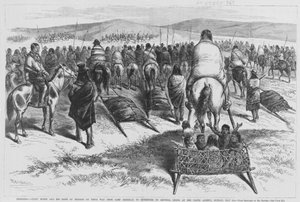
Crazy Horse and his band travelling to surrender: “Nebraska—Crazy Horse and his band of Indians on their way from Camp Sheridan to surrender to General Crook at Red Cloud Agency, Sunday, May 6,” credited to Berghavy from sketches by Mr. Hottes, 1877. Library of Congress Prints and Photographs Division, digital ID cph.3c22957. Public domain in the United States and identified by Wikimedia Commons as free of known copyright restrictions.
Explore Related Profiles
Help Keep These Stories Alive
If you enjoyed reading this profile and believe more overlooked voices deserve to be heard, you can help fund future research, writing, and free educational resources.
Every contribution—whether a one-off donation or monthly support—helps create new historical profiles, downloadable materials, and articles that remain freely available to everyone.
Thank you for helping history reach more people.
