

Chiune Sugihara
Historical Profile
The Diplomat Who Chose Humanity
Introduction
History often presents diplomacy as the art of negotiation between governments.
Diplomats attend meetings, exchange formal documents, interpret policy and represent the interests of their country abroad. Their authority comes from the state, and their responsibilities are usually defined by rules, instructions and procedures.
Chiune Sugihara faced a moment when those rules became a barrier between thousands of people and survival.
In the summer of 1940, he was serving as a Japanese diplomat in Kaunas, Lithuania. Europe was being divided between Nazi Germany and the Soviet Union. Poland had been invaded. Lithuania had been occupied by Soviet forces. Jewish families who had fled eastward found themselves trapped between two expanding regimes.
Many possessed no recognised destination.
Few countries were willing to accept them.
Without valid travel documents, they could not cross the Soviet Union, pass through Japan or escape Europe.
Outside the Japanese consulate, desperate refugees gathered and asked Sugihara for transit visas.
Japanese regulations required applicants to possess valid destination visas and sufficient money for their journey. Many of the people standing before him could not meet those conditions. Sugihara asked his superiors for permission to make an exception.
Permission was not granted.
He issued the visas anyway.
During several extraordinary weeks in July and August 1940, Sugihara and his family worked for long hours as he wrote and signed Japanese transit visas by hand. His surviving official list records 2,139 names, although individual documents sometimes covered spouses, children and other relatives. Thousands were consequently able to cross the Soviet Union by rail, travel by ship to Japan and continue towards other destinations.
No single figure can capture the rescue perfectly.
Sugihara issued a little over two thousand recorded visas, not six thousand separate documents. Estimates of the number of people helped are higher because visas often covered entire families, some documents were copied or reused, and the escape network extended beyond the names recorded in his surviving list. The often-repeated estimate of approximately six thousand lives saved should therefore be understood as an estimate of people assisted, rather than the exact number of visas he personally wrote.
Sugihara did not act alone.
Dutch honorary consul Jan Zwartendijk supplied many refugees with notations suggesting they could enter Curaçao or another Dutch territory without a conventional entry visa. Sugihara then provided the Japanese transit visas required for the refugees to travel east. Soviet officials still had to grant permission to cross the country, railway tickets had to be purchased, ships had to be boarded and communities in Japan had to help the refugees after their arrival.
The rescue was therefore not the work of one heroic man standing outside history.
It was a chain of human decisions.
But Sugihara was one of its indispensable links.
His story asks a question that reaches far beyond the Holocaust:
What is an official’s responsibility when obedience to procedure means abandoning people to danger?
Chiune Sugihara answered not through speeches, but through signatures.
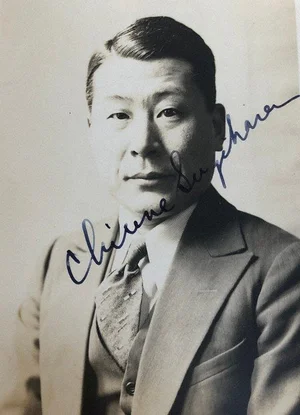
Portrait of Chiune Sugihara
Chiune Sugihara. The Japanese diplomat issued more than two thousand recorded transit visas to refugees in Lithuania during the summer of 1940, enabling thousands of people to begin an escape across the Soviet Union and through Japan.
Early Life
Chiune Sugihara was born on 1 January 1900 in Japan.
He grew up during a period of extraordinary national transformation. Only a few decades earlier, the Meiji Restoration had replaced the Tokugawa shogunate with a modern imperial government. Japan was industrialising rapidly, building a modern military and creating diplomatic institutions modelled partly upon those of European powers.
Education became central to this national project.
Sugihara was an able student and initially hoped to pursue a career connected with language and teaching. His family, however, expected him to enter medicine. According to later accounts, he resisted that path and instead turned towards foreign languages and international service. Financial difficulties also affected his education, prompting him to seek a government-supported route into diplomatic work.
He eventually passed a Foreign Ministry examination that allowed him to study abroad.
The language assigned to him was Russian.
That decision would shape the rest of his life.
Russian was not an easy or fashionable speciality. It required mastery of a complex language and familiarity with a region of growing strategic importance to Japan. Sugihara developed considerable fluency and became knowledgeable about Russian politics, culture and society.
His ability opened a path into East Asia, diplomacy and intelligence work.
It also made him useful to a government whose interests increasingly extended beyond Japan itself.
Manchuria and the Japanese Empire
Sugihara’s early career unfolded against the expansion of Japanese influence in northeastern China.
After the Russo-Japanese War of 1904–1905, Japan had acquired important strategic interests in Manchuria. Those interests grew dramatically after the Japanese military occupied the region in 1931 and established the state of Manchukuo under the nominal rule of the former Chinese emperor Puyi.
Manchukuo was presented as an independent state.
In reality, it operated under overwhelming Japanese control.
Sugihara worked within this imperial system, using his Russian-language skills in diplomatic and administrative roles. He became involved in negotiations concerning the Chinese Eastern Railway, an important transport route connecting Manchuria with Soviet territory.
His fluency, intelligence and ability to understand Russian officials made him valuable.
He was building the kind of career that might have led to senior diplomatic office.
Yet Manchuria also exposed him to the moral consequences of imperial policy.
Later accounts state that Sugihara resigned from his position in Manchukuo in 1934, objecting to the treatment of Chinese people by Japanese authorities. The precise details and motives are difficult to reconstruct fully, but Yad Vashem’s educational biography records that he resigned in protest.
This moment matters because it complicates the image of Sugihara as someone who suddenly discovered conscience in Lithuania.
His later decision did not emerge from nowhere.
Years before the refugees appeared outside his consulate, he had already encountered a conflict between state service and personal judgement.
He continued to serve Japan.
But he had begun to understand that institutions could demand loyalty without guaranteeing justice.
Marriage and Return to Diplomatic Service
After leaving Manchuria, Sugihara returned to the Japanese diplomatic service and later married Yukiko Kikuchi.
Yukiko would become an essential witness to the events in Lithuania and an active participant in the family’s response to the refugees. The couple eventually had four sons.
Sugihara’s knowledge of Russia and Eastern Europe continued to shape his postings.
In the late 1930s he served in Europe, including a period in Finland. He operated in a world of rising tension. Nazi Germany was rearming. The Soviet Union was expanding its influence. Japan was fighting a full-scale war in China and moving towards closer relations with Germany and Italy.
Diplomacy in this period was inseparable from intelligence.
Governments needed officials who could observe troop movements, political alliances, railways and military intentions.
Sugihara was not sent to Lithuania merely to stamp passports.
His location had strategic importance.
Arrival in Lithuania
In 1939 Sugihara was appointed to establish a Japanese consular presence in Kaunas, then Lithuania’s temporary capital.
Vilnius, the historic capital, had been contested and controlled by Poland for much of the interwar period, leaving Kaunas as the centre of Lithuanian government. The city was modern, politically active and culturally diverse.
It also stood close to the fault line between Germany and the Soviet Union.
Sugihara’s official duties included gathering information about Soviet and German military activity. From Lithuania, he could observe movements across Eastern Europe and report upon developments that might affect Japanese strategy.
He arrived at precisely the moment Europe was collapsing into war.
On 1 September 1939, Nazi Germany invaded Poland.
Two weeks later, Soviet forces entered Poland from the east under the terms of the secret arrangements attached to the German-Soviet non-aggression pact.
Poland was divided.
Millions of civilians were displaced.
Among them were large numbers of Polish Jews fleeing persecution, violence and eventual extermination.
Some travelled towards Lithuania, which remained temporarily independent and appeared to offer a fragile refuge.
That refuge would not last.
A Country Between Two Powers
Lithuania’s geographical position made it dangerously vulnerable.
To the west stood Nazi Germany.
To the east stood the Soviet Union.
In June 1940, Soviet forces occupied Lithuania, and the country was soon incorporated into the Soviet Union.
Foreign consulates were ordered to close.
Refugees who had fled into Lithuania now faced another crisis. Soviet authorities demanded that many accept Soviet citizenship or risk punishment and deportation. At the same time, the danger from Nazi Germany was becoming increasingly clear.
The German invasion of the Soviet Union had not yet begun.
But refugees understood that Europe’s political boundaries were closing around them.
To escape, they needed a legal route.
That route appeared almost impossible.
Western countries had imposed restrictive immigration systems.
Embassies demanded proof of money, sponsorship and final destinations.
Ships were limited.
Borders were closing.
A refugee could possess the will to flee and still remain trapped by a missing stamp.
In this world, paperwork had become a form of power.
A passport could mean movement.
A visa could mean life.
The absence of either could mean death.
The Refugees Arrive
By July 1940, Jewish refugees began gathering outside the Japanese consulate in Kaunas.
Many had come from Poland.
Some were associated with religious schools, including members of the Mir Yeshiva, one of the most important centres of Jewish learning in Eastern Europe. Others were families, merchants, intellectuals, students and political refugees.
They shared one problem.
They needed a recognised destination before Japan would grant them permission to transit through its territory.
A possible solution emerged through the Dutch diplomatic network.
Jan Zwartendijk and the Curaçao Notations
Jan Zwartendijk was a Dutch businessman who managed the local Philips operation in Lithuania and served as an honorary consul for the Netherlands.
Refugees approached him seeking documentation that might allow them to leave.
Curaçao, a Dutch-controlled island in the Caribbean, became the centre of an ingenious diplomatic solution.
Entry to Curaçao technically required the permission of its governor. However, Dutch officials could write a statement in a passport indicating that no conventional entry visa was required, without explicitly emphasising the separate requirement for gubernatorial approval.
Zwartendijk began writing such notations.
They did not guarantee that the refugees would ever reach Curaçao.
Many never intended to do so.
The documents created something equally important: the appearance of a valid final destination.
Surviving records indicate that Zwartendijk issued at least 2,345 such documents or notations.
The refugees could now claim that they were travelling towards Dutch territory.
But Curaçao lay on the other side of the world.
To reach it, they needed to cross the Soviet Union, enter Japan and continue from there.
That required Japanese transit visas.
The next link in the chain depended upon Chiune Sugihara.
The Rules
Japanese regulations were clear.
An applicant for a transit visa was generally expected to possess:
- a valid passport;
- a confirmed visa for a final destination;
- sufficient funds for the journey;
- and evidence that they would leave Japan within the permitted period.
Many of the refugees could not satisfy those requirements.
The Curaçao notations were uncertain.
Some refugees lacked money.
Some had incomplete documents.
Others did not know where they would go after reaching Japan.
Sugihara contacted the Japanese Foreign Ministry and asked for permission to issue visas despite these problems.
He did not simply abandon procedure at the first opportunity.
He tried to work through the system.
He explained the emergency.
He asked whether an exception could be made.
The answer from Tokyo insisted that normal requirements should still be met.
Sugihara faced a choice.
He could obey.
No one could have accused him of failing in his official duty. He could have closed the consulate, left Lithuania and explained that the applicants did not meet the regulations.
Or he could treat the people outside his home as something more than incomplete applications.
The Decision
Sugihara discussed the situation with Yukiko.
The choice placed more than his own career at risk.
Diplomatic disobedience could damage the future of his entire family. Japan in 1940 was highly authoritarian, militarised and increasingly intolerant of dissent. Officials were expected to obey the chain of command.
Yet the danger facing the refugees was immediate.
Sugihara later explained his decision in direct moral terms. He believed that the people asking for help would die if he turned them away.
He began issuing visas without explicit authorisation.
The decision is sometimes presented as a dramatic rejection of Japan itself.
It was more complicated.
Sugihara did not renounce his country.
He did not join an enemy movement.
He remained a Japanese diplomat and continued to use the authority of his office.
What he rejected was the idea that loyalty required moral blindness.
He chose to interpret his responsibility more widely than his instructions allowed.
Writing the Visas
The work was immense.
Each visa had to be written, signed and stamped.
Sugihara normally wrote documents by hand. Refugees waited in lines outside the consulate while the family worked within.
Accounts describe him labouring for long hours each day, sometimes until his hand and wrist became painful. Yukiko helped organise the applicants, prepare materials and support the exhausting routine.
The surviving official list contains 2,139 names. Because some visas covered more than one person and because not every document was recorded in exactly the same way, the number of individuals ultimately assisted was larger.
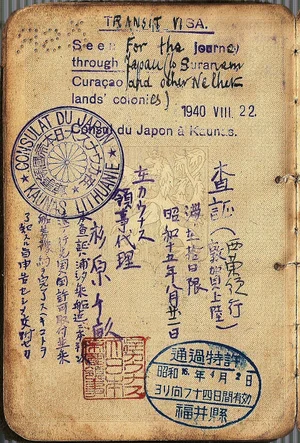
The documents usually granted approximately ten days of transit through Japan.
Ten days was not enough time to build a new life.
But it was enough to begin an escape.
Sugihara’s signature did not carry the refugees to safety by itself.
It opened the next door.
The Route Across the Soviet Union
After obtaining Japanese transit visas, refugees still needed Soviet exit permission.
They also needed to purchase costly tickets for the Trans-Siberian Railway.
The journey stretched thousands of miles across the Soviet Union to Vladivostok on the Pacific coast. From there, travellers boarded ships bound for Japanese ports.
Between July 1940 and June 1941, approximately 2,200 Jewish refugees left Lithuania along this route. The journey by Trans-Siberian rail covered roughly 5,800 miles and took around ten days.
Not everyone who received documentation escaped.
Some could not afford the journey.
Some failed to obtain Soviet permission.
Some waited too long.
Some remained behind with relatives.
A visa was an opportunity, not a guarantee.
Those who did travel carried little certainty with them.
They crossed a vast authoritarian state during wartime.
They did not know whether officials would honour their papers.
They did not know whether Japan would admit them.
They did not know which country, if any, would allow them to settle permanently.
What they possessed was movement.
In 1940, movement was survival.
Arrival in Japan
Refugees travelled by ship from Vladivostok to Japan, with many landing at Tsuruga before continuing to Kobe.
Kobe contained a small but established Jewish community. Local residents and Jewish organisations helped arrivals find accommodation, food, clothing and onward travel documents.
Many refugees remained in Japan far longer than the ten days allowed by their transit visas.
Japanese authorities were concerned that people intended only to pass through the country were becoming long-term residents. Nevertheless, permits were repeatedly extended while refugees searched for destinations.
Some travelled onward to the United States, Canada, Australia, Palestine or other territories.
Others were eventually sent to Japanese-occupied Shanghai, where a large population of Jewish refugees survived the war under difficult and increasingly restrictive conditions.
Japan’s wartime relationship with Jewish refugees was contradictory.
The Japanese state was allied with Nazi Germany from September 1940, yet it did not adopt the full machinery of Nazi racial extermination. Some officials viewed Jewish communities through antisemitic conspiracy theories, while others saw them as economically or diplomatically useful.
The refugees were not entering a liberal sanctuary.
They were passing through an empire pursuing its own wars and occupations.
Their survival resulted from a mixture of individual courage, bureaucratic flexibility, strategic calculation, community assistance and historical circumstance.
Sugihara’s visas formed one vital part of that complicated reality.
The Final Days in Kaunas
The Soviet authorities had ordered foreign missions to close, and Sugihara could not remain in Kaunas indefinitely.
He continued issuing visas as the date of departure approached.
Accounts from refugees and members of the Sugihara family describe him writing documents from his hotel after leaving the consulate and continuing to sign papers at the railway station.
One of the most famous stories claims that he handed out signed documents or blank sheets bearing his signature from the window of the departing train.
This image has become central to his legend.
It should be presented carefully.
The broader fact that he continued helping refugees until the final stage of his departure is supported by survivor testimony and historical accounts. The precise details of every paper passed through the train window cannot be independently reconstructed.
Yet the scene endures because it expresses something true about the entire episode.
Sugihara did not stop when the work became inconvenient.
He stopped only when physical departure made it impossible to continue.
Beyond the Heroic Image
Stories of rescue often become simplified.
One righteous individual is placed against an evil system.
The individual acts.
Thousands are saved.
History becomes a moral fable.
Sugihara’s story is more powerful when its complexity is preserved.
He was not a lone saviour.
The refugees themselves displayed extraordinary courage and ingenuity. They built networks, gathered information, negotiated with officials, borrowed money, cared for children and endured journeys across continents.
Jan Zwartendijk created the destination papers that made many applications possible.
Soviet officials chose to issue some exit permissions.
Railway workers, ship crews, Jewish organisations and Japanese communities helped people continue.
Other diplomats provided additional documents.
Families shared information and sometimes returned papers to relatives so they could attempt the same route.
Rescue was collaborative.
Sugihara’s importance lies not in replacing all of those people within the story, but in refusing to become the official who broke the chain.
Diplomatic Service During the War
After leaving Lithuania, Sugihara continued serving in Europe.
His subsequent postings included Prague, Königsberg and diplomatic assignments connected with Romania.
The Second World War eventually caught up with him and his family.
When Soviet forces entered Romania near the war’s end, Sugihara and members of his family were detained and spent time in Soviet custody.
They returned to Japan after the conflict.
By then, the country he had served had been defeated, occupied and transformed.
The Japanese empire had collapsed.
Cities lay in ruins.
Millions of soldiers and officials were returning home.
The diplomatic service itself was being reduced and reorganised.
Sugihara’s future within it was uncertain.
Leaving the Foreign Ministry
In 1947, Sugihara left the Japanese Foreign Ministry.
For many years, popular accounts stated that he had been dismissed specifically as punishment for disobeying orders in Lithuania.
The truth is less certain.
Sugihara and members of his family believed that his visa actions contributed to his removal. However, the ministry later maintained that he was among many officials dismissed during a broad post-war reduction in personnel.
No surviving document conclusively proves that the visas were the sole or formal reason.
It is therefore safer to say that Sugihara was required to leave the diplomatic service during post-war restructuring, while acknowledging that the relationship between his disobedience and his dismissal remains debated.
This distinction matters.
A powerful story does not become weaker when uncertainty is admitted.
Historical respect requires us to separate what is documented from what later memory has made symbolic.
Whatever the precise reason, Sugihara lost the career for which his linguistic abilities and experience had prepared him.
He now had to support his family outside diplomacy.
An Ordinary Life After an Extraordinary Decision
Sugihara worked in a variety of jobs after leaving government service.
His knowledge of Russian remained useful, and he spent extended periods working in connection with trade and business involving the Soviet Union.
For years, he lived without public celebration.
The refugees he had helped were scattered across the world.
Some had rebuilt their lives in Israel, North America, Australia and elsewhere.
Some remembered the Japanese diplomat whose name appeared in their passports.
But in Japan, Sugihara’s actions were not widely known.
There were no immediate national honours.
No monuments awaited him.
No public campaign presented him as a hero.
This long silence is an important part of his story.
It shows how historical recognition often depends not only upon what someone did, but upon whether survivors remain able to identify them, whether records survive and whether later generations choose to listen.
Sugihara did not act because he expected history to reward him.
For decades, it did not.
Survivors Search for Sugihara
Among the refugees who remembered Sugihara was Yehoshua Nishri, who later worked in Israel.
Survivors attempted to trace the diplomat who had helped them escape.
The search was made more difficult by the way Sugihara’s given name had sometimes been rendered. In diplomatic contexts he had also used the reading Sempo, leading some survivors to search for a person they knew as Sempo Sugihara.
Eventually, contact was re-established.
Sugihara learned that people carrying his visas had survived, raised families and built new lives.
The consequences of those weeks in Kaunas were no longer abstract.
They stood before him in the form of living people.
Children had become adults.
Families that might otherwise have ended had continued.
Righteous Among the Nations
Yad Vashem, Israel’s official memorial to the victims of the Holocaust, recognises non-Jews who risked their lives, liberty or positions to save Jews from persecution as Righteous Among the Nations.
In 1984, Chiune Sugihara received that recognition for his role in the rescue of Jewish refugees.
Yad Vashem records the award date as 10 October 1984.
Sugihara was elderly and in poor health, and members of his family participated in the recognition associated with the honour.
The title placed him among diplomats, clergy, resistance members, farmers, workers and ordinary citizens who had chosen to help persecuted people during the Holocaust.
It also brought greater international attention to his story.
The quiet former diplomat was becoming a symbol of moral courage.
Death
Chiune Sugihara died on 31 July 1986.
He was eighty-six years old.
His death came only a short time after international recognition had begun to restore his actions to public memory.
During much of his life, neighbours and acquaintances had known him primarily as a former diplomat and businessman.
Only gradually did Japan begin to understand the scale of what he had done.
As with many historical figures, recognition arrived late.
But it did arrive.
The Number of Lives Saved
The figure most frequently associated with Sugihara is six thousand.
It appears in books, museums, memorials and public accounts.
The number is plausible as a broad estimate of people assisted, but it should not be treated as a precise count.
Sugihara’s surviving list contains 2,139 names.
Some entries represented families rather than individuals.
Some travellers possessed documents derived from, copied from or connected to the original visas.
Not every listed person escaped.
Some people travelled using related paperwork that may not appear clearly in the surviving record.
Researchers therefore distinguish between:
- the number of recorded visas;
- the number of names on surviving lists;
- the number of people who actually travelled;
- and the larger number of relatives and descendants whose lives followed from those escapes.
The United States Holocaust Memorial Museum states that Sugihara issued more than two thousand transit visas, while broader commemorative accounts estimate that several thousand people were saved.
Precision does not diminish the achievement.
Even if the lower documented figure alone were used, Sugihara’s actions helped enable one of the most significant diplomatic rescue operations of the Holocaust.
The Descendants
Public accounts sometimes claim that tens of thousands of people alive today descend from refugees helped by Sugihara.
Such figures are difficult to verify because descendants are spread across many countries, family histories overlap and definitions differ.
The underlying truth is nevertheless clear.
Every survivor carried future possibilities with them.
Children were born.
Families expanded.
Communities continued.
A visa that appeared to concern one traveller could affect generations not yet born.
This is one reason Sugihara’s story resonates so powerfully.
The value of his decision cannot be measured only by the documents he signed in 1940.
Its consequences continued long after his death.
Barriers He Faced
Sugihara’s achievement becomes more meaningful when the forces constraining him are understood.
He faced bureaucratic regulations designed for ordinary travel at a moment when ordinary travel had ceased to exist.
He served an authoritarian and militarised government that expected obedience.
He was stationed in a country occupied by the Soviet Union and threatened by Nazi Germany.
His consulate was being closed.
His family’s security and financial future depended upon his career.
The refugees lacked recognised destinations, money and reliable documents.
He had limited time.
He could not know whether the Soviet Union would permit them to leave or whether Japan would allow them to land.
He could not know which countries would eventually accept them.
He acted without certainty.
That uncertainty is essential.
Moral courage is sometimes imagined as the confidence of knowing that one is right and that everything will succeed.
Sugihara possessed no such guarantee.
He chose to help while the outcome remained unclear.
Diplomacy and Conscience
Diplomats are entrusted with a nation’s authority.
That authority can protect people.
It can also exclude them.
A visa officer rarely appears in traditional histories of war because the work seems administrative rather than dramatic. Yet for refugees, administrative decisions can be as decisive as battles.
A rejected application may close an escape route.
A signature may open one.
Sugihara understood that neutrality was impossible.
Refusing the visas would not have been an absence of choice.
It would have been a choice in favour of the existing rules and against the people those rules excluded.
He therefore used bureaucracy against its most destructive tendency.
He turned the stamp, the signature and the form into instruments of rescue.
The Question of Obedience
Sugihara’s story is often described as one of disobedience.
That is true, but incomplete.
He disobeyed a specific instruction because he believed he owed obedience to a deeper principle.
Governments depend upon officials following rules.
Without procedure, public administration can become arbitrary, corrupt or unfair.
But no set of rules can anticipate every human emergency.
The moral challenge arises when procedure ceases to protect order and begins to obstruct survival.
Sugihara did not reject all rules.
He issued official visas.
He recorded names.
He used the recognised mechanisms of diplomatic authority.
His rebellion occurred within the form itself.
He stretched the institution towards humanity.
That makes his example especially valuable.
He did not need to become a soldier, revolutionary or resistance fighter.
He acted from behind a desk.
Jan Zwartendijk: The Other Essential Diplomat
Sugihara should never be remembered without Jan Zwartendijk.
The Dutch honorary consul’s Curaçao notations created the destination that made the Japanese transit visas possible.
Zwartendijk acted rapidly, issuing at least 2,345 survivingly documented notations during July and August 1940.
The two men did not design a large formal rescue organisation.
Their cooperation was practical, improvised and urgent.
One document led to another.
A Dutch notation supported a Japanese visa.
The Japanese visa supported a Soviet exit request.
The exit permit supported the railway journey.
The railway reached the ship.
The ship reached Japan.
Each stage depended upon the previous one.
Zwartendijk later returned to the Netherlands and lived for decades without knowing the full outcome of his actions. He died in 1976. According to the Sugihara House account, confirmation that more than two thousand visa holders had escaped reached his family shortly after his funeral. He was recognised posthumously by Yad Vashem in 1997.
Together, Zwartendijk and Sugihara demonstrate that humanitarian action is often not one great gesture, but a series of people refusing to become the point where hope ends.
The Refugees as Historical Actors
It is equally important not to portray the refugees as passive recipients of rescue.
They searched for loopholes.
They travelled between consulates.
They negotiated with diplomats.
They circulated information.
They raised funds.
They bought rail tickets.
They endured Soviet inspections.
They crossed Siberia with children, luggage and uncertain documents.
They supported one another in Kobe and Shanghai.
Some members of religious communities organised the movement of entire groups.
Others left relatives behind because only part of a family had received permission to travel.
Their courage is inseparable from Sugihara’s.
He opened a door.
They still had to cross the world to reach it.
Japan, Memory and Recognition
Sugihara’s reputation within Japan developed slowly.
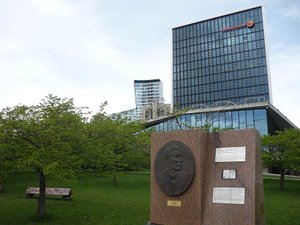
In later decades, schools, museums, memorials and public ceremonies began presenting him as an example of Japanese humanitarian courage.
His birthplace region established commemorative institutions.
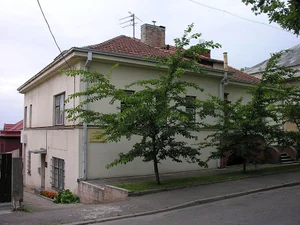
The former Japanese consulate building in Kaunas became the Sugihara House Museum, preserving the rooms in which the visas had been written. The museum was established in 1999 and later developed renewed exhibitions interpreting the work of Sugihara and Zwartendijk.
His name has been given to streets, memorials and educational projects.
Japanese diplomatic institutions have also acknowledged his legacy.
This recognition carries both value and risk.
It restores a deserving figure to public memory.
But it can also tempt nations to use one person’s courage as evidence of collective virtue while avoiding the wider history of Japanese wartime aggression.
Sugihara’s actions should not be used to simplify Japan’s role in the Second World War.
He served a state that occupied territories, conducted brutal military campaigns and caused immense suffering across Asia.
His moral significance lies precisely in the fact that an individual within such a system still possessed the ability to choose differently.
Legacy
Chiune Sugihara’s legacy exists on several levels.
He helped thousands of refugees begin journeys out of danger.
He demonstrated how diplomatic authority could be used humanely.
He showed that obedience does not remove personal responsibility.
He revealed that small administrative actions can carry enormous historical consequences.
He also became part of a broader history of diplomats who used their positions to protect persecuted people.
These included figures such as Aristides de Sousa Mendes of Portugal, Hiram Bingham IV of the United States, Ho Feng-Shan of China, Raoul Wallenberg of Sweden and Jan Zwartendijk of the Netherlands.
They worked in different places and under different conditions.
What connected them was a refusal to accept that official limitations ended moral responsibility.
Why Chiune Sugihara Matters
Chiune Sugihara matters because he occupied one of history’s most ordinary positions of power.
He sat behind a desk.
People approached him with documents.
He decided whether to approve or reject them.
There was no battlefield before him.
No army waited for his command.
His weapon was a pen.
His authority was a stamp.
The refugees who stood outside his consulate had been sorted by every category the modern state could impose.
Nationality.
Religion.
Citizenship.
Destination.
Financial status.
Political usefulness.
Legal eligibility.
Sugihara looked beyond those categories and saw people in danger.
That does not mean he ignored identity or circumstance.
The refugees were being persecuted precisely because they were Jewish.
Their condition cannot be separated from antisemitism, Nazi racial policy or the destruction of Eastern European Jewish life.
But Sugihara refused to let the labels used against them determine whether they deserved help.
He judged the immediate reality.
Human beings needed a path to safety.
He possessed the ability to provide part of that path.
So he acted.
His decision did not end the Holocaust.
It did not overthrow the regimes threatening the refugees.
It did not guarantee that every visa holder would survive.
It did something more limited and more tangible.
It gave thousands of people a chance.
History often focuses on those who possess the greatest authority.
Sugihara reminds us to examine how authority is used at every level.
A law may be written by a government.
A policy may be approved by a ministry.
But eventually, that policy reaches a person sitting across from another human being.
At that moment, responsibility becomes personal.
Chiune Sugihara could have said that the rules left him no choice.
Instead, he made one.
Key Achievements
Key Achievements
- Issued more than two thousand recorded Japanese transit visas to refugees in Lithuania during July and August 1940.
- Helped enable thousands of Jewish refugees to travel across the Soviet Union and through Japan towards safer destinations.
- Acted despite the Japanese Foreign Ministry refusing to authorise a general exception to normal visa requirements.
- Worked within a broader rescue chain involving refugees, Jan Zwartendijk, Soviet officials, transport workers and Jewish communities in Japan.
- Continued assisting refugees until the final stages of his departure from Kaunas.
- Demonstrated how diplomatic authority could protect human life rather than merely enforce procedure.
- Was recognised by Yad Vashem as Righteous Among the Nations in 1984.
- Became an enduring international symbol of moral responsibility within public service.
Key Dates
Born in Japan on 1 January.
Receives his early education and develops strong academic and linguistic abilities.
Enters the Japanese Foreign Ministry’s training system and begins specialising in Russian.
Works in Manchuria and develops extensive knowledge of Russian affairs.
Resigns from his position in Manchukuo; later accounts associate the decision with objections to Japanese treatment of Chinese people.
Returns to Japanese diplomatic service in a European capacity.
Serves in Finland.
Appointed to establish a Japanese consular presence in Kaunas, Lithuania.
Germany and the Soviet Union invade Poland, sending refugees into Lithuania.
The Soviet Union occupies Lithuania.
Jewish refugees gather outside the Japanese consulate seeking transit visas.
Sugihara begins issuing visas despite lacking explicit authorisation to waive standard requirements.
The Japanese consulate closes under Soviet pressure.
Sugihara leaves Lithuania after continuing to assist refugees during the final stages of his departure.
Thousands of refugees travel across the Soviet Union by Trans-Siberian rail and continue by ship to Japan.
Germany invades the Soviet Union, closing the escape route across Siberia to private travellers.
Sugihara continues serving in European diplomatic posts during the war.
Sugihara and his family are detained by Soviet forces in Romania.
Returns to Japan after the war.
Leaves the Japanese Foreign Ministry during post-war restructuring.
Works in commercial and language-related roles, including positions connected with the Soviet Union.
Survivors begin successfully re-establishing contact with him.
Recognised by Yad Vashem as Righteous Among the Nations.
Dies in Japan on 31 July, aged eighty-six.
Receives growing recognition through memorials, museums, education and diplomatic commemoration in Japan, Lithuania, Israel and elsewhere.
Final Reflection
Chiune Sugihara did not possess the power to stop a war.
He could not defeat Nazi Germany.
He could not reopen the borders of countries that had rejected refugees.
He could not guarantee what would happen to anyone after they left his consulate.
What he possessed was narrower.
A diplomatic title.
An official stamp.
A pen.
A limited amount of time.
History is often changed within such limits.
Sugihara was expected to administer rules.
Instead, he asked what those rules were doing to the people standing before him.
He understood that following instructions would protect his position, while abandoning those who needed his authority most.
So he continued writing.
One name.
One family.
One visa at a time.
His courage was not the courage of certainty.
It was the courage to accept responsibility when the outcome remained unknown.
Thousands of people crossed the Soviet Union carrying documents bearing his signature. Many reached Japan. Many continued elsewhere. Families survived that might otherwise have disappeared into the Holocaust.
Chiune Sugihara did not rescue them alone.
But when history placed him at one of the gates through which they had to pass, he chose not to close it.
He reminds us that institutions are never entirely impersonal.
Behind every policy is someone who applies it.
Behind every refusal is someone who decides that refusal is acceptable.
And behind every act of humanity is a person who could have looked away, but did not.
Chiune Sugihara was given the authority to represent his country.
In the moment that defined his life, he chose to represent something larger.
He chose humanity.
Did You Know?
Did You Know?
- Sugihara specialised in Russian, a skill that shaped his diplomatic career and later helped him understand the political geography surrounding Lithuania.
- His surviving official list records 2,139 names, rather than six thousand separate visas.
- The estimate of approximately six thousand people saved reflects the fact that some visas covered entire families and that the surviving record is incomplete.
- Jan Zwartendijk’s Curaçao notations supplied many refugees with the destination paperwork needed before Sugihara could issue Japanese transit visas.
- Refugees still had to obtain Soviet exit permission and purchase expensive Trans-Siberian Railway tickets.
- Many refugees landed at Tsuruga and continued to Kobe, where organisations and local communities helped them find shelter and onward routes.
- Sugihara continued helping refugees until the final stage of his departure from Kaunas.
- The famous train-window story is supported by survivor testimony, although every detail cannot be independently reconstructed.
- He lived for decades without widespread public recognition in Japan.
- Yad Vashem honoured him only two years before his death.
Further Reading
- Yad Vashem — Chiune Sugihara, Righteous Among the Nations
- United States Holocaust Memorial Museum — Chiune Sugihara and the Visas for Life
- Sugihara House Museum, Kaunas — historical exhibitions and archival resources
- Chiune Sugihara Memorial Hall, Yaotsu — biographical and educational materials
- Japanese Ministry of Foreign Affairs — historical materials concerning Sugihara
- Hillel Levine — In Search of Sugihara
- Yukiko Sugihara — Visas for Life
- Akira Kitade — Visas of Life and the Epic Journey
Image Credits
Chiune Sugihara seated: Wikimedia Commons image supplied through the website media library. Confirm the original photographer, date, source institution and licence details against the Commons file page before publication.
Sugihara transit visa: Wikimedia Commons image supplied through the website media library. Confirm the document holder, archival source and licence details against the Commons file page before publication.
Former Japanese consulate in Kaunas: Wikimedia Commons photograph supplied through the website media library. Confirm the photographer, date and licence details against the Commons file page before publication.
Sugihara memorial in Lithuania: Wikimedia Commons photograph supplied through the website media library. Confirm the photographer, date and licence details against the Commons file page before publication.
Explore Related Profiles
Help Keep These Stories Alive
If you enjoyed reading this profile and believe more overlooked voices deserve to be heard, you can help fund future research, writing, and free educational resources.
Every contribution—whether a one-off donation or monthly support—helps create new historical profiles, downloadable materials, and articles that remain freely available to everyone.
Thank you for helping history reach more people.
