

Wangari Maathai
Historical Profile
The Woman Who Followed the Roots
Introduction
History often separates environmentalism from politics.
Trees belong to conservation.
Elections belong to democracy.
Poverty belongs to economics.
Women’s rights belong to social reform.
Peace belongs to diplomacy.
Wangari Maathai understood that these were not separate problems.
When rural women in Kenya told her that streams were drying, firewood was becoming scarce, harvests were failing and children were suffering from poor nutrition, she did not treat their experiences as isolated domestic difficulties.
She recognised a pattern.
Forests had been cleared.
Commercial agriculture had replaced diverse local planting.
Soil was being washed away.
Water systems were deteriorating.
Land and public resources were being controlled by political and commercial interests.
The environmental crisis was also an economic crisis.
The economic crisis intensified inequality.
Inequality weakened communities.
And when people lacked democratic power, they had little ability to protect either their land or themselves.
Maathai’s answer began with something deceptively simple:
Plant trees.
In 1977, she founded the Green Belt Movement under the National Council of Women of Kenya. Rural women were encouraged to collect seeds, establish local nurseries, plant indigenous trees and receive modest payment when those trees survived.
The work restored damaged land.
It provided firewood, food and small sources of income.
It also gave women practical authority within their communities.
A woman who had been treated as a passive victim of poverty became a nursery organiser, environmental educator and guardian of local resources.
The movement spread.
Millions of trees were planted.
Thousands of women became involved.
But as Maathai followed the roots of environmental destruction, she encountered something larger than deforestation.
Public forests were being transferred to private interests.
Urban green spaces were threatened by prestige developments.
Political leaders treated public land as a reward for loyalty.
Those who challenged the system faced harassment, arrest and violence.
Tree planting became political because the destruction of trees was political.
Maathai opposed the construction of a vast commercial complex in Nairobi’s Uhuru Park.
She stood with mothers demanding the release of political prisoners.
She confronted land-grabbing in Karura Forest.
She was insulted, beaten, detained and publicly dismissed as an unruly woman.
She continued.
In 2002, after years of resisting an authoritarian government, she was elected to Kenya’s parliament. Two years later, she became the first African woman to receive the Nobel Peace Prize, awarded for her contribution to sustainable development, democracy and peace.
The prize recognised something Maathai had spent decades demonstrating:
Peace cannot be sustained where resources are destroyed, communities are impoverished and governments silence those who object.
Wangari Maathai did more than plant trees.
She changed what a tree could represent.
A seedling became a source of fuel and food.
Its roots protected the soil.
Its branches sheltered future generations.
And the act of planting it became a declaration that ordinary people possessed both the right and the power to repair their world.
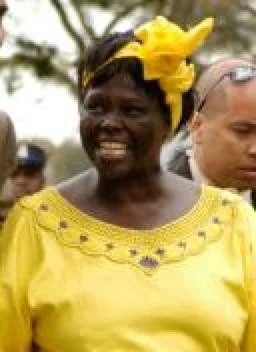
Portrait of Wangari Maathai
Wangari Maathai. A scientist, environmental organiser and democratic activist, she founded the Green Belt Movement and became the first African woman to receive the Nobel Peace Prize.
A Childhood Among Trees
Wangari Muta was born on 1 April 1940 in the Nyeri region of central Kenya.
She grew up near the fertile highlands surrounding Mount Kenya, in a landscape of forests, streams, farms and richly cultivated soil.
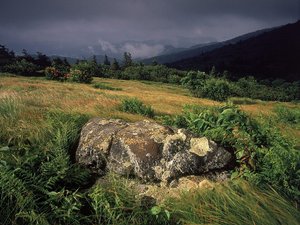
Her family belonged to the Kikuyu community, whose cultural and agricultural traditions were deeply connected to the land. Trees were not merely raw materials. Certain species carried spiritual, practical and communal meaning.
Among the most important was the mugumo, or sacred fig tree.
Maathai later remembered a great mugumo growing near her childhood home. Its roots helped protect a spring from which her family drew water. She was taught not to collect fallen wood from beneath it because the tree was regarded with reverence.
At the time, she did not think of this as environmental science.
It was simply part of life.
The tree stood.
The spring flowed.
The soil remained moist.
Only years later did she understand the ecological relationship hidden within the cultural teaching.
The roots stabilised the earth and helped preserve the water source.
Traditional respect had protected a functioning ecosystem.
This lesson would return throughout her life:
Communities often preserve environmental knowledge long before institutions give that knowledge scientific names.
Kenya during Maathai’s childhood was a British colony. Its fertile highlands had been transformed by European settlement, plantation agriculture and the appropriation of land.
Indigenous communities were displaced or confined to increasingly crowded areas.
Forests were cleared for timber, tea and coffee.
The land Maathai experienced as a child was therefore already changing under colonial pressure.
Yet her earliest memories retained a sense of abundance.
There was clean water.
There was food grown close to home.
There were trees large enough to shape the landscape around them.
Much of her later activism would be driven by the contrast between that remembered world and the degraded environment she encountered as an adult.
Education in Colonial Kenya
Formal schooling was not an automatic path for a rural Kenyan girl in the 1940s.
Many families prioritised boys’ education, while girls were expected to contribute to farming, childcare and domestic work.
Maathai’s elder brother reportedly questioned why she was not attending school.
That simple question helped change the direction of her life.
She began at Ihithe Primary School in 1948 and later studied at Mathari Intermediate School. Her academic ability became increasingly clear. She continued to Loreto High School in Limuru, a Catholic girls’ school that offered one of the stronger educational opportunities available to African girls in colonial Kenya.
Missionary education carried its own contradictions.
It opened doors that colonial society had largely closed.
It also operated within a system that often treated European culture and Christianity as superior to African traditions.
Maathai became a committed Catholic and found real intellectual opportunity through the schools she attended. Yet her later work would also recover values embedded in the landscape and cultural memory of her childhood.
Her education did not require her to choose permanently between science and tradition.
Instead, she learned to recognise where the two could illuminate one another.
By the end of the 1950s, she had become one of a small number of Kenyan students qualified for higher education abroad.
Then an extraordinary opportunity appeared.
The Kennedy Airlift
As independence movements gathered strength across Africa, political and educational leaders recognised that newly independent nations would need trained teachers, scientists, administrators and professionals.
Kenya possessed very few universities and limited opportunities for advanced study.
A programme popularly known as the Kennedy Airlift helped hundreds of East African students travel to colleges and universities in the United States.
The initiative was associated with Kenyan leader Tom Mboya and received support from American educational and philanthropic networks. John F. Kennedy’s family foundation helped fund one of the later stages, giving the wider programme its familiar name.
In 1960, Maathai was selected to study in the United States.
She entered Mount St Scholastica College in Atchison, Kansas, now Benedictine College.
For a young woman raised in colonial Kenya, the journey represented a dramatic transition.
She moved from the highlands of East Africa to the American Midwest.
She encountered unfamiliar climates, customs and racial dynamics.
She also entered a country in the midst of the civil-rights movement.
America and the Civil-Rights Era
Maathai studied biological sciences, graduating in 1964.
Her years in the United States coincided with student sit-ins, freedom rides, the March on Washington and expanding campaigns against racial segregation.
She was not at the centre of those movements, but she could not avoid their significance.
African nations were struggling to free themselves from colonial rule while Black Americans were struggling against discrimination within a country that proclaimed liberty.
The contradiction was instructive.
Political independence alone did not guarantee equality.
Laws alone did not dissolve hierarchy.
Citizens had to organise, persist and force institutions to recognise rights they claimed to represent.
Maathai also saw forms of public participation that differed from the colonial government under which she had grown up. Protest, civic organisation and open political debate demonstrated that ordinary people could challenge powerful systems.
These lessons later became part of her environmental work.
A tree nursery might seem far removed from a civil-rights campaign.
But both depended upon people discovering that they did not have to remain passive before unjust conditions.
After completing her undergraduate degree, Maathai continued to the University of Pittsburgh, where she received a master’s degree in biological sciences in 1966.
Pittsburgh was undergoing efforts to reduce industrial pollution and restore parts of its environment. The experience reinforced her growing awareness that ecological damage was not inevitable. Cities and communities could choose restoration.
She returned to Kenya with advanced scientific training at a time when the country was newly independent and urgently seeking educated professionals.
Returning to an Independent Kenya
Kenya had achieved independence from Britain in December 1963.
The new nation carried enormous hope.
It also inherited deep inequalities in land ownership, education and political power.
Maathai returned in 1966 expecting to begin an academic position at the University College of Nairobi.
According to her later account, she discovered that the promised appointment had been given to someone else. She believed gender and ethnic prejudice had contributed to the decision.
She eventually secured work in the Department of Veterinary Anatomy.
The position placed her within a field largely dominated by men.
Her research examined animal tissues and reproductive development, requiring laboratory discipline, microscopy and detailed anatomical analysis.
She travelled to Germany for further study through the Nairobi–Giessen academic partnership and completed research on the early development of male bovine reproductive organs.
In 1971, the University of Nairobi awarded her a doctorate.
She became the first woman in East and Central Africa to earn a PhD.
This achievement alone would have secured her place in academic history.
But Maathai’s importance lies partly in what she did after reaching an institution from which women had long been excluded.
She did not treat individual advancement as the end of equality.
A Pioneer at the University of Nairobi
Maathai rose through the academic ranks.
In 1976, she became chair of the Department of Veterinary Anatomy.
The following year she became an associate professor.
The University of Nairobi describes her as the first indigenous woman in the region to hold those positions.
Her success exposed persistent inequality within the institution.
Women employees did not always receive the same benefits as men.
Housing allowances, pensions and other employment provisions were structured around an assumption that a male worker supported a family while a woman remained dependent upon a husband.
Maathai challenged this logic.
She became involved with staff organisations and campaigns for equal employment treatment.
The issue revealed a pattern she would encounter repeatedly:
Discrimination rarely survives only through openly hostile declarations.
It becomes embedded in administrative rules that present male experience as normal and female experience as exceptional.
Maathai had followed the accepted path.
She had studied.
Qualified.
Returned home.
Conducted research.
Earned a doctorate.
Yet the system still treated women’s labour as less valuable.
Her academic career therefore became another form of political education.
Institutions could celebrate merit while preserving unequal structures.
The National Council of Women of Kenya
During the 1970s, Maathai became increasingly active in civic organisations.
Among the most important was the National Council of Women of Kenya.
Through the council, she met women from rural communities and listened to the problems affecting their daily lives.
They spoke about shortages of firewood.
Streams that had once flowed reliably were drying.
Women walked greater distances to collect fuel.
Food crops were becoming less productive.
Children suffered from malnutrition.
Families had less money.
These complaints were often treated as separate symptoms of rural poverty.
Maathai’s scientific training helped her see the ecological connection.
Trees had been cleared.
Without tree cover, rainwater ran rapidly across exposed ground.
Topsoil eroded.
Springs and streams became less reliable.
Land lost fertility.
Women spent more time searching for wood and water, leaving less time for farming, education or paid work.
A damaged environment increased the burdens already placed upon women.
The crisis was ecological.
But it was experienced through gender.
Why Trees?
Maathai did not begin with a vast international theory.
She began with a practical question:
What could rural communities do with the resources available to them?
Trees addressed several problems simultaneously.
Their roots held soil in place.
Their leaves and branches protected the ground from heavy rain.
Some provided fruit.
Others supplied animal fodder.
Pruned branches could become fuel.
Trees helped retain water and restore local ecosystems.
They could be planted without expensive machinery.
Most importantly, communities could grow them themselves.
The first experiments were not immediately successful.
Professionally trained foresters often insisted that tree cultivation required specialist knowledge.
Some seedlings died.
Nurseries struggled.
But Maathai recognised that perfection was not necessary.
Rural women already knew how to cultivate crops.
They could learn to collect seeds, fill containers with soil, protect seedlings and identify which trees survived.
The movement developed the idea of foresters without diplomas.
This phrase challenged more than professional pride.
It questioned the assumption that useful knowledge belongs only to formally qualified experts.
Maathai herself possessed the highest academic qualifications.
Yet she did not use those qualifications to silence local knowledge.
She used them to connect scientific understanding with community experience.
The Green Belt Movement
On 5 June 1977, World Environment Day, the first public tree-planting initiative associated with what became the Green Belt Movement took place.
The movement developed under the National Council of Women of Kenya before becoming an independent organisation.
Its structure was deliberately local.
Women formed groups.
They collected seeds.
They created nurseries near their homes.
They planted seedlings in farms, schools, church grounds and shared spaces.
The movement paid small amounts for trees once they had survived, rewarding successful cultivation rather than simply distributing seedlings.
This created both environmental and economic value.
The women were not hired as anonymous labourers for a project designed elsewhere.
They became organisers.
They selected sites.
Managed nurseries.
Tracked survival.
Taught others.
The Green Belt Movement describes its purpose as combining environmental conservation with community empowerment, especially the empowerment of women.
By the time Maathai received the Nobel Peace Prize, the movement had contributed to the planting of more than thirty million trees. Later organisational figures placed the total above fifty million. The difference reflects the movement’s continued work rather than a contradiction between the estimates.
But the number of trees tells only part of the story.
The movement created networks.
People who once believed they possessed no political power began discussing land ownership, corruption and public responsibility.
Tree planting became the entrance to civic education.
Women as Environmental Authorities
The Green Belt Movement is sometimes described as a programme that helped poor women.
That is true, but incomplete.
It also revealed how much expertise those women already possessed.
Rural women understood where water had once flowed.
They knew which plants had disappeared.
They could compare current harvests with earlier ones.
They saw how much farther they had to walk for firewood.
Their daily work made them witnesses to environmental change.
Yet because that knowledge was expressed through domestic labour rather than academic reports, governments and professionals often ignored it.
Maathai reversed the direction of authority.
Instead of arriving with a finished policy and instructing women to implement it, she listened to the problems they identified.
The women’s experience became the starting evidence.
Science helped explain the pattern.
Organisation created the response.
This was one of the movement’s most radical features.
It did not merely add women to environmental policy.
It recognised that women had already been analysing the environment through lived experience.
Independence Without Transformation
Kenya’s independence had transferred political authority from colonial officials to African leaders.
It had not removed the structures through which land and wealth could be concentrated.
Large estates remained.
Political elites gained access to land formerly controlled by colonial interests.
Forests and public spaces could be allocated to private developers.
Government contracts and property became tools of political reward.
President Daniel arap Moi, who assumed office in 1978, gradually presided over an increasingly authoritarian system.
Opposition was constrained.
Critics faced detention and intimidation.
Public institutions were expected to serve political power.
Maathai came to understand that damaged environments could not be restored permanently while public resources remained vulnerable to corruption.
Communities might plant thousands of trees.
A government could still transfer an entire forest to private interests.
The Green Belt Movement therefore expanded beyond tree planting.
Its seminars encouraged participants to discuss why communities were poor, why forests were disappearing and why citizens found it difficult to challenge harmful decisions.
Environmental awareness became democratic awareness.
Personal Attacks and Public Defiance
Maathai’s growing public role unfolded alongside intense personal difficulty.
Her marriage to Mwangi Mathai ended in divorce during the late 1970s.
The proceedings became public and humiliating.
Her former husband reportedly argued that she was too strong-minded and difficult to control.
After commenting upon the judgment, she was briefly imprisoned for contempt of court.
She also lost the right to continue using her former husband’s surname in its existing form and added an extra “a,” becoming Maathai.
The episode reflected the standards imposed upon women who entered public life.
A forceful man could be admired as decisive.
A forceful woman could be presented as disorderly, unfeminine or impossible to manage.
These personal attacks did not remain separate from politics.
Government supporters repeatedly used gendered insults against her.
President Moi publicly belittled her and suggested that a proper African woman should respect men and remain within accepted boundaries.
The insults revealed why her activism seemed so threatening.
Maathai did not merely oppose particular developments.
She rejected the assumption that power belonged naturally to men and that women should request permission before entering public debate.
Uhuru Park
In 1989, Maathai learned of plans to construct the Kenya Times Media Trust complex in Nairobi’s Uhuru Park.
The proposed development included a high-rise office tower and associated commercial facilities.
Supporters presented it as a symbol of modernity and national prestige.
Maathai saw something else.
Uhuru Park was one of Nairobi’s most important public green spaces.
The development would transfer shared land into a politically connected commercial project.
She wrote letters to government departments, foreign embassies, international organisations and potential investors.
She questioned the environmental effects, financial arrangements and public legitimacy of the scheme.
The government responded with hostility.
Officials portrayed her as disloyal, irrational and opposed to national development.
The Green Belt Movement was attacked.
Maathai was ridiculed in parliament and the press.
Yet international concern grew.
Investors withdrew.
The project collapsed.
The park remained.
The campaign demonstrated that environmental resistance could expose the relationship between land, corruption and authoritarian power.
It also showed how public definitions of “development” could conceal private benefit.
A tower might produce visible evidence of investment.
A park provided something harder to measure:
Open space.
Shade.
Air.
Community.
The right of people without wealth to occupy valuable land without purchasing anything.
By defending Uhuru Park, Maathai defended the idea that public value could not be reduced to commercial profit.
Environmentalism Becomes Democratic Resistance
The Uhuru Park campaign changed Maathai’s public position.
She was no longer perceived only as a scientist encouraging women to plant trees.
She had successfully challenged a project associated with the ruling political establishment.
The government recognised that environmental activism could mobilise citizens around questions of ownership and accountability.
Maathai increasingly spoke against one-party rule and political repression.
She joined other campaigners demanding democratic reform.
The Green Belt Movement’s civic education programmes taught participants to connect soil erosion with poor governance and land loss with political silence.
This was not an accidental expansion.
Maathai had concluded that environmental responsibility required democratic space.
People could not defend forests if they were forbidden to question those allocating them.
They could not protect water systems if records remained hidden.
They could not challenge corruption if protest led to detention.
In her Nobel lecture, she later expressed the lesson clearly: sustainable development, democracy and peace were inseparable.
Arrest and Detention
By the early 1990s, pressure for multiparty democracy was growing in Kenya.
The Moi government responded to opposition with intimidation and arrests.
Maathai participated in pro-democracy activity and publicly warned against political violence.
In January 1992, police surrounded her home.
Fearing arrest or worse, she barricaded herself inside while supporters and international observers drew attention to her situation.
She was eventually arrested and detained.
International criticism followed.
The episode demonstrated both her vulnerability and the protection that public visibility could sometimes provide.
Many less prominent critics of the regime suffered without similar attention.
Maathai understood that her international reputation carried responsibility.
She could use the visibility created by environmental work to draw attention to political prisoners and democratic repression.
Freedom Corner
In February 1992, mothers of political prisoners gathered in Uhuru Park.
They demanded the release of sons who had been detained for opposing the government.
Maathai supported them.
The women established a protest site that became known as Freedom Corner.
They petitioned officials.
Prayed.
Fasted.
Waited.
When police moved against the protest, the women were beaten and tear-gassed.
Some stripped naked and exposed their breasts—a powerful act of condemnation within their cultural context, placing shame upon men who abused women of their mothers’ generation.
Maathai was knocked unconscious during the violence.
The protest did not end.
The mothers continued their campaign from another location associated with Nairobi’s All Saints Cathedral.
Over time, political prisoners were released.
Freedom Corner became a symbol of resistance.
The episode revealed how women could transform identities traditionally used to restrict them.
Motherhood was often invoked to keep women away from politics.
These women used motherhood as the moral basis for entering politics.
They did not ask to be admitted to formal power.
They made private grief a public accusation.
Ethnic Violence and the Politics of Division
During the transition towards multiparty politics, parts of Kenya experienced serious ethnic violence.
Political competition was manipulated through community identity, land grievance and fear.
Maathai travelled to affected areas and criticised leaders who encouraged division.
She argued that political elites benefited when ordinary citizens blamed neighbouring communities rather than examining the systems that produced insecurity and inequality.
Her environmental thinking again shaped her political analysis.
Competition over land and resources could become violent when governance was corrupt and communities lacked secure rights.
Peace therefore required more than asking hostile groups to reconcile.
It required addressing the conditions that made manipulation possible.
Land.
Poverty.
Exclusion.
Political impunity.
Environmental degradation.
Maathai’s peace activism was not detached from material reality.
She understood conflict as something that could grow from damaged relationships between people, institutions and the land sustaining them.
Karura Forest
In the late 1990s, portions of Karura Forest near Nairobi were allocated for private development.
Karura was not a distant wilderness.
It was one of the largest remaining urban forests in the capital.
Its trees protected biodiversity, water systems and public access to green space.
Maathai and other activists opposed the allocations.
In January 1999, she entered the forest with supporters and members of the press to plant trees in an area threatened by development.
They were attacked by men armed with clubs and other weapons.
Maathai was injured, and images of the violence attracted national and international attention.
The attack exposed how far private and political interests were prepared to go to prevent scrutiny of land allocation.
The protesters had carried seedlings.
Their opponents carried weapons.
The contrast became difficult to ignore.
Public pressure increased.
The allocations were eventually reversed, and Karura Forest survived as a protected public space.
Today it is one of Nairobi’s most significant urban forests.
Its preservation demonstrates that resistance can become physically embedded in a landscape.
Visitors do not merely enter a forest.
They enter land that remained public because people were willing to be attacked rather than surrender it quietly.
Planting a Tree as Political Action
Tree planting is often presented as the gentlest form of environmentalism.
It appears agreeable.
Non-confrontational.
Almost ceremonial.
Maathai revealed its political potential.
To plant a tree is to make a claim about the future use of land.
The seedling says that this space should remain capable of sustaining life.
Its presence resists erosion, enclosure and short-term extraction.
When a community plants together, the act also creates shared responsibility.
People who have invested labour in a landscape become more likely to question those who threaten it.
The Green Belt Movement therefore did not use trees as a substitute for political action.
Trees became a method of political education.
Planting demonstrated that damaged systems could be repaired through collective effort.
It gave participants visible evidence of their own effectiveness.
A surviving tree contradicted the belief that ordinary people were powerless.
The Hummingbird
Maathai often told a story about a hummingbird.
A forest is burning.
The animals flee and watch helplessly.
A tiny hummingbird repeatedly carries drops of water in its beak and releases them over the flames.
The larger animals mock it.
The hummingbird replies that it is doing the best it can.
The story is sometimes misunderstood as a celebration of small, purely individual gestures.
Maathai’s life suggests something stronger.
One hummingbird cannot extinguish a forest fire.
But one act can challenge paralysis.
It can be copied.
Organised.
Expanded.
The Green Belt Movement began with individual seedlings but did not remain individual.
It created nurseries, groups, education programmes and continental networks.
Maathai’s philosophy was not that tiny actions are always sufficient.
It was that no collective movement begins until someone refuses to use the scale of the crisis as an excuse for doing nothing.
An Unsuccessful Political Beginning
Maathai attempted to enter electoral politics before her eventual parliamentary victory.
In 1982, she sought to stand for a parliamentary seat.
The attempt became entangled in administrative and legal obstacles. She resigned her university position believing she was eligible to run, only to be prevented from contesting the election.
The outcome left her without either the parliamentary candidacy or the academic role she had surrendered.
It was a serious personal and professional setback.
The episode demonstrated how formal political systems could exclude challengers without openly declaring them forbidden.
Eligibility rules, registration decisions and procedural deadlines could achieve what direct censorship might make too obvious.
Maathai continued her activism outside elected office.
Her authority came increasingly from civil society rather than state institutions.
Multiparty Politics and Continuing Pressure
Kenya formally restored multiparty politics in the early 1990s.
The change did not immediately produce a fully open political system.
Opposition parties were divided.
Government resources favoured the ruling establishment.
Political violence and intimidation continued.
Maathai repeatedly argued that democratic reform required more than holding elections.
Citizens needed access to information.
Public institutions needed accountability.
Natural resources had to be protected from political distribution.
Communities required the confidence to question authority.
Her position sometimes brought disagreement even within the opposition.
She was independent, outspoken and unwilling to treat any political leader as beyond criticism.
This made coalition-building difficult.
It also preserved the moral consistency that defined her public life.
Election to Parliament
In December 2002, Kenya’s political landscape changed dramatically.
A broad opposition coalition defeated the party that had governed since independence.
Maathai stood for the Tetu constituency in the Nyeri region.
She won with an overwhelming majority.
After years of being described as unrepresentative, unruly and politically marginal, she entered parliament through democratic election.
In 2003, she was appointed Assistant Minister for Environment and Natural Resources, serving until 2005. Her parliamentary and ministerial roles gave her an opportunity to influence policy from within the state she had spent years challenging.
The transition was significant.
Activists often discover that opposing a system and administering part of it require different skills.
Government moves slowly.
Compromises multiply.
Institutions resist change.
Maathai’s years in office did not produce the complete transformation her supporters might have imagined.
But her presence carried symbolic and practical importance.
A woman once beaten for defending public land now held governmental responsibility for the environment.
The Nobel Peace Prize
On 8 October 2004, the Norwegian Nobel Committee announced that Wangari Maathai would receive the Nobel Peace Prize.
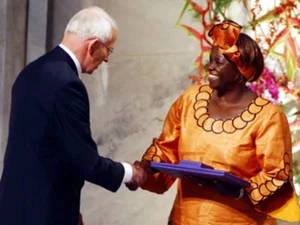
She was the first African woman to receive the award.
The committee honoured her contribution to sustainable development, democracy and peace.
The choice expanded the conventional meaning of peace.
Maathai had not negotiated a treaty.
She had not ended a war through diplomacy.
She had not commanded a peacekeeping force.
Her work demonstrated that peace begins long before formal conflict.
When forests disappear, water becomes scarce.
When land is concentrated, communities are displaced.
When people cannot meet basic needs, competition intensifies.
When governments distribute resources corruptly and silence criticism, resentment grows.
Environmental destruction does not automatically cause war.
But it can deepen the conditions through which conflict, inequality and authoritarianism thrive.
The Nobel Committee recognised this wider architecture of peace.
Protecting ecosystems was not separate from protecting societies.
The Nobel Lecture
In Oslo on 10 December 2004, Maathai connected personal memory, African experience and global responsibility.
She spoke about growing up in a landscape where streams carried clear water and forests appeared secure.
She described returning to find ecosystems degraded and communities struggling.
She credited rural women with helping her understand how closely environmental destruction affected daily survival.
Her lecture also insisted that ecological restoration required democratic governance.
Citizens had to participate in decisions affecting their resources.
Leaders had to be accountable.
Cultural values that respected the natural world had to be recovered rather than dismissed as backward.
Her central argument was not that humanity needed to return nostalgically to the past.
It was that development without ecological or moral limits would destroy the foundations upon which development depended.
She stated that sustainable development, democracy and peace were indivisible.
The phrase summarised decades of lived experience.
She had begun with trees.
The roots had led everywhere.
Science and Community Knowledge
Maathai’s scientific background mattered deeply.
She understood biological systems, soil, reproduction and ecological interdependence.
But she rejected the idea that expertise should flow in only one direction.
Professional foresters initially doubted that rural women could raise trees effectively.
Maathai’s answer was not to replace one elite with another.
She simplified techniques.
Encouraged experimentation.
Accepted failure.
Rewarded survival.
The women became skilled through practice.
This approach challenged a common pattern in international development.
Outside experts often arrive with technical plans created far from the communities expected to implement them.
Success is measured through reports, funding cycles and short-term targets.
Local people become recipients rather than authors.
The Green Belt Movement worked best when communities identified their own needs and maintained responsibility for the outcome.
Its knowledge was scientific, but not remote.
Practical, but not anti-intellectual.
Local, but connected to global environmental questions.
Maathai stood between worlds without accepting that any single world possessed all wisdom.
Culture, Christianity and the Environment
Maathai remained influenced by Christianity throughout her life.
She also increasingly emphasised African cultural traditions that had protected forests, water sources and communal obligations.
These influences were not always easy to reconcile.
Colonial Christianity had often dismissed Indigenous beliefs as superstition.
Modern development policies likewise treated sacred groves and customary restrictions as obstacles to economic use.
Maathai asked what ecological knowledge had been lost when those traditions were abandoned.
A sacred tree might be scientifically understood as a keystone of a local water system.
A taboo against cutting in a particular place might preserve biodiversity.
The cultural explanation and biological explanation did not need to be identical for both to produce protection.
In her later writing, she explored spiritual values as part of environmental restoration.
The Earth could not be repaired only through regulation.
People also needed to recover humility, gratitude and restraint.
Without those values, technological solutions might simply create more efficient methods of exploitation.
The Congo Basin and International Work
Maathai’s concerns extended beyond Kenya.
She supported efforts to protect the forests of the Congo Basin, one of the world’s most important tropical forest regions.
She became involved in international environmental initiatives and served as a goodwill ambassador for the Congo Basin Forest ecosystem.
She also addressed the United Nations and participated in global discussions on governance, women and sustainability.
Her international stature never erased the local origin of her work.
She did not begin by attempting to solve climate change for the entire planet.
She began by listening to women who needed firewood and clean water.
The global significance emerged because the local relationships were real.
This gave her international advocacy unusual credibility.
She was not describing environmental crisis only through statistics.
She had watched seedlings die.
Seen streams disappear.
Faced people who profited from forest destruction.
And stood beside communities rebuilding damaged land.
Writing and Public Thought
Maathai authored several books explaining both her life and philosophy.
The Green Belt Movement documented the organisation’s development and practical approach.
Unbowed, her memoir, connected her personal history with Kenya’s political and environmental transformation.
The Challenge for Africa examined governance, culture, development and the continent’s relationship with international systems.
Replenishing the Earth explored the ethical and spiritual values required for environmental healing.
Her writing expanded the image of Maathai beyond activism.
She was not simply a charismatic figure associated with tree planting.
She was a political thinker.
She examined why postcolonial states reproduced colonial structures.
Why citizens accepted disempowerment.
Why leaders manipulated ethnicity.
Why development programmes failed when communities lacked ownership.
And why environmental responsibility required changes in both institutions and personal values.
The Green Belt Movement and the Nelson Mandela Foundation identify these four works among her principal publications.
Criticism and Controversy
No serious profile should turn Maathai into a figure beyond criticism.
Her statements regarding HIV/AIDS in 2004 caused controversy when she appeared to suggest that the virus had been deliberately created or used against Africans.
She later stated that her comments had been misunderstood and affirmed that the origins of HIV should be addressed through scientific evidence.
The episode troubled public-health experts and complicated the period surrounding her Nobel recognition. Nobel’s own historical summary records both the criticism and her response.
Acknowledging this does not erase her achievements.
It places them within a complete human life.
People capable of exceptional insight in one area can make poorly evidenced or damaging statements in another.
Respect does not require silence about error.
Maathai’s scientific career makes the controversy particularly important, because scientific authority carries responsibility beyond one’s original speciality.
Her legacy is strong enough to withstand an honest account.
Illness and Death
Wangari Maathai was diagnosed with ovarian cancer.
She died in Nairobi on 25 September 2011, aged seventy-one.
Her death brought tributes from environmentalists, political leaders, women’s organisations and communities around the world.
She left behind three children, an international movement and landscapes physically changed by the work she inspired.
The most fitting memorials were not statues.
They were living trees.
Each one continued the work quietly:
Holding soil.
Sheltering water.
Creating shade.
Producing seeds.
The Green Belt Movement After Maathai
The Green Belt Movement continued after its founder’s death.
Its work expanded beyond planting to watershed restoration, climate resilience, environmental education, advocacy and the strengthening of community livelihoods.
The organisation reports that more than fifty-one million trees have been planted in Kenya through its work.
The figure is impressive.
But movements cannot be measured only by totals.
A tree planted without protection may die.
A forest restored without public accountability may later be allocated to developers.
A community project without local ownership may disappear when external funding ends.
Maathai’s deeper legacy therefore lies in the combination of restoration and citizenship.
Plant the tree.
Understand why the forest disappeared.
Question who benefited.
Protect the public land.
Teach others.
Hold leaders accountable.
Without that complete chain, environmentalism risks treating symptoms while leaving the cause untouched.
Wangari Maathai Institute
Before her death, Maathai worked with the University of Nairobi towards the establishment of an institute connecting environmental governance, peace and experiential learning.
The Wangari Maathai Institute for Peace and Environmental Studies was established by the university and later developed programmes intended to unite academic study with direct community engagement.
In 2010, Maathai became its founding distinguished chair.
The institute reflects the full arc of her life.
She began as a university scientist.
Moved into community organising.
Entered democratic activism.
Served in government.
And returned to higher education with a vision in which knowledge would not remain confined to classrooms.
The institute’s purpose is not simply to preserve her name.
It is to address the question her career repeatedly raised:
How can learning become responsible action?
The Meaning of “Unbowed”
Maathai titled her memoir Unbowed.
The word captures her public image.
She faced professional discrimination.
Marital humiliation.
Political ridicule.
Police violence.
Detention.
Physical attack.
Electoral obstruction.
She did not become invulnerable.
She was frightened, hurt and sometimes strategically defeated.
Being unbowed did not mean feeling no pain.
It meant refusing to accept humiliation as proof that the powerful were right.
Authoritarian systems often seek more than compliance.
They seek internal surrender.
They want the person being attacked to accept the description imposed upon them:
Difficult.
Unwomanly.
Disloyal.
Uneducated.
Dangerous.
Insignificant.
Maathai repeatedly declined those definitions.
She continued to speak as a scientist when politicians dismissed her.
As a citizen when officials treated public land as private property.
As a woman when men suggested public authority was not hers to claim.
Her refusal was not merely personal resilience.
It prevented political power from controlling the meaning of her actions.
Barriers She Faced
Wangari Maathai confronted several forms of power at once.
She lived under colonial rule and then within a postcolonial state that retained many authoritarian habits.
She entered scientific institutions dominated by men.
She challenged employment policies that treated women as dependants.
She organised rural women whose labour was essential but politically undervalued.
She opposed a government willing to use police violence and public humiliation against critics.
She defended land desired by wealthy and politically connected interests.
Her identity intensified the resistance she faced.
She was an African woman confronting both international assumptions about expertise and domestic assumptions about gender.
She was highly educated, which made it difficult to dismiss her as uninformed.
She worked with rural women, which made it difficult to isolate her as an elite academic.
She spoke internationally, which made it harder for the government to silence her without scrutiny.
And she planted trees, an activity so visibly constructive that attempts to portray her as destructive often exposed the insecurity of her opponents.
Environmental Justice Before the Phrase Became Familiar
Today, environmental justice describes the unequal distribution of environmental harm and access to resources.
Poor communities are more likely to experience polluted water, damaged soil, unsafe housing and climate vulnerability.
Women often absorb the additional labour created when water, fuel and food become scarce.
Maathai was practising environmental justice before the phrase became globally familiar.
She did not ask only how many trees Kenya possessed.
She asked who suffered when they disappeared.
Who walked farther.
Who went hungry.
Who profited from the timber.
Who received the land.
Who had a voice in the decision.
This transformed conservation from a project of protecting nature from people into a project of protecting the relationship between people and nature.
Rural communities were not the enemy of forests.
They could become their strongest defenders when their survival and authority were recognised.
Why the Nobel Prize Was for Peace
Some questioned why an environmentalist received the Nobel Peace Prize.
The question assumed that peace begins only after violence has already erupted.
Maathai worked further upstream.
A society becomes less peaceful when basic resources disappear.
When land is stolen.
When leaders use ethnic identity to direct anger away from corruption.
When citizens cannot question decisions.
When women’s labour increases while their authority remains limited.
When public resources become rewards for political loyalty.
Tree planting could not solve every one of these problems.
But the movement surrounding it created a method for confronting them.
Restore the environment.
Strengthen livelihoods.
Educate citizens.
Build local organisation.
Demand accountability.
Reduce the conditions through which conflict and authoritarianism gain strength.
The Nobel Committee’s decision recognised this larger understanding of peace. It described her approach as joining ecological sustainability with democracy, human rights and women’s rights.
Legacy
Wangari Maathai changed environmental history in at least four ways.
First, she demonstrated that local ecological repair could reach enormous scale without beginning as a centralised government programme.
Second, she placed rural women at the centre of environmental leadership.
Third, she connected conservation with democratic accountability.
Fourth, she expanded the meaning of peace to include humanity’s relationship with the natural systems sustaining life.
Her legacy can be seen in protected public spaces such as Uhuru Park and Karura Forest.
It survives in the Green Belt Movement.
In university programmes.
In community nurseries.
In climate activism led by younger African environmentalists.
And in the simple idea that planting a tree can be both practical and political.
She also left an intellectual warning.
Environmental language can be emptied of meaning.
Governments can celebrate tree-planting days while permitting forests to be destroyed.
Corporations can advertise sustainability while extracting resources elsewhere.
International institutions can speak about community empowerment while designing programmes that leave communities dependent.
Maathai’s example demands more than symbolic greenness.
It asks who controls the land.
Who participates.
Who benefits.
And whether environmental action changes power as well as scenery.
Why Wangari Maathai Matters
Wangari Maathai matters because she refused to accept the boundaries placed around problems.
She was told that women’s difficulties were domestic.
She recognised environmental degradation.
She was told that tree planting was non-political.
She followed the roots into corruption and land ownership.
She was told that educated professionals should direct rural communities.
She treated rural women as partners and experts.
She was told that protecting a park obstructed development.
She asked whom that development served.
She was told that respectable women did not confront presidents, police or developers.
She confronted them anyway.
Her work embodies a central truth:
The environment is not a background against which human history takes place.
It is part of the history.
Forests shape economies.
Water shapes health.
Soil shapes food.
Land shapes power.
And the people whose labour depends most directly upon those systems often understand their deterioration first.
Maathai listened to those people.
Then she helped transform observation into action.
She did not save Kenya’s environment alone.
Millions of seedlings died.
Forests remain threatened.
Climate change has intensified.
Political corruption did not disappear.
Her achievement was not perfection.
It was mobilisation.
She showed that ordinary people could restore something.
That restoration could produce confidence.
That confidence could lead to questions.
And those questions could challenge systems that once appeared immovable.
Wangari Maathai planted trees because communities needed fuel, food, water and soil.
She defended them because citizens needed democracy.
She connected them because humanity needed peace.
Final Reflection
Wangari Maathai began by listening.
Rural women did not approach her with theories of environmental governance.
They spoke about daily life.
The walk for firewood was longer.
The streams carried less water.
The soil produced less food.
Their children were hungry.
Maathai listened closely enough to recognise that these were not isolated complaints.
They were evidence.
The trees had gone.
And with them had gone shade, moisture, fuel, fertility and security.
Her answer was simple enough to be dismissed.
Plant trees.
But the simplicity was deceptive.
To plant a tree was to restore soil.
To organise a nursery was to create knowledge.
To pay women for surviving seedlings was to recognise their labour.
To defend a forest was to question ownership.
To question ownership was to confront corruption.
To confront corruption was to demand democracy.
And to demand democracy in an authoritarian state was to risk everything.
This is why Maathai’s story cannot be reduced to environmental inspiration.
She was not merely the woman who planted trees.
She was the woman who followed their roots.
She followed them into the soil and discovered erosion.
Into villages and discovered inequality.
Into government offices and discovered corruption.
Into public parks and discovered contested ownership.
Into prisons and protest camps and discovered the price of dissent.
Then she followed them outward again—towards community, citizenship, peace and the generations who would inherit the land.
Her opponents called her troublesome because she would not remain within the category assigned to her.
Scientist.
Woman.
Mother.
Activist.
Politician.
Environmentalist.
She refused to accept that any one label should limit what she was permitted to understand or challenge.
Wangari Maathai showed that power does not always begin in parliament.
Sometimes it begins in a seed held between a person’s fingers.
A seed is small.
It can be crushed.
Ignored.
Swept aside.
But when it is planted, protected and joined by thousands of others, it changes the ground itself.
That was her work.
Not simply planting trees within the existing landscape—
but helping people realise that together, they could transform it.
Key Achievements
Key Achievements
- Became the first woman in East and Central Africa to earn a doctorate, receiving her PhD from the University of Nairobi in 1971.
- Became the first indigenous woman in the region to chair a university department and later become an associate professor.
- Founded the Green Belt Movement in 1977 through the National Council of Women of Kenya.
- Helped build a women-led environmental movement linking reforestation with livelihoods, civic education and democratic participation.
- Played a central role in protecting Nairobi’s Uhuru Park from commercial development.
- Opposed the allocation of Karura Forest to private developers and endured physical attack while defending it.
- Supported mothers of political prisoners at Freedom Corner and campaigned against authoritarian rule.
- Was elected to Kenya’s parliament in 2002 and later served as Assistant Minister for Environment and Natural Resources.
- Became the first African woman to receive the Nobel Peace Prize in 2004.
- Demonstrated that sustainable development, democracy, human rights and peace are inseparable.
Key Dates
Born in the Nyeri region of colonial Kenya on 1 April.
Begins formal schooling at Ihithe Primary School.
Studies at Mathari Intermediate School and Loreto High School, Limuru.
Travels to the United States through the educational initiative widely known as the Kennedy Airlift.
Graduates from Mount St Scholastica College with a degree in biological sciences.
Earns a master’s degree from the University of Pittsburgh and returns to Kenya.
Joins the University College of Nairobi in veterinary anatomy.
Conducts doctoral research partly through the Nairobi–Giessen partnership in Germany.
Receives her doctorate from the University of Nairobi, becoming the first woman in East and Central Africa to earn a PhD.
Becomes chair of the Department of Veterinary Anatomy.
Becomes an associate professor and establishes the Green Belt Movement through the National Council of Women of Kenya.
Campaigns for women’s equal employment rights and becomes increasingly active in national women’s organisations.
Attempts to enter parliamentary politics but is prevented from contesting after resigning her university position.
The Green Belt Movement expands its tree nurseries, community education and women-led conservation work.
Leads opposition to the proposed Kenya Times commercial complex in Nairobi’s Uhuru Park.
The Uhuru Park project collapses after investors withdraw.
Is arrested during pro-democracy activity and supports mothers of political prisoners at Freedom Corner.
Campaigns against political repression, ethnic violence and the allocation of public land.
Is injured during an attack on activists attempting to plant trees in Karura Forest.
Elected as member of parliament for Tetu during Kenya’s major democratic transition.
Appointed Assistant Minister for Environment and Natural Resources.
Awarded the Nobel Peace Prize for her contribution to sustainable development, democracy and peace.
Completes her service as assistant minister.
Publishes her memoir, Unbowed.
Publishes The Challenge for Africa.
Becomes founding distinguished chair of the Wangari Maathai Institute for Peace and Environmental Studies.
Publishes Replenishing the Earth.
Dies from ovarian cancer in Nairobi on 25 September.
The African Union establishes the joint commemoration of Africa Environment Day and Wangari Maathai Day in recognition of her work.
Did You Know?
Did You Know?
- She was a trained veterinary anatomist: Maathai’s doctorate concerned the development of bovine reproductive anatomy. Environmental activism was not an alternative to her scientific career; it grew partly from the analytical habits that career developed.
- She was the first woman in East and Central Africa to earn a doctorate: She received her PhD from the University of Nairobi in 1971.
- The Green Belt Movement began through a women’s organisation: It was established in 1977 under the auspices of the National Council of Women of Kenya rather than beginning as a conventional conservation agency.
- Tree planting created income: Women’s groups received small payments when planted trees survived, linking ecological restoration with livelihoods and local responsibility.
- She helped save Uhuru Park: Her opposition to a government-supported commercial development helped preserve one of Nairobi’s central public green spaces.
- She was beaten while defending Karura Forest: In 1999, Maathai and fellow activists were attacked while trying to plant trees in an area threatened by private development.
- She won election by an overwhelming margin: After years of political obstruction, she was elected to parliament for Tetu in 2002 and subsequently appointed an assistant environment minister.
- She was the first African woman awarded the Nobel Peace Prize: She received the prize in 2004, and her selection helped establish environmental protection as a central question of peace and security.
- The Green Belt Movement continued after her death: The organisation now reports more than fifty-one million trees planted in Kenya since its founding.
Further Reading
- Wangari Maathai, Unbowed: A Memoir
The fullest personal account of her childhood, education, academic career, environmental organising and confrontations with the Kenyan government. - Wangari Maathai, The Green Belt Movement
An explanation of the movement’s origins, community methods and environmental philosophy. - Wangari Maathai, The Challenge for Africa
A broader examination of governance, identity, development and responsibility across the continent. - Wangari Maathai, Replenishing the Earth
Her exploration of spiritual values, cultural memory and environmental repair. - Wangari Maathai’s 2004 Nobel Lecture
A concise expression of her belief that sustainable development, democracy and peace cannot be separated.
Image Credits
Wangari Maathai in Nairobi: Wikimedia Commons image supplied through the website media library. Confirm the original photographer, date and licence details against the Commons file page before publication.
Mount Kenya landscape: Wikimedia Commons photograph supplied through the website media library. Confirm the photographer, date and licence details against the Commons file page before publication.
Wangari Maathai receiving the Nobel Peace Prize: Photograph by John McConnico, Pressens Bild AB, 10 December 2004. Copyright © Pressens Bild AB 2004. Retain this credit and ensure that website use is covered by the source’s permission or licensing terms.
Explore Related Profiles
Help Keep These Stories Alive
If you enjoyed reading this profile and believe more overlooked voices deserve to be heard, you can help fund future research, writing, and free educational resources.
Every contribution—whether a one-off donation or monthly support—helps create new historical profiles, downloadable materials, and articles that remain freely available to everyone.
Thank you for helping history reach more people.
