

Enheduanna
Historical Profile
Recovering Enheduanna
Introduction
For more than four thousand years, Enheduanna’s name remained buried among the ruins and written remains of ancient Mesopotamia. The temples in which she served were rebuilt repeatedly and eventually abandoned. The Akkadian dynasty disappeared, Sumerian ceased to be spoken as an everyday language, and cuneiform writing itself became unreadable. Although texts associated with Enheduanna had once circulated among Mesopotamian scribes, the cultural tradition that preserved them eventually came to an end.
Her return to history began during excavations at Ur in the 1920s. Archaeologists working in the sacred complex associated with the high priestess of the moon god Nanna uncovered fragments of a circular calcite disk. Once reconstructed, the disk revealed a ritual scene centred upon a woman wearing ceremonial clothing and a distinctive head covering. An inscription on the reverse identified her as Enheduanna, high priestess of Nanna and daughter of Sargon, king of Akkad.
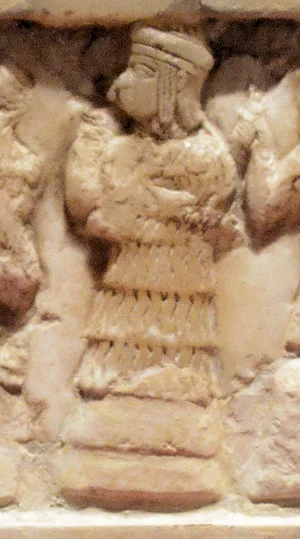
Other objects from the same complex named members of her household, confirming that she occupied an organised religious institution rather than a purely symbolic position. At the same time, scholars studying Sumerian literary tablets began to connect the priestess known from archaeology with compositions in which a woman called Enheduanna spoke in the first person about religious authority, political expulsion, humiliation, prayer and restoration.
The evidence securely establishes Enheduanna as a historical woman who held one of the most important religious offices in southern Mesopotamia during the Akkadian period. The relationship between that woman and the surviving literary works attributed to her is more complicated. The principal manuscripts were copied centuries after her lifetime, and scholars continue to debate how much of their wording originated with Enheduanna herself, how much was transmitted through her institutional circle and how extensively later scribes reshaped the compositions.
This uncertainty does not diminish her significance. It places Enheduanna at the centre of several related histories: the political integration of the Akkadian Empire, the religious authority of women in ancient Mesopotamia, the development of named literary identity and the modern recovery of voices once lost to historical memory.
A Name Connected with Office
The name Enheduanna is generally interpreted as meaning “high priestess, ornament of heaven.” It was probably a ceremonial or official name adopted when she entered the service of Nanna at Ur, rather than necessarily the personal name given to her at birth. No other name can be securely associated with her.
This limitation is typical of ancient biography. The surviving record does not begin with Enheduanna’s childhood, education or family relationships. It begins when her identity becomes connected with institutions powerful enough to preserve it: the Akkadian dynasty, the temple of Nanna and the system of royal and religious inscription.
Enheduanna is identified as a daughter of Sargon of Akkad, the founder of the dynasty that extended political authority over much of Mesopotamia during the later third millennium BCE. Her mother is not identified in surviving contemporary evidence. Later retellings have sometimes described her as Sumerian or as a priestess, but these claims remain speculative.
Her place of birth and upbringing are also unknown. As a royal daughter intended for high religious office, she probably received an elite education and would have needed familiarity with ritual, temple administration, offerings and the religious traditions of southern Mesopotamia. She may also have been familiar with both Akkadian and Sumerian, although the precise extent of her linguistic education cannot be reconstructed.
Enheduanna therefore enters the historical record as an adult woman already situated at the meeting point of royal authority and sacred office.
Sargon and the Akkadian Expansion
Before the rise of Sargon, southern Mesopotamia consisted of a network of cities including Ur, Uruk, Lagash, Nippur and Kish. These cities possessed long-established rulers, temples, patron deities and local political traditions. Their identities were closely connected with their religious institutions, and each city understood itself partly through its relationship with a particular god or goddess.
Sargon’s conquests altered this political landscape. From Akkad, a city whose precise archaeological location has not been securely identified, he defeated rival rulers and established authority across both Akkadian-speaking northern Mesopotamia and the Sumerian-speaking south.
The Akkadian Empire should not be imagined as a modern territorial state with uniform administration. Its authority depended upon military victories, local governors, tribute, dynastic connections, garrisons and the continued cooperation of cities whose traditions were much older than the dynasty itself. Conquest could secure obedience, but it could not automatically create legitimacy.
Religious institutions therefore remained essential. By appointing his daughter high priestess of Nanna at Ur, Sargon linked his family with one of the most important sacred centres in southern Mesopotamia. The appointment helped position the Akkadian dynasty as a participant in the religious order of the south rather than as a purely external military power.
This was clearly a political act, but it should not be reduced to political symbolism alone. Once installed, Enheduanna occupied an office with its own history, ritual authority, household and economic resources. Her position derived partly from Sargon, but it also drew legitimacy from the temple of Nanna and the traditions of Ur.
Ur and the Sacred Household of Nanna
Ur was one of the major urban centres of southern Mesopotamia. Located near the Euphrates, it formed part of the irrigated landscape that supported some of the earliest large cities in human history. Its patron deity was Nanna, the moon god, known in Akkadian as Sîn.
The moon possessed both practical and religious importance. Lunar cycles helped organise calendars, festivals and systems of timekeeping. Nanna was associated with the ordering of months, divine judgement and the rhythms through which temple and agricultural life could be regulated.
The principal temple complex at Ur formed the sacred centre of the city. Later rulers rebuilt and expanded it, producing the monumental ziggurat whose remains still dominate the site, but Enheduanna lived centuries before the surviving structure reached its best-known form.

Her official residence was associated with the giparu, a sacred complex connected with the office of the high priestess. The exact daily duties of an en priestess cannot be reconstructed in complete detail, and modern accounts sometimes attribute a broader range of functions to Enheduanna than the surviving evidence can support directly.
Her position nevertheless carried substantial authority. She probably participated in major rituals and offerings, presided over an organised household and exercised influence within an institution that managed land, stored produce, animals, workshops and dependent labour. Mesopotamian temples were not separate from economic and political life; they were among the most important institutions within the city.
The high priestess therefore occupied a role that was simultaneously religious, administrative and political.
Daughter of the King and Representative of the God
The Disk of Enheduanna identifies her through two relationships. She was the daughter of Sargon and the high priestess of Nanna.
These identities expressed different forms of authority. Her place within the royal dynasty connected her with Akkadian power, while her priestly office linked her with the sacred order of Ur. The high priestess was sometimes understood as the ritual spouse or earthly representative of the divine consort of Nanna, though this relationship should not be interpreted as an ordinary human marriage.
Sargon could appoint his daughter, but once Enheduanna entered office, her authority operated through a religious system whose legitimacy did not depend entirely upon him. She could speak as a recognised participant in the sacred traditions of southern Mesopotamia rather than simply as an official carrying commands from Akkad.
The literary works associated with Enheduanna present intense devotion, particularly towards the goddess Inanna. It is impossible to know how closely every expression reflects the private beliefs of the historical woman, but there is no reason to assume that her religious role was merely a political performance. In ancient Mesopotamia, worship, kingship, war, agriculture and law were all understood within a shared sacred order.
For Enheduanna, political and religious commitments may therefore have been inseparable.
The Disk of Enheduanna
The most direct surviving image associated with Enheduanna appears on a circular calcite disk approximately twenty-five centimetres in diameter. It was discovered broken during excavations at Ur and later reconstructed.
One side contains an inscription naming Enheduanna as high priestess of Nanna and daughter of Sargon. The other depicts a ritual scene. At its centre stands a woman wearing a long flounced garment and ceremonial head covering. She is shown at a larger scale than the attendants around her, following an artistic convention in which physical size expressed status rather than literal height.
The central figure is generally identified as Enheduanna. The identification is highly persuasive because the inscription names her and because her visual prominence corresponds with the office described. The image should not, however, be treated as a modern portrait intended to preserve her exact facial appearance. It presents her public and ritual identity rather than an individual likeness in the later portrait tradition.
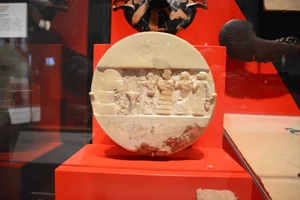
The disk shows Enheduanna participating in or presiding over a ceremonial act involving libation. She does not appear as a passive royal daughter standing behind a king. She occupies the visual centre of the composition.
This does not mean that women generally possessed equal authority within Mesopotamian society. Enheduanna belonged to the royal family and held an exceptional office. Nevertheless, the disk provides clear evidence that a woman could exercise highly visible religious authority within one of the most important cults of the ancient city.
The Temple Hymns and a Sacred Landscape
The collection known as the Sumerian Temple Hymns praises temples associated with cities and deities across Mesopotamia. Each sanctuary is described according to its own sacred character, yet the collection brings these distinct places together within a larger religious framework.
The concluding lines identify Enheduanna as the compiler or creator of the tablet and state that something previously unknown had been brought into being. This ancient attribution forms one of the principal foundations for associating the collection with her.
If the attribution reflects historical authorship, Enheduanna did more than compose isolated praise poems. She organised the sacred centres of several cities into a coherent theological vision. For this reason, she has been described as an early systematic theologian.
The political implications are significant. The Akkadian dynasty governed cities with strong local identities. A literary collection that honoured many temples could acknowledge their individual traditions while placing them within a shared sacred order. Such a framework would have been well suited to a dynasty seeking to integrate politically diverse regions without erasing their local gods.
The hymns should not be understood as simple propaganda. Their political effect was more subtle. By presenting the temples of different cities as parts of one religious landscape, they offered a theological language through which imperial unity could be imagined.
Enheduanna’s own position made her especially suited to such a task. She belonged to the ruling house of Akkad, served the ancient god of Ur and was remembered through literature written in Sumerian.
Inanna and the Theology of Power
Although Enheduanna served Nanna at Ur, the goddess most closely associated with her literary memory is Inanna.
Inanna was connected with love, sexuality, fertility, warfare, royal authority and violent transformation. Her Akkadian counterpart, Ishtar, became one of the most powerful deities in the Mesopotamian world.
The goddess does not fit easily into a single category. She grants kingship but can also destroy cities. She is associated with attraction, abundance and fertility, but also with battle, upheaval and the reversal of established status.
The hymns linked with Enheduanna emphasise this overwhelming power. Inanna appears capable of altering political and cosmic order, humiliating enemies and determining who possesses legitimate authority.
This emphasis may have supported Akkadian royal ideology, since Ishtar held particular importance within the dynasty. By elevating Inanna in Sumerian-language compositions, Enheduanna may have helped connect southern religious traditions with the deity honoured by the rulers of Akkad.
Political usefulness, however, need not exclude sincere devotion. The poetry presents Inanna as a dangerous and independent divine power rather than a decorative symbol of government. Even those who appeal to her must approach with awe and uncertainty.
Rebellion, Expulsion and Restoration
The composition usually called The Exaltation of Inanna contains the most personal narrative associated with Enheduanna. Within it, a speaker identifying herself as Enheduanna describes being removed from office by a man named Lugal-Ane. She is expelled from the sanctuary, deprived of authority and subjected to humiliation and danger.
The historical setting is generally connected with rebellions against Akkadian rule, probably during the reign of Naram-Sin, Sargon’s grandson. A ruler called Lugal-Ane appears to have claimed authority at Ur or within the surrounding region.
Enheduanna’s position would have made her politically significant to any rebel ruler. As both Sargon’s daughter and high priestess of Nanna, she embodied the relationship between Akkadian dynastic authority and the sacred institutions of Ur. Removing her would therefore have challenged both political and religious legitimacy.
The poem presents her expulsion as more than personal misfortune. The displacement of the priestess becomes evidence that sacred order itself has been violated. Enheduanna first appeals to Nanna, but when relief does not come, she turns with greater urgency to Inanna.
The precise details remain uncertain. The poem survives in later manuscript copies, and literary language cannot be treated as a straightforward administrative report. The chronology of Lugal-Ane’s rebellion and the relationship between the poem and known political events remain debated.
Nevertheless, the tradition clearly remembered Enheduanna as a priestess whose office became vulnerable during political revolt.
Her removal also threatened the identity expressed by her name and title. Her public standing, household, ritual role and connection with Ur all depended upon the office from which she had been expelled.
Within The Exaltation of Inanna, prayer functions as a form of political action. The speaker praises Inanna, describes the wrong committed against her and appeals for divine intervention. The composition defends Enheduanna’s legitimacy while associating the defeat of rebellion with the restoration of sacred order.
The poem therefore combines several forms of expression that modern readers might separate: hymn, political argument, personal testimony and theological interpretation.
The rebellion was eventually defeated, probably under Naram-Sin, and the literary tradition presents Enheduanna as restored to office. No independent administrative record confirms every detail of this return, but the composition resolves the crisis through renewed religious and dynastic authority.
The Question of Authorship
Enheduanna is often described as the earliest author known by name. The claim is important, but it requires careful explanation.
Several compositions identify Enheduanna, speak in her voice or are associated with her through ancient attribution. The Temple Hymns name her in their conclusion. The Exaltation of Inanna includes a first-person speaker who identifies herself as Enheduanna. Other works, including A Hymn to Inanna and Inanna and Ebih, have also been attributed to her with varying degrees of confidence.
The surviving manuscripts, however, were not written during Enheduanna’s lifetime. Most belong to later periods, particularly the Old Babylonian era, several centuries after the Akkadian dynasty. These texts were copied within scribal schools and may preserve works that had passed through generations of transmission, adaptation and linguistic change.
No surviving tablet can be identified securely as having been written by Enheduanna’s own hand.
Physical writing is not the only possible definition of authorship. Ancient rulers, priests and officials could compose, dictate, commission, revise or authorise texts that professional scribes then wrote. A person might therefore function as an author without personally pressing the cuneiform signs into clay.
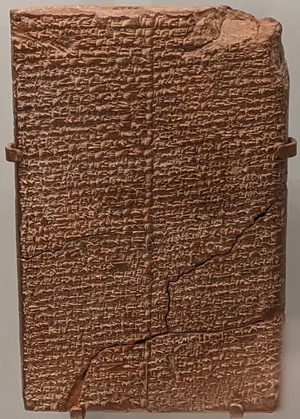
The more difficult question is whether the surviving compositions originated substantially with the historical Enheduanna or whether later scribes created works around her remembered identity.
Scholars remain divided. Those who support her authorship point to the explicit ancient attributions, the first-person biographical details, the correspondence between her known political position and the setting of the poems, and the unusual preservation of her name within a literary culture where many compositions remained anonymous.
More sceptical interpretations emphasise the late date of the manuscripts, the possibility of extensive scribal revision, the linguistic distance between the Akkadian period and the surviving copies, and the fact that first-person narration does not by itself prove historical authorship.
The most cautious conclusion is that Enheduanna is the earliest historical individual to whom a substantial body of literature was attributed by ancient tradition and whose identity appears within that literature as a speaking and creating presence.
That conclusion remains significant even if later scribes altered the wording.
Authorship in Cuneiform Culture
Modern readers often imagine an author as a single individual composing an original work privately and retaining control over its final wording. This model does not fit easily with cuneiform literary culture.
Texts were copied by hand and could circulate in multiple versions. Scribes learned through repetition and reproduction. Teachers, students and copyists could correct, expand, abbreviate or reshape compositions over time.
Enheduanna may have originated poems that were later transmitted and revised, dictated or supervised works written by trained scribes, or contributed to compositions produced within her institutional household. These possibilities do not make authorship meaningless; they demonstrate that authorship operated differently within ancient Mesopotamian institutions.
The continued association of Enheduanna’s name with these works is itself historically important. Ancient literary compositions were often transmitted anonymously. The preservation of her identity suggests that later scribes considered the person of Enheduanna essential to the meaning or authority of the texts.
Language, Transmission and Translation
The works associated with Enheduanna were composed in Sumerian. By the Old Babylonian period, when many surviving copies were produced, Sumerian was no longer the ordinary spoken language of most Mesopotamians. It remained a language of scholarship, ritual and literary prestige.
This long history of transmission both preserved the works and complicated them. Without generations of scribes copying older compositions, Enheduanna’s literary tradition might have disappeared. Each act of copying, however, created opportunities for alteration.
Modern translation introduces further uncertainty. Sumerian grammar, divine terminology, poetic structure and wordplay do not always correspond directly with English. Tablets may be damaged, signs may support more than one reading, and different manuscripts may preserve different versions.
Translations of Enheduanna can therefore vary considerably. Some present the works in highly personal and modern language, while others remain formal and closer to the structure of the Sumerian. Neither should be assumed to reproduce the original voice without interpretation.
Reading Enheduanna therefore requires attention to several layers: the possible original composition, later scribal transmission, modern reconstruction and translation.
Scribal Education and Later Preservation
The survival of works associated with Enheduanna indicates that they held value within Mesopotamian scribal education.
Scribal students learned by copying signs, lexical lists, legal and administrative documents and literary texts. Cuneiform writing required mastery of a large number of signs with multiple possible meanings and readings.
Copies of compositions linked to Enheduanna have been found in contexts associated with scribal learning. This suggests that later students encountered her name and works as part of their education, centuries after the Akkadian Empire had ended.
Her disappearance from history was therefore not immediate. The literary tradition continued to preserve her. Only after cuneiform literacy disappeared did the tablets become silent to later readers.
Her words survived physically, but the ability to understand them was lost.
Death and the End of the Historical Record
The date and circumstances of Enheduanna’s death are unknown.
Some reconstructions suggest that she remained high priestess across several reigns and may have continued in office into the reign of Naram-Sin. If the rebellion described in The Exaltation of Inanna belongs to that period, she must have held the office for many years.
The precise birth and death dates sometimes assigned to her should therefore be treated as estimates rather than established facts.
No securely identified tomb or funerary inscription records her death. No surviving narrative describes her final years.
She disappears from the historical record through the office by which she entered it. The institution continued, and later rulers also appointed royal daughters as high priestesses of Nanna, demonstrating the lasting political importance of the position.
Archaeological Rediscovery
Ur remained an important city for centuries after Enheduanna’s lifetime. Its temples were rebuilt repeatedly, and later rulers left inscriptions and monuments within the same sacred landscape.
The city eventually declined, and its buildings were covered by accumulated debris and erosion. Knowledge of cuneiform disappeared, leaving the written remains unreadable.
Excavations at Ur between 1922 and 1934 were led by Leonard Woolley on behalf of the British Museum and the University Museum of the University of Pennsylvania. The expedition became famous for the Royal Cemetery, its rich burials and its spectacular objects.
Within the temple complex, archaeologists also uncovered fragments of the Disk of Enheduanna and seals associated with members of her household. These finds securely connected a daughter of Sargon with the office of high priestess at Ur.
Early interpretations did not immediately recognise the full significance of the discovery. Woolley described parts of the sacred complex using terms such as “nunnery” and “harem,” drawing upon categories familiar to modern European readers but not necessarily suited to the Mesopotamian institution.
The importance of Enheduanna emerged gradually as archaeologists, epigraphers and philologists connected the material finds from Ur with literary compositions preserved in later cuneiform copies.
In the mid-twentieth century, scholars increasingly recognised that the priestess named on the disk was also the woman identified in important Sumerian texts. The publication of The Exaltation of Inanna by William Hallo and J. J. A. van Dijk in 1968 played a major role in establishing Enheduanna’s place within literary history.
Her recovery therefore occurred in stages. Archaeology established the historical woman, while philology reconstructed the literary tradition associated with her.
Historical Interpretation
Enheduanna’s modern reputation has developed through several overlapping interpretations.
Older scholarship often treated her primarily as the daughter of Sargon and as evidence of the political strategies used by the Akkadian dynasty. Within this interpretation, her appointment at Ur was understood mainly as a means of securing control over southern Mesopotamia.
Later scholars placed greater emphasis upon her religious and literary authority. The Temple Hymns were interpreted as evidence of theological organisation, while The Exaltation of Inanna revealed a first-person voice describing political suffering and restoration.
From the 1970s onward, Enheduanna became increasingly important within women’s history and feminist scholarship. Her existence challenged the widespread assumption that the earliest literature and intellectual traditions belonged only to men.
This recovery was necessary, but it also created a tendency to assign modern identities to her. Enheduanna has sometimes been described as a feminist, philosopher, astronomer, mathematician or campaigner for women’s rights. These descriptions often go beyond what the surviving evidence can support.
There is no evidence that she argued for social or political equality between women and men. She was a royal woman whose authority depended partly upon dynasty, status and religious office. The works associated with her defend the sacred and political order in which she held power.
Her importance does not require her to be transformed into a modern activist. The evidence already demonstrates that she exercised substantial religious authority, occupied a significant political role and became central to an ancient literary tradition.
The authorship debate presents a further interpretive challenge. Legitimate reasons exist for caution because the manuscripts are later than Enheduanna’s lifetime and may preserve extensive scribal revision. At the same time, scepticism should be applied consistently. Ancient kings are often credited with inscriptions or compositions even when scribes physically produced them.
The most balanced position recognises both the uncertainty of direct authorship and the unusual importance ancient scribes attached to Enheduanna’s name and identity.
The Archive and Its Limitations
The surviving evidence for Enheduanna reflects the priorities of the institutions that preserved it.
The disk records her because royal descent and priestly office mattered. Seals record members of her household because administration required names and recognised authority. The literary compositions survived because scribal schools considered them worth copying.
What is missing is more personal.
Her birth name is unknown.
Her mother is unidentified.
Her childhood, education and private relationships cannot be reconstructed.
It is not known whether she wanted the office to which she was appointed or how she understood her relationship with Sargon’s conquests.
It is not possible to determine whether she thought of herself as Akkadian, Sumerian, both or neither in any modern ethnic sense.
The archive preserves Enheduanna as priestess, royal daughter and literary figure. It offers much less access to the woman beyond those roles.
These absences should not be filled through speculation. They should remain part of the historical interpretation.
What We Know — and What We Do Not
What We Know — and What We Do Not
Firmly Supported
- Enheduanna was a historical woman who lived during the Akkadian period in the third millennium BCE.
- She was a daughter of Sargon of Akkad.
- She served as high priestess of the moon god Nanna at Ur.
- Her name and titles appear on the Disk of Enheduanna.
- Objects naming members of her household or entourage were excavated at Ur.
- Her office possessed major religious and political significance.
- Ancient literary tradition associated her with hymns to Inanna and with the Sumerian Temple Hymns.
- The Exaltation of Inanna presents a first-person Enheduanna who is expelled from office during political rebellion.
- Later scribes copied works associated with her centuries after her lifetime.
Strongly Plausible
- Sargon appointed Enheduanna partly to connect his dynasty with the religious institutions of southern Mesopotamia.
- She exercised institutional and economic authority through the temple household.
- She was removed from office during a rebellion against Akkadian rule and later restored.
- At least part of the literary tradition associated with her originated during her lifetime or within her immediate institutional circle.
- She possessed substantial knowledge of Sumerian religion, ritual and literary culture.
Uncertain or Debated
- Her exact birth and death dates.
- Her birth name.
- The identity and background of her mother.
- Where she grew up and how she was educated.
- Whether she personally wrote cuneiform tablets with a stylus.
- How much of each surviving composition was created directly by her.
- How extensively later scribes revised earlier works.
- Whether all texts traditionally attributed to her belong to the same historical period.
- The precise chronology of her expulsion and restoration.
- The full range of her daily responsibilities as high priestess.
- Her private beliefs, relationships and understanding of Akkadian imperial power.
Key Contributions
Key Contributions
- Religious Leadership at Ur: Enheduanna occupied one of the most important priestly offices in southern Mesopotamia. Her position linked the Akkadian royal house with the cult of Nanna and the sacred institutions of Ur.
- Political Integration: Her appointment helped connect the new Akkadian dynasty with the older traditions of the Sumerian cities. She embodied a political and religious relationship that military conquest alone could not create.
- Theological Organisation: The Sumerian Temple Hymns associated with her brought together temples from different Mesopotamian cities within a shared sacred framework, preserving local distinctions while presenting them as parts of a wider religious order.
- The Elevation of Inanna: The works attributed to Enheduanna contributed to the development of Inanna as a deity of overwhelming political, military and cosmic authority, closely related to the Akkadian Ishtar.
- Named Literary Identity: Ancient scribes preserved Enheduanna’s name in connection with a substantial body of literature. This makes her one of the earliest historical individuals to appear as a recognised creative and speaking presence within surviving texts.
- Preservation through Scribal Culture: The continued copying of works associated with Enheduanna demonstrates their importance within later Mesopotamian education and literary tradition.
- Modern Historical Recovery: Her rediscovery illustrates how archaeology, epigraphy and philology can recover a historical person whose name and works had been unreadable for millennia.
Historical Confidence
Historical Confidence
⭐⭐⭐⭐⭐ Extensive archaeological and documentary evidence
Enheduanna’s existence, royal descent and office as high priestess of Nanna are securely supported by material evidence from Ur, including the Disk of Enheduanna and objects associated with her household.
Her political and religious importance is also strongly supported by the nature of her office and its connection with the Akkadian dynasty.
Greater uncertainty surrounds the literary corpus. The surviving manuscripts were copied centuries after her lifetime, and scholars disagree about how much of the wording originated directly with Enheduanna, how much was produced within her institutional circle and how extensively later scribes reshaped the texts.
The available evidence is therefore exceptionally strong for a historical figure of the third millennium BCE. Her existence, office and political importance are securely established through archaeology and inscriptional evidence, while direct authorship of every composition attributed to her remains the principal area of scholarly debate.
Key Dates
Sargon of Akkad establishes a dynasty that extends political authority over northern and southern Mesopotamia. The exact chronology remains debated.
Enheduanna is appointed high priestess of Nanna at Ur.
She occupies the sacred residence associated with the high priestess and presides over an organised religious household.
The Disk of Enheduanna is created, depicting a ritual scene and identifying her as priestess of Nanna and daughter of Sargon.
A rebellion associated with Lugal-Ane results in Enheduanna’s removal from office.
The events remembered in The Exaltation of Inanna take place, presenting her expulsion, appeal to Inanna and restoration.
Enheduanna is traditionally understood to have returned to office at Ur.
Royal women continue to occupy the high priestly office of Nanna.
Scribes copy and transmit compositions associated with Enheduanna.
Knowledge of cuneiform disappears, and Enheduanna’s name becomes unreadable.
Excavations at Ur uncover the sacred complex associated with the high priestess.
Fragments of the Disk of Enheduanna and objects connected with her household are excavated.
Scholars begin to connect the historical priestess known from archaeology with literary compositions preserved on cuneiform tablets.
William Hallo and J. J. A. van Dijk publish a major edition of The Exaltation of Inanna.
Enheduanna becomes increasingly important within literary history, religious studies, women’s history and debates concerning ancient authorship.
Did You Know?
Did You Know?
- Enheduanna’s name was probably ceremonial and may mean “high priestess, ornament of heaven.”
- Her birth name is unknown.
- Her mother has not been securely identified.
- She served Nanna at Ur, but the literary works associated with her give particular prominence to Inanna.
- The Disk of Enheduanna was found broken and had to be reconstructed.
- The image on the disk probably represents Enheduanna, but it should not be treated as a precise portrait.
- Objects belonging to members of her household also preserve her name.
- The Sumerian Temple Hymns praise sanctuaries across several cities rather than concentrating upon one temple.
- The Exaltation of Inanna presents Enheduanna as expelled by a rebel ruler named Lugal-Ane.
- The poem combines religious praise, political argument and personal testimony.
- No surviving literary tablet associated with Enheduanna dates securely to her lifetime.
- Most surviving copies were produced several centuries later.
- Ancient Mesopotamian literary works were often anonymous, making the preservation of Enheduanna’s name unusual.
- Her works continued to be copied within scribal education long after the Akkadian Empire had disappeared.
- Archaeology recovered material evidence for Enheduanna before scholars fully recognised her literary importance.
- Her modern reconstruction depended upon the combined work of excavators, museum specialists, epigraphers, philologists and historians.
Further Reading
Scholarly Editions and Studies
- William W. Hallo and J. J. A. van Dijk, The Exaltation of Inanna
- Åke W. Sjöberg and Eugen Bergmann, The Collection of the Sumerian Temple Hymns
- Annette Zgoll, studies and critical editions of The Exaltation of Inanna
- Joan Goodnick Westenholz, studies of Enheduanna and early Mesopotamian religion
- Irene J. Winter, studies of the Disk of Enheduanna and Akkadian representation
- William W. Hallo, essays on Sumerian literature and Enheduanna’s authorship
- Paul Delnero, studies of scribal education and Mesopotamian textual transmission
Accessible Modern Studies
- Sophus Helle, Enheduana: The Complete Poems of the World’s First Author
- Benjamin R. Foster, translations and studies of Akkadian and Sumerian literature
- Jeremy Black, Graham Cunningham, Eleanor Robson and Gábor Zólyomi, The Literature of Ancient Sumer
Museums and Digital Resources
- The Penn Museum collections record for the Disk of Enheduanna
- The Morgan Library & Museum, She Who Wrote: Enheduanna and Women of Mesopotamia
- The Electronic Text Corpus of Sumerian Literature
Legacy and Historical Significance
Enheduanna’s historical importance begins with the office she held. As high priestess of Nanna at Ur, she stood at the centre of the relationship between the Akkadian dynasty and the religious institutions of southern Mesopotamia. Sargon’s conquests had created a new political order, but military victory alone could not secure the loyalty or legitimacy of cities with long-established sacred traditions. Enheduanna’s appointment helped connect royal power with those traditions.
Her position should not be reduced to the strategy of her father. Although Sargon placed her in office, the authority she exercised operated through the temple, its rituals, its household and its divine associations. She was a royal daughter, but she was also a religious leader whose status possessed meaning within the sacred world of Ur.
The literary works associated with her extend that importance. The Temple Hymns present the sacred centres of Mesopotamia as parts of a connected religious landscape, while the hymns to Inanna explore divine power in relation to kingship, warfare, destruction and restoration. The Exaltation of Inanna is particularly significant because it places a named speaker within a political and religious crisis. The text does not merely record rebellion; it presents the consequences of rebellion through the experience of a priestess removed from office.
The extent of Enheduanna’s direct authorship remains debated. The surviving manuscripts are later than her lifetime and may have been revised by generations of scribes. Yet the ancient attribution itself is historically important. Mesopotamian scribes repeatedly preserved Enheduanna’s identity within a literary culture where many works remained anonymous.
Her name therefore became part of the meaning of the texts.
The continuation of these compositions within scribal education shows that Enheduanna’s significance outlived the Akkadian dynasty. Students copied works associated with her centuries after the political circumstances of her life had passed.
Her eventual disappearance resulted from the loss of cuneiform literacy rather than from a single deliberate act of erasure. Once the writing system became unreadable, her disk, seals and tablets could no longer communicate their meaning. The evidence remained, but its historical voice was lost.
The recovery of Enheduanna in the twentieth century demonstrates how historical memory can be reconstructed through the combination of archaeology and language. The broken disk established the existence and office of a royal priestess. Seal impressions revealed members of her institutional household. Literary tablets preserved a speaking identity associated with her name. Philological study connected these different forms of evidence.
This reconstruction also reflects changes within modern historical scholarship. Early excavators concentrated heavily upon kings, dynasties, rich burials and monumental states. Enheduanna’s broader significance became clearer only when scholars began to ask more sustained questions about religion, literary identity and the authority of women in ancient societies.
She should not be transformed into a modern feminist or treated simply as a record-holder. Her life belongs to the political and religious structures of ancient Mesopotamia. She was a privileged royal woman who participated in the sacred order supporting an expanding dynasty.
At the same time, the surviving evidence shows that she exercised substantial authority, became the centre of a major literary tradition and was remembered by ancient scribes as a named creative presence.
Enheduanna’s significance therefore rests not on one claim alone. She was a high priestess, political intermediary, religious thinker and the earliest historical individual securely associated with a substantial body of named literature.
Her recovery also carries wider importance for the Historical Profiles archive. She demonstrates that absence from later historical memory does not mean absence from the past. Sometimes a life remains present in objects and texts long after the ability to recognise it has disappeared.
In Enheduanna’s case, archaeology did not create a historical voice that had never existed. It restored the connection between a woman, an office and a literary tradition that had been separated by the loss of language and time.
Image Credits
Disk of Enheduanna — complete reconstructed calcite disk: Photograph by Mefman00, via Wikimedia Commons, CC0 1.0 Universal. Object: Disk of Enheduanna, c. 2300 BCE, Penn Museum B16665.
Enheduanna — vertical detail from the disk: Detail from photograph by Mefman00; extraction uploaded by Pataliputra!, via Wikimedia Commons, CC0 1.0 Universal. Object: Disk of Enheduanna, Penn Museum B16665.
Tablet CBS7847 preserving The Exaltation of Inanna: Photograph by Masha Stoyanova, via Wikimedia Commons, CC0 1.0 Universal. Tablet CBS7847, Penn Museum. This Old Babylonian copy postdates Enheduanna by several centuries.
Great Ziggurat of Ur viewed from the north-west, 1932: G. Eric and Edith Matson Photograph Collection, Library of Congress, matpc.16094. Public domain; no known restrictions on publication. The visible ziggurat was built after Enheduanna’s lifetime.
Help Keep These Stories Alive
If you enjoyed reading this profile and believe more overlooked voices deserve to be heard, you can help fund future research, writing, and free educational resources.
Every contribution—whether a one-off donation or monthly support—helps create new historical profiles, downloadable materials, and articles that remain freely available to everyone.
Thank you for helping history reach more people.
