

Purea
Historical Profile
The Woman Europe Called Queen Oberea
Introduction
When the British expedition commanded by Samuel Wallis reached Tahiti in 1767, its officers encountered a high-ranking woman whose status, presence and influence impressed them. They heard her name imperfectly, rendered it as Oberea and decided that she was the queen of Tahiti.
Europe remembered Queen Oberea. The more difficult historical task is to recover Purea.
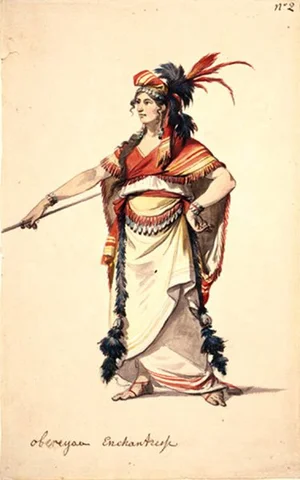
Purea was not the absolute monarch of a unified Tahitian kingdom. Eighteenth-century Tahiti was politically divided among districts, chiefly families and competing lines of authority. Rank depended heavily upon genealogy, inherited titles, marriage alliances, control of land and relationships with important marae and religious offices.
Purea belonged to this political world at its highest levels. She was a daughter of Teriʻi Vaetua, the ariʻi rahi, or paramount chief, associated with Ahurai in the district of Faaa. Her family belonged to the powerful Teva political network of southern and western Tahiti. She married Amo, a leading chief of Papara who appears under several names and spellings in European accounts.
Their marriage joined important chiefly lines, and their son Teriʻirere stood at the centre of an unusually ambitious dynastic project. The surviving evidence suggests that Purea and Amo attempted to elevate him above rival title-holders and strengthen his claims across Tahiti and neighbouring Moʻorea. The enormous marae constructed at Mahaiatea formed part of this political and religious programme.
Purea’s encounters with Europeans occurred while these ambitions were unfolding. The British did not meet a woman merely enjoying the novelty of foreign visitors. They encountered a chiefly leader operating within a competitive political landscape at a moment when ships carrying iron, firearms and unfamiliar forms of material wealth had suddenly appeared offshore.
European observers described Purea’s body, appearance and supposed sexual behaviour in extraordinary detail. They understood far less about her lineage, political relationships and ambitions for her son. Yet recovering Purea does not require replacing the European fantasy of a sensual island queen with an equally simplistic image of a flawless Indigenous stateswoman.
The evidence is too uneven for that. Much of what survives was written by foreign men who initially understood little about Tahitian political organisation, recorded names inconsistently and interpreted behaviour through European assumptions about monarchy, gender and sexuality. Later Tahitian traditions preserve essential genealogical and political information, but many were written down after the events they describe.
Even with these limitations, the surviving evidence supports a much stronger interpretation than the old story of Queen Oberea. Purea was a high-ranking Maʻohi woman whose lineage, marriage and influence placed her near the centre of one of the most ambitious dynastic projects in eighteenth-century Tahiti. Europe mistook her for a queen and allowed that mistake to become more famous than the woman herself.
Birth, Lineage and the Teva World
The precise date of Purea’s birth is unknown. European descriptions from the 1760s and 1770s offer impressions of her age, but these were estimates made by visitors with limited knowledge of her earlier life. Claims assigning her a particular birth year should therefore be treated cautiously.
Her genealogy is more historically important than an uncertain date. Purea was a daughter of Teriʻi Vaetua, a high-ranking chief associated with Ahurai in Faaa. Her brother Te Pau i Ahurai inherited their father’s title. Through this family, Purea belonged to a chiefly lineage whose influence extended beyond a single settlement or district.
She was part of the Teva world. The Teva were not a modern political party, territorial state or unified royal dynasty in the European sense. They were a network of powerful chiefly families associated particularly with southern and western Tahiti. Genealogy, marriage and inherited titles connected individuals with different districts, sacred centres and political claims.
In this society, ancestry was political knowledge. A genealogy could establish relationships with land, marae, religious authority and chiefly titles. The precise position of an individual within a line mattered because political legitimacy could depend upon descent through particular ancestors and upon the relative rank of both parents.
Women were integral to these systems of transmission. A chiefly woman’s ancestry could strengthen the claims of her children and connect families whose authority extended across different districts. Marriage among high-ranking families was therefore not simply a private arrangement. It could reshape political possibilities and create new claims to land, title and ritual precedence.
Purea’s lineage gave her considerable status, but it did not make her queen of Tahiti. The distinction is essential because the title later given to her by Europeans creates the false impression that Tahiti already possessed a central monarchy resembling those of Europe.
Authority was instead distributed among chiefs and chiefly families whose relationships could include alliance, rivalry, marriage and war. An individual might possess exceptional rank and substantial influence without exercising government over the entire island. Purea’s political importance emerged from her position near the top of this complex hierarchy.
Marriage to Amo and the Papara Chiefly Line
Purea married Amo, a high-ranking chief associated with Papara. European records render Tahitian names inconsistently, and Amo appears under different names and spellings in voyage literature and later histories. This creates considerable confusion, particularly because early visitors frequently misunderstood relationships among the chiefs they encountered.
The marriage connected important chiefly lines. Their son Teriʻirere inherited claims through both parents and through the wider genealogical networks of their families. Some historical accounts identify him under other forms of his name, including Teriinui.
The precise structure of every title associated with Teriʻirere is difficult to reconstruct from European evidence alone. What is clear is that his parents believed his ancestry could support exceptional political advancement. Purea’s later activities therefore make little sense if she is understood only as the wife of a district chief. She was the mother of a son whose combined lineage could be used to make claims extending beyond Papara.
Motherhood among high-ranking families could possess direct political significance because descent was not merely personal ancestry. It shaped entitlement, precedence and access to sacred authority. Purea’s importance cannot therefore be separated entirely from her family, but neither should that relationship be used to diminish her individual influence.
The ambitions associated with Teriʻirere were family ambitions. Amo participated in them, and other relatives, priests and supporters were also involved. The surviving evidence does not allow every decision to be assigned confidently to one person. Modern scholarship has often emphasised Purea’s political ambition, and the evidence certainly places her near the centre of the project, but it does not prove that she acted alone.
A more responsible interpretation recognises a chiefly household pursuing a dynastic strategy in which Purea’s lineage, influence and relationships were fundamental. The greatest surviving monument to that strategy was Mahaiatea.
Mahaiatea and an Extraordinary Political Ambition
At Papara stood one of the most remarkable structures encountered by early European visitors to Tahiti. The marae of Mahaiatea was an enormous ceremonial complex dominated by a stepped structure of coral stone. European observers compared it with a pyramid because they lacked a more appropriate architectural vocabulary.
Joseph Banks was astonished by its scale. Later descriptions and archaeological study indicate that its principal structure consisted of multiple terraces and rose to a considerable height. Stone was assembled on an extraordinary scale, and material appears to have been taken from older marae in the surrounding region.
Mahaiatea was not simply an impressive building. It belonged to a political and religious project associated with the attempted elevation of Teriʻirere. Purea and Amo appear to have sought a strengthened ceremonial position for their son through connections with the god ʻOro and through claims extending beyond his existing rank.
The precise title intended for Teriʻirere and the detailed religious programme surrounding his elevation must be handled cautiously. Much of the fuller explanation comes through later Tahitian traditions rather than contemporary records produced by the participants themselves. The broad purpose is nevertheless clearer: Teriʻirere was to be raised above his existing position, and the project threatened established relationships among Tahiti’s chiefly families.
Constructing Mahaiatea required extensive labour and resources. A rāhui, or sacred restriction, was imposed upon activities and resources associated with the project. Such restrictions could possess religious, economic and political force, affecting the people required to provide labour or support the ceremonial programme.
The scale of the complex also communicated a political claim. Architecture can express ambition without a written proclamation. A ceremonial centre larger than its predecessors, associated with an ambitious programme for a high-ranking child, could announce the aspirations of the family responsible for creating it.
Purea and Amo were therefore not merely preserving an inherited order. They were attempting to alter the balance within it. Mahaiatea reveals political agency before European descriptions transformed Purea into Queen Oberea. Her ambitions did not begin with the arrival of the British. The Europeans arrived while those ambitions were already taking material form.
Samuel Wallis Arrives
In June 1767, HMS Dolphin, commanded by Captain Samuel Wallis, reached Tahiti. The encounter did not begin peacefully. Large numbers of Tahitian canoes gathered around the ship, stones were thrown, and the confrontation escalated into serious violence.
Wallis responded with the overwhelming firepower of the Dolphin. British cannon and firearms were unlike the weapons available to Tahitian forces. Canoes were destroyed, people were killed and shots were fired towards the shore.
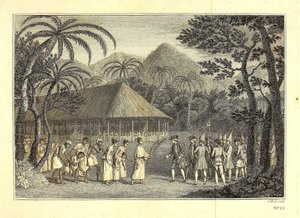
The precise intentions of the Tahitians before the fighting remain difficult to establish. European journals interpreted their actions according to British assumptions, while Tahitian testimony from the immediate encounter was not preserved in an equivalent contemporary written record.
The British possessed the surviving pen. They also possessed the cannon.
After the violence, relations changed. Exchange, visits and political contact developed between the expedition and local leaders. It was during this period that Wallis and his officers encountered Purea.
Her status impressed them immediately. British descriptions presented her as physically imposing, dignified and commanding. She participated prominently in the welcome offered to the visitors, and the Europeans interpreted the respect shown to her as evidence that they had discovered Tahiti’s sovereign.
The mistake was understandable, but it was also revealing. European officers came from societies in which political authority was imagined through kings, queens, courts and recognised hierarchies. When they encountered an influential woman receiving foreign visitors and surrounded by signs of rank, they searched for the nearest category they understood.
They called her queen because they had not yet learned enough to recognise the political system in front of them. Purea became Queen Oberea before Europe understood who Purea was.
The Creation of Queen Oberea
The name Oberea emerged from European attempts to hear and reproduce Purea’s name. Such distortions were common during early encounters in the Pacific. Voyage journals contain multiple spellings of the same people and places because writers attempted to represent unfamiliar sounds through European alphabets and languages.
The title of queen had much greater consequences. Once British officers decided that Purea was a sovereign, later descriptions interpreted her actions through that assumption. Hospitality became royal hospitality, gifts became diplomatic offerings from a monarch, and influence became government over the island.
Published voyage literature carried this image far beyond Tahiti. European readers encountered the Pacific through accounts that mixed observation, misunderstanding, literary arrangement and expectation. Tahiti became a place upon which writers and readers projected fantasies of abundance, natural freedom and sexual openness. Purea was absorbed into that imaginative construction.
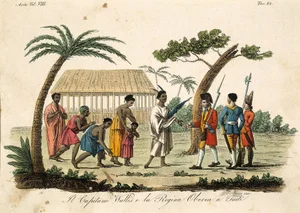
Her appearance acquired the significance of royal spectacle. Her relationships with visitors became episodes of courtly intimacy. When her political position later weakened, European writers could describe the fall of a queen because they had already invented the throne from which she supposedly fell.
The political world necessary to understand Purea was much more difficult to communicate. European writers could describe a body immediately, but reconstructing a chiefly genealogy required knowledge of descent, title, district, marriage and ritual authority that they did not yet possess.
The result was a persistent imbalance. Europe received a memorable character called Queen Oberea, but learned far less about Purea’s position within Teva and Papara politics or the dynastic strategy centred upon Teriʻirere and Mahaiatea. The invented queenship supplied a simple narrative that travelled easily through European literature. The more complex explanation remained fragmented across voyage journals, oral traditions, genealogies and later scholarship.
Queen Oberea was therefore not wholly fictional. She was constructed from encounters with a real, powerful woman. Yet the title, name and assumptions attached to her reorganised the surviving evidence into a story that Tahitian political structures did not support.
The queen survived in European memory. The chiefly strategist became harder to see.
What Did Purea Understand About the Europeans?
Purea’s own thoughts about the Wallis expedition do not survive in a personal written account. We know what British officers thought they saw, but we cannot read Purea’s description of the visitors or recover her intentions from her own words.
It is nevertheless reasonable to recognise that European ships created immediate political possibilities. Iron was immensely valuable. Nails, tools and other metal objects could be exchanged and redistributed, enhancing the prestige and practical resources of those who obtained them. The visitors also possessed extraordinary military technology whose destructive power had already been demonstrated.
Relationships with Europeans could therefore affect local status, exchange and competition. Purea engaged with the British during a period when her family was pursuing Teriʻirere’s advancement, and modern scholarship has persuasively interpreted her cultivation of European relationships as part of that wider political setting.
The interpretation should not be turned into certainty about every conversation, gift or decision. There is no evidence that Purea immediately devised a detailed policy of foreign alliance when Wallis arrived. She did, however, belong to a political elite accustomed to negotiating relationships, exchange, precedence and competition. She had reason to recognise that powerful newcomers might become valuable political partners or sources of desirable goods.
The British believed they were meeting a queen. Purea may have had little reason to correct a misunderstanding that directed attention, respect and gifts towards her. That possibility remains an interpretation rather than a documented confession, but the error did not necessarily disadvantage her.
For a time, the European invention of Queen Oberea may have served Purea’s interests even though it badly misrepresented her political position.
Between Wallis and Cook
Wallis left Tahiti in July 1767, but the island he departed was not politically static. Purea and Amo continued the project associated with Teriʻirere and Mahaiatea, and their attempt to elevate their son intensified tensions with rival chiefly lines.
Later Tahitian traditions connect the crisis particularly with Vehiatua and with competing claims involving Papara. The genealogical details are complex, but the central issue concerned rival entitlement and the threat created by Teriʻirere’s proposed elevation.
The precise chronology is not preserved with equal clarity in every source. Later traditions describe a major defeat in 1769 and connect it with fighting that forced Purea, Amo and Teriʻirere to flee towards the interior. Members of the Endeavour expedition were present in Tahiti during part of the crisis and recorded serious conflict, although they did not understand all its political causes.
Later Maʻohi accounts provide more detailed interpretations of the rival claims. These traditions cannot be treated as contemporary transcripts of events, but neither can they be dismissed. They preserve genealogical and political knowledge that European visitors were often incapable of recording because they did not understand the relationships involved.
The strongest conclusion is that Purea and Amo’s dynastic project failed. Papara was defeated, and Teriʻirere did not attain the pre-eminent position his parents had sought for him. Mahaiatea survived, but the political future it had been intended to support did not.
Cook, Banks and the Rediscovery of Oberea
James Cook arrived at Tahiti aboard HMS Endeavour in April 1769. The expedition’s principal scientific objective was to observe the Transit of Venus, although its presence inevitably created new political and economic relationships with Tahitian communities.
Members of the expedition had already heard of Queen Oberea. On 13 April, the Endeavour’s master, John Molyneux, recognised Purea as the woman he had encountered during Wallis’s voyage. Joseph Banks recorded the moment, connecting Purea directly with the celebrated Oberea of the Dolphin expedition.
The political reality confronting Cook was more complicated than the earlier story suggested. Cook recognised that Purea possessed authority within her own family or political group, but he did not conclude that she governed Tahiti. Other chiefs exercised substantial power, and the visitors gradually encountered a distribution of authority that contradicted the assumption of a single island monarchy.
Purea nevertheless remained an important figure. She visited the ship, exchanged gifts and interacted with Banks and other members of the expedition. Cook recorded her status and presence, but she was not the ruler the British had imagined two years earlier.
The Europeans interpreted the difference partly as a decline in her fortunes. There had probably been a real change in Purea’s political position as conflict surrounding Papara intensified. Yet the earlier assumption had also been wrong. Purea had not fallen from the throne of Tahiti because she had never occupied such a throne.
The contrast between 1767 and 1769 therefore reflected both Tahitian political change and improved European understanding. Purea’s influence had weakened, while the British had begun to recognise that Tahiti was not organised like Britain.
Joseph Banks and the Sexualised Record
Joseph Banks’s journal is one of the most important sources for Purea’s encounters with the Endeavour expedition. It is also evidence of the selective attention through which European knowledge of Tahiti was produced.
Banks described Purea’s height, body, complexion and appearance in considerable detail, even speculating about whether she might once have been regarded as beautiful. Such observations form part of the historical record, but they also reveal the priorities and assumptions of the observer.
European accounts of Tahiti were strongly shaped by fascination with sexuality. The conduct of Tahitian men and women was interpreted through ideas about natural freedom, exoticism, civility and European morality. Descriptions of intimacy were particularly attractive to readers, publishers and later writers seeking to present the Pacific as a place freed from European restraint.
Purea became entangled in these narratives. Stories concerning her interactions and supposed relationships with European visitors circulated widely, and the figure of Queen Oberea came to represent the sensuality Europeans imagined they had discovered in the Pacific.
The difficulty is not resolved by assuming that every sexual encounter described in European journals was invented. The more important issue is selection. European observers chose to record certain details repeatedly, while asking far fewer questions about genealogy, ritual authority or the political future Purea and Amo sought for their son.
The surviving archive therefore magnifies particular parts of Purea’s life. A journal may preserve an observer’s description of her body while leaving no equivalent account of her understanding of Mahaiatea, her relationships with rival families or her response to the developing crisis in Papara.
This imbalance can create a false impression that what was most thoroughly recorded was also what mattered most. In Purea’s case, other evidence demonstrates that her political world cannot be reduced to the intimate encounters emphasised by European writers. Mahaiatea required extensive labour and resources. Teriʻirere’s elevation was pursued. Rival interests responded, and Papara went to war.
Banks’s journal is therefore indispensable, but it cannot be read simply as a transparent biography of Purea. It records a Tahitian woman through the interests of an eighteenth-century European man and through a literary culture already preparing to turn Tahiti into an object of fascination.
The Defeat of Papara
The ambitions associated with Teriʻirere created serious opposition. Later Tahitian accounts describe conflict involving Vehiatua and rival claims to authority, and by June 1769 Papara faced a major military crisis.
The fighting ended in defeat for Purea’s side. Accounts describe Purea, Amo and Teriʻirere fleeing with their people towards the mountains. The precise circumstances should be treated cautiously because the fullest political explanations were preserved through later traditions rather than in contemporary records produced by Purea or her family.
The broad outcome is much firmer. The attempt to elevate Teriʻirere failed, and Purea’s political influence declined. Mahaiatea could proclaim the family’s ambitions in stone, but it could not preserve the authority the project was intended to create.
Purea’s defeat should not be interpreted as proof that the project was politically trivial or foolish. History often treats successful ambition as foresight and unsuccessful ambition as delusion. The scale of the opposition suggests that rival families regarded Teriʻirere’s elevation as a serious challenge.
Purea and Amo had attempted to rearrange relationships among powerful chiefly lines through genealogy, religion and monumental construction. The project failed, but the conflict it generated demonstrates that it had threatened the existing balance of power.
Mahaiatea After the Ambition
Mahaiatea outlived the political project associated with its construction. European visitors continued to describe the structure with astonishment, although they often interpreted it through comparison with buildings they already understood.
Its stepped form became a pyramid in European writing. Its political and religious meaning within Tahitian society was more difficult to preserve.
The scale of Mahaiatea challenged assumptions that Pacific societies lacked monumental architecture, organised labour or complex religious institutions. Its construction required mobilisation, resources and sustained purpose, even if the precise ceremonial programme associated with Teriʻirere remains partly uncertain.
Over time, the marae suffered destruction and deterioration. Stones were removed, vegetation spread and the structure that had once dominated the ceremonial landscape became a ruin. Enough survived, however, for Mahaiatea to remain one of the most important physical connections with Purea’s political world.
Stone cannot provide Purea’s memoir or identify the precise contribution of every member of her family. It can nevertheless demonstrate the scale of the enterprise with which she and Amo were associated. Mahaiatea placed their ambitions into the landscape and preserved evidence of a project extending far beyond ordinary household authority.
European literature remembered an exotic queen. The remains at Papara preserve evidence of an ambitious political monument.
After 1769
Purea’s political influence declines following the failure of the project to elevate Teriʻirere.
1773–1774
George Forster’s observations during Cook’s second Pacific voyage show that Purea remains known to European visitors, although her former political position has diminished.
Late 18th century
Details of Purea’s later life and death become uncertain.
19th century onward
European literature continues to reproduce the image of Queen Oberea, frequently emphasising sexuality and exoticism.
Modern scholarship
Purea is increasingly reconsidered as a high-ranking Tahitian political figure whose dynastic ambitions were obscured by European misunderstanding.
The Rise of the Pōmare Dynasty
Purea’s political world was later overshadowed by the rise of the Pōmare dynasty. Emerging from northern Tahitian political networks, the Pōmare family benefited from changing relationships created by European contact, including access to weapons, foreign alliances and, later, missionary support.
By the nineteenth century, Tahiti possessed something much closer to the monarchy Europeans had imagined in 1767. There were recognised kings and queens of Tahiti, but Purea had not been one of them.
The later existence of the Pōmare monarchy may have made the story of Queen Oberea appear retrospectively plausible to European readers. It became easy to assume that Wallis had simply met an earlier monarch. In reality, Purea belonged to a period of competing chiefly authorities, and her family’s attempt to elevate Teriʻirere should not be presented as an early version of the Pōmare state.
The later dynasty arose through different alliances, religious changes and relationships with foreign power. Its success nevertheless demonstrates that Tahitian politics were already dynamic when European ships arrived. Foreign visitors did not enter a timeless island society. They entered ongoing political competitions and introduced new resources into them.
Purea stands near the beginning of that transformed historical landscape, but her project belonged to the chiefly world from which she came rather than to the later monarchy that followed it.
European Sources and the Problem of the Archive
Almost everything written about Purea requires attention to who recorded it and under what circumstances.
Samuel Wallis’s expedition encountered her during an early and violent British contact with Tahiti. Joseph Banks observed her through the perspective of an eighteenth-century English gentleman deeply interested in Tahitian society and sexuality. James Cook attempted to understand political authority more carefully but remained dependent upon interpreters, limited time and incomplete knowledge. George Forster encountered a woman whose European reputation had already been shaped by earlier accounts.
John Hawkesworth’s published compilation of Pacific voyages further transformed journal material into literature for a European audience. Editorial arrangement, paraphrase and narrative expectation all influenced the story readers received.
These sources are invaluable. Without them, many details of Purea’s encounters with European expeditions would be lost. They are not, however, neutral windows onto Tahitian life. Names were misheard, titles misunderstood and relationships incorrectly identified. European ideas about monarchy shaped political interpretation, while assumptions about gender and sexuality shaped the description of women.
Later Tahitian traditions provide a different body of evidence. Genealogies and oral histories preserve relationships, rivalries and political meanings that European visitors often failed to understand. Yet many were recorded after Purea’s lifetime and may reflect later political developments, retrospective explanation or the interests of the families preserving them.
The task is therefore not to declare either European or Tahitian sources automatically correct. It is to compare them carefully and grade the certainty of the conclusions drawn from them.
Cook’s recognition that Purea did not govern all Tahiti helps correct the earlier assumption made by Wallis’s officers. Tahitian genealogical traditions provide political context for Teriʻirere’s claims that European journals could not adequately explain. Where later traditions supply exact dialogue, private motives or detailed sequences that cannot be independently verified, caution remains necessary.
Purea’s history survives between archives. Her life must be reconstructed by placing European observations, Tahitian political knowledge, genealogy, oral tradition and material evidence into conversation without forcing them into a single, falsely certain narrative.
What We Know — and What We Do Not
What We Know — and What We Do Not
Firmly Supported
- Purea was a high-ranking Tahitian chiefly woman belonging to an important Teva lineage.
- Her father was Teriʻi Vaetua, a high-ranking chief associated with Ahurai.
- She married Amo, a leading chief associated with Papara.
- Their son Teriʻirere stood at the centre of an ambitious chiefly and dynastic project.
- Purea was encountered by Samuel Wallis’s expedition in 1767.
- British visitors rendered her name as Oberea and interpreted her as the queen of Tahiti.
- Members of James Cook’s Endeavour expedition encountered her again in 1769 and connected her with the woman known from Wallis’s voyage.
- Cook recognised that Purea held considerable status within her family or political group but did not exercise authority over all Tahiti.
- Purea and Amo were associated with the great marae at Mahaiatea.
- The Mahaiatea project was connected with the attempted elevation of Teriʻirere.
- The family’s political ambitions provoked, or became entangled in, serious conflict with rival chiefly interests.
- Papara suffered defeat in 1769.
- Purea’s political influence declined after the failure of the project associated with Teriʻirere.
- European publications transformed her into the famous figure of Queen Oberea.
Strongly Supported but Requiring Interpretation
- Purea actively participated in a dynastic strategy intended to make Teriʻirere one of the pre-eminent title-holders of Tahiti and Moʻorea.
- Her cultivation of relationships with European visitors formed part of her wider political strategy.
- The Mahaiatea project represented an attempt to alter the existing balance of chiefly and religious authority.
- Purea may have recognised that the European misunderstanding of her as a queen could increase her prestige and access to foreign goods.
- Her personal authority within Teva and Papara political networks was substantial.
- The scale of the opposition to Teriʻirere’s elevation indicates that Purea and Amo’s project was regarded as a serious political threat.
- European emphasis upon Purea’s appearance and sexuality significantly distorted later understanding of her historical role.
Uncertain or Unknown
- Purea’s exact date and place of birth.
- Her precise age when Wallis arrived in 1767.
- The details of her childhood and upbringing.
- How Purea described her own political position.
- Whether she deliberately encouraged Europeans to believe that she was queen of Tahiti.
- The exact division of political decision-making between Purea and Amo.
- The precise title and ceremonial programme intended for Teriʻirere at Mahaiatea.
- How Purea personally understood the god ʻOro and the religious significance of her son’s elevation.
- The complete sequence of events leading to the conflict of 1769.
- The exact circumstances of Purea’s flight following the defeat of Papara.
- Her private response to the failure of the dynastic project.
- The details of her later life.
- The exact date and circumstances of her death.
Historical Confidence
Historical Confidence
Existence, Lineage and High Chiefly Status: ★★★★★
Purea is securely identified through European voyage accounts and Tahitian genealogical traditions. Her connection with important chiefly families and her position within the Teva political world are well established.
Encounters with Wallis, Cook and Banks: ★★★★★
European expeditions recorded their meetings with the woman they called Oberea, and members of the Endeavour expedition explicitly connected her with the figure encountered during Wallis’s earlier voyage.
Status as Queen of Tahiti: ★☆☆☆☆
The title was a European misunderstanding. Cook’s observations and the wider evidence of Tahitian political organisation demonstrate that Purea did not govern the entire island as an absolute monarch.
Role in the Mahaiatea and Teriʻirere Project: ★★★★☆
Purea and Amo’s association with Mahaiatea and the attempted elevation of their son is strongly supported. Some detailed interpretations of the intended title, religious programme and individual decision-making depend upon later traditions.
Political Strategy Towards Europeans: ★★★☆☆
The timing of Purea’s interactions with European visitors and her wider dynastic ambitions make political calculation highly plausible. Her intentions were not recorded in her own words, so claims about a deliberate foreign policy remain interpretative.
Private Personality and Motives: ★★☆☆☆
European journals describe Purea’s appearance and behaviour but were shaped by exoticism, sexual fascination and political misunderstanding. They provide evidence of interaction rather than a complete or neutral account of her inner life.
Later Life and Death: ★★☆☆☆
Purea remained known to later European visitors, but the details of her final years and the circumstances of her death are poorly documented.
Key Contributions
Key Contributions
- Exercised substantial influence within the Teva and Papara chiefly networks of eighteenth-century Tahiti.
- Participated with Amo in an ambitious dynastic strategy centred upon the elevation of their son Teriʻirere.
- Was closely associated with the construction and political programme of Mahaiatea, one of the largest and most remarkable marae complexes recorded in Tahiti.
- Engaged directly with some of the earliest British expeditions to Tahiti, including the voyages of Samuel Wallis and James Cook.
- Occupied a prominent position during the first sustained period of contact between Tahitian chiefly society and British navigators.
- Became one of the earliest individually named Tahitian women to achieve widespread recognition in European literature.
- Provides historians with an important case study in the European misunderstanding of Indigenous political authority.
- Her life helps recover the complexity and dynamism of Tahitian political competition before the consolidation of the Pōmare monarchy.
Key Dates
Purea is born into a high-ranking Tahitian chiefly family. Her exact birth date is unknown.
Purea marries Amo, a leading chief associated with Papara.
Their son Teriʻirere becomes the focus of important genealogical and political claims.
The great marae complex at Mahaiatea is constructed or substantially developed in connection with the political and religious project surrounding Teriʻirere.
Samuel Wallis and HMS Dolphin arrive at Tahiti.
Violent conflict occurs between Tahitians and the Dolphin before relations shift towards exchange and political contact.
Wallis and his officers encounter Purea. British visitors interpret her as the queen of Tahiti and record her name as Oberea.
The Dolphin leaves Tahiti. European accounts begin carrying the story of Queen Oberea beyond the Pacific.
The project to elevate Teriʻirere intensifies political tensions with rival chiefly interests.
James Cook’s Endeavour expedition arrives at Tahiti.
John Molyneux recognises Purea as the woman encountered during Wallis’s 1767 expedition. Joseph Banks records the rediscovery of the famous Oberea.
Cook, Banks and other members of the Endeavour expedition interact with Purea and recognise that she does not rule all Tahiti.
Later Tahitian traditions associate this period with a major battle and the defeat of Papara. Purea, Amo and Teriʻirere are said to have fled with their people.
Did You Know?
Did You Know?
- Purea was never queen of all Tahiti, despite becoming famous across Europe as Queen Oberea.
- The name Oberea developed from European attempts to record her Tahitian name.
- She belonged to the powerful Teva chiefly world of southern and western Tahiti.
- Her father, Teriʻi Vaetua, held high chiefly status associated with Ahurai.
- Purea married Amo, a leading chief associated with Papara.
- Their son Teriʻirere stood at the centre of an ambitious attempt to strengthen the family’s political authority.
- Purea and Amo were associated with Mahaiatea, an enormous marae complex that astonished European visitors.
- Mahaiatea contained multiple terraces and was so unfamiliar to Europeans that they frequently described it as a pyramid.
- Samuel Wallis’s first encounter with Tahiti in 1767 included serious fighting before exchange and political contact developed.
- British officers interpreted Purea’s high status as evidence that she was Tahiti’s sovereign.
- James Cook later recognised that Purea did not possess authority over the entire island.
- John Molyneux, who had sailed with Wallis, recognised Purea in 1769 and confirmed that she was the woman Europeans remembered as Oberea.
- Joseph Banks wrote extensively about Purea but devoted considerable attention to her physical appearance.
- Purea’s political ambitions become clearer when European voyage accounts are compared with Tahitian genealogical and oral traditions.
- The project to elevate Teriʻirere failed following conflict and the defeat of Papara in 1769.
- Purea’s exact date of death is unknown.
- The woman remembered in European literature as an exotic queen was participating in a serious dynastic struggle within Tahitian politics.
Further Reading
- Anne Salmond, Aphrodite’s Island: The European Discovery of Tahiti
- Douglas L. Oliver, Ancient Tahitian Society
- Teuira Henry, Ancient Tahiti
- Joseph Banks, The Endeavour Journal of Joseph Banks, 1768–1771
- James Cook, journals of the first Pacific voyage and the Endeavour expedition
- John Hawkesworth, An Account of the Voyages Undertaken by the Order of His Present Majesty for Making Discoveries in the Southern Hemisphere
- George Forster, A Voyage Round the World
- Paul Turnbull, biographical scholarship on Purea and the European construction of “Queen Oberea”
- Modern scholarship on the Teva chiefly lines, Mahaiatea marae and Tahitian political history before the Pōmare monarchy
Legacy and Historical Significance
Purea occupies an unusual position in Pacific history. She was one of the first Tahitian women to become famous in Europe, yet fame did not preserve her accurately.
The woman Europeans remembered as Queen Oberea was partly a creation of misunderstanding. British visitors encountered a political system they did not recognise, saw the respect given to a high-ranking woman and fitted her into the nearest category available to them. The title travelled farther than the explanation.
European readers encountered Oberea through voyage literature shaped by fascination with Tahiti as a place of abundance, exoticism and sexual freedom. Her body, relationships and supposed behaviour became material for entertainment and speculation, while the political world in which Purea actually lived remained difficult for outsiders to understand.
She belonged to a powerful chiefly lineage. Her marriage connected important families, and her son’s genealogy created opportunities for exceptional political advancement. Mahaiatea represented an extraordinary investment of labour, resources and sacred authority. The attempt to elevate Teriʻirere challenged rival interests strongly enough to contribute to conflict and the eventual defeat of Papara.
These events reveal a woman connected with political ambition on a scale far removed from the decorative island queen of European imagination. Purea’s significance does not depend upon proving that every element of the Mahaiatea project originated with her personally. The surviving evidence does not allow such precision, and Amo, priests, relatives and other supporters also participated in the family’s strategy.
Nor should Purea be transformed into a modern feminist or anti-colonial leader. British contact with Tahiti had only just begun, and colonial rule had not yet been established. Her ambitions were dynastic, her politics were chiefly politics and her position depended upon genealogy and inherited rank. She sought advantage for her family within a society structured by distinctions of status.
Recognising those realities does not make her less important. It makes her historical.
Purea also demonstrates that historical erasure does not always mean forgetting a name. Sometimes a person is remembered so incorrectly that the invented version becomes a form of erasure itself.
Europe did not forget Oberea. It wrote about her, sexualised her and turned her into a queen. What it largely failed to preserve was the political context necessary to understand Purea.
Mahaiatea offers a different form of memory. Its remains stand in the landscape of Papara as evidence of a moment when a powerful chiefly family attempted to reshape Tahiti’s political future. Teriʻirere did not become the pre-eminent leader his parents hoped he might be. Purea’s influence declined, other families rose and the Pōmare dynasty eventually created the monarchy Europeans had prematurely imagined.
Yet Tahiti’s later history should not obscure the uncertainty of the earlier moment. During the 1760s, before the island’s political future had been decided, Purea stood near the centre of an ambitious attempt to change it.
Europe remembered the woman it called Queen Oberea. History should also remember Purea.
Image Credits
Oberea (Purea): Historical European portrait engraving representing Purea under the name “Oberea”. Image supplied through the site’s Squarespace image library. Confirm the original publication details and licence wording before publication.
Captain Wallis in conversation with Oberea: Historical engraving depicting Samuel Wallis’s meeting with Purea at Tahiti. Image supplied through the site’s Squarespace image library. Confirm the original publication details and licence wording before publication.
Captain Wallis and Queen Oberea at Tahiti: Historical European illustration of Wallis and Purea. Image supplied through the site’s Squarespace image library. Confirm the original publication details and licence wording before publication.
Help Keep These Stories Alive
If you enjoyed reading this profile and believe more overlooked voices deserve to be heard, you can help fund future research, writing, and free educational resources.
Every contribution—whether a one-off donation or monthly support—helps create new historical profiles, downloadable materials, and articles that remain freely available to everyone.
Thank you for helping history reach more people.
