

Hypatia
Historical Profile
The Philosopher Behind the Symbol
Introduction
In March 415 CE, a group of men seized Hypatia of Alexandria as she travelled through the city. They dragged her from her carriage and took her to the Caesareum, a former imperial cult complex that had become a Christian church. There she was stripped and killed. Her body was dismembered and the remains carried away and burned.
The principal near-contemporary account comes from Socrates Scholasticus, a Christian church historian writing only a few decades after the murder. Socrates did not describe Hypatia as an enemy of learning, a dangerous magician or an opponent who had deserved her fate. He presented her as a distinguished philosopher whose education and character had earned widespread respect, and he condemned the killing as an act that brought disgrace upon Cyril, bishop of Alexandria, and the Alexandrian church.
Hypatia's death is among the most famous murders of the ancient world. Her life is considerably harder to reconstruct.
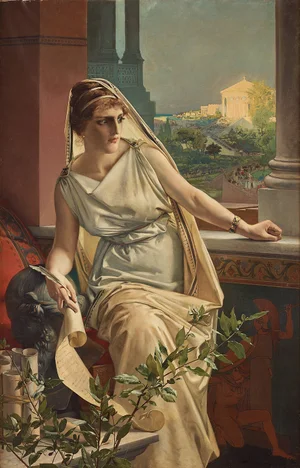
Later generations have repeatedly turned her into a symbol. She has been portrayed as a pagan martyr, a martyr for science, a defender of reason against religion, the last philosopher of antiquity and the final guardian of the Library of Alexandria. Paintings, novels, philosophical arguments and films have placed her at the symbolic end of classical civilisation, often presenting her death as the moment when the intellectual world of Greece and Rome gave way to religious intolerance.
The historical evidence supports a more complicated life. Hypatia did not die defending the Library of Alexandria, and no ancient source places her at the destruction of the Serapeum in 391, more than twenty years before her murder. Philosophy and mathematical scholarship also continued after her death. Neoplatonic teachers remained active in Alexandria and Athens, while Christian scholars continued to study and interpret parts of the Greek philosophical tradition.
Removing those later stories does not make Hypatia less significant. It allows the evidence for her actual career to become clearer.
She was the daughter of Theon of Alexandria, a mathematician and astronomical scholar. She became a prominent teacher of philosophy, participated in the advanced mathematical and astronomical culture for which Alexandria had been famous for centuries and developed an intellectual circle that included members of the late Roman elite. One of her students, Synesius of Cyrene, continued to seek her advice after leaving Alexandria and later becoming a Christian bishop.
By the final years of her life, Hypatia also had access to Orestes, the imperial prefect of Egypt. When Orestes entered a bitter conflict with Cyril, rumours circulated that Hypatia was preventing the two men from reconciling. Her intellectual reputation and civic connections had placed her close to a political struggle in a city already known for communal violence.
The central historical question is therefore not whether Hypatia should be celebrated as the representative of reason or condemned as an opponent of Christianity. It is how much can be recovered of the philosopher, teacher and scholar who existed before later generations made her death more famous than her life.
Alexandria in the Late Roman World
Hypatia lived in a city whose intellectual reputation was already centuries old.
Founded by Alexander the Great in 331 BCE and developed under the Ptolemaic dynasty, Alexandria became one of the largest and most important cities of the Mediterranean. Its position on the Egyptian coast connected the Nile Valley with maritime trade routes extending across the Roman world. Greek, Egyptian and Jewish communities formed major parts of its population, while merchants, officials, soldiers, students and travellers arrived from many other regions.
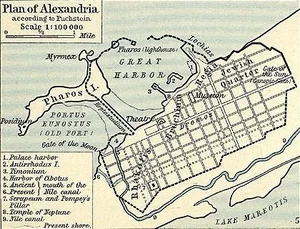
The city had long been associated with scholarship. The mathematical tradition connected with Euclid, the astronomical work of Claudius Ptolemy and the activities of generations of editors, commentators, physicians and teachers contributed to a reputation that survived the fall of the Ptolemaic monarchy and Egypt's incorporation into the Roman Empire.
The Alexandria of Hypatia's lifetime was not, however, the Alexandria of the early Ptolemies.
The famous royal Library of Alexandria had ceased to exist as the great central institution imagined in many later accounts. Exactly when and how its collections declined remains debated because ancient references describe several episodes of damage and because Alexandria continued to possess books, scholars and other centres of learning after the Ptolemaic period. The Serapeum, a temple complex associated with scholarship and sometimes described as containing a subsidiary library, survived until its destruction in 391 CE.
Hypatia's intellectual career therefore belonged to a scholarly tradition that had changed repeatedly over several centuries. Learning was no longer concentrated around a single royal institution. Teachers, philosophical circles, private collections and networks of students played an important role in maintaining and transmitting knowledge.
The Roman Empire itself was also changing. Christianity had moved from periods of persecution to imperial favour during the fourth century. Constantine's support for the church and the policies of later emperors altered the religious and political environment of the empire, but Christianisation was neither immediate nor uniform. Traditional cults continued in many places, philosophical schools remained active and Christian communities disagreed fiercely among themselves over doctrine and ecclesiastical authority.
In Alexandria, religious identity could overlap with civic and political rivalry. The city's bishops possessed growing institutional influence. Imperial officials represented the authority of the Roman state. Monks, clergy, neighbourhood groups, organised workers and civic elites could all become involved in public disputes. Alexandria also possessed a long history of urban unrest extending back far beyond the Christian period. Crowds had participated in political and communal violence under pagan and Christian rulers alike.
This context is essential to understanding Hypatia. She was a philosopher associated with traditional Hellenic intellectual culture, but several people within her circle were Christians. She studied mathematics and astronomy, yet her reputation also gave her access to civic officials. Her murder involved Christians hostile to her perceived influence, but the immediate crisis developed within a struggle between an imperial prefect and a bishop.
No single modern category completely explains the world in which she lived.
The Daughter of Theon
Hypatia's exact date of birth is unknown. Modern estimates generally place it somewhere between approximately 350 and 370 CE, a wide range produced by the absence of any surviving contemporary statement of her age. Historians have attempted to reconstruct the chronology indirectly from the career of her father, Theon, the period in which Synesius studied in Alexandria and later descriptions of Hypatia, but none of these provides a secure birth year.
The date of her death is considerably better established. Socrates Scholasticus places the murder during the tenth consulship of Honorius and the sixth of Theodosius II, in the season of Lent, fixing the event to 415 CE and allowing it to be placed in March of that year. The contrast is characteristic of the surviving evidence for Hypatia: decades of her life must be reconstructed from scattered references, while the violent event that ended it can be dated with unusual precision.
Her father, Theon of Alexandria, is much better represented in the surviving mathematical record.
Theon was a mathematician and astronomical scholar who produced commentaries and revised texts associated particularly with Euclid and Claudius Ptolemy. He belonged to a scholarly tradition in which the preservation of earlier mathematical works required active intellectual labour.
Modern readers can easily misunderstand the role of an ancient commentator. Mathematical texts circulated through handwritten copies. Errors could enter during copying, diagrams might become corrupted and arguments that were clear to one generation of specialists could become difficult for later students. Editors and commentators compared texts, corrected calculations, supplied explanatory steps and reorganised material for teaching.
Theon's work helped make difficult mathematical and astronomical texts usable.
Hypatia appears to have been educated within this environment. No reliable evidence survives concerning her mother or the domestic circumstances of her childhood. Later biographies have sometimes imagined Theon designing an elaborate programme of physical and intellectual training for his daughter, but the ancient evidence does not provide such detail.
What can be established is that Hypatia acquired an advanced education in philosophy, mathematics and mathematical astronomy. Her father's expertise and scholarly environment provide the most obvious context for that education, although the precise stages of her training are unknown.
At some point, Hypatia's reputation became independent of Theon's. Socrates Scholasticus states that she had attained such learning that she surpassed the philosophers of her own time and attracted people who wished to study philosophy. Damascius, writing more than a century later from within a pagan Neoplatonic tradition, also remembered her as a prominent public teacher.
The precise institutional structure of Hypatia's school is uncertain. Alexandria did not possess a modern university divided into departments with formal academic posts and standardised qualifications. Philosophical education frequently centred upon individual teachers whose reputations attracted groups of students.
Hypatia's authority appears to have depended substantially upon her standing as a teacher.
Philosophy, Mathematics and the Education of the Mind
Modern accounts frequently introduce Hypatia as a mathematician or astronomer. The ancient narrative sources most consistently identify her as a philosopher.
The distinction matters because philosophy in late antiquity could encompass a wider intellectual and ethical programme than the modern academic discipline of the same name.
Hypatia belonged to the Platonic tradition now generally described as Neoplatonism. The movement developed from the work of Plotinus and later philosophers who interpreted Plato through increasingly elaborate accounts of reality, intellect and the relationship between the material and divine worlds. Neoplatonic schools were not identical, and individual teachers could differ substantially in their treatment of religious ritual, metaphysics and earlier philosophical texts.
Mathematics possessed an important place within this intellectual culture. For philosophers influenced by Plato, mathematical study could train the mind to move beyond immediate sensory experience and recognise abstract relationships and rational order. Arithmetic, geometry and astronomy were therefore not necessarily separate technical interests attached to a philosophical career. They could form part of the education through which a student learned how to reason.
This helps explain Hypatia's combination of interests. A teacher capable of discussing Plato while also working with advanced mathematics and astronomical calculation was not moving randomly between unrelated subjects. She belonged to an intellectual tradition in which these forms of knowledge could support one another.
The surviving evidence does not allow Hypatia's own philosophical system to be reconstructed. None of her philosophical lectures or treatises survives, and Synesius's writings cannot simply be treated as transcripts of her teaching. His ideas developed through his own reading, political career and eventual Christian episcopate.
His relationship with Hypatia nevertheless provides the clearest evidence for the character of her intellectual circle.
Synesius came from a wealthy family in Cyrenaica, in what is now Libya. He travelled to Alexandria and studied with Hypatia, probably during the 390s. Other members of their circle appear in his surviving correspondence, suggesting that the students formed relationships with one another as well as with their teacher.
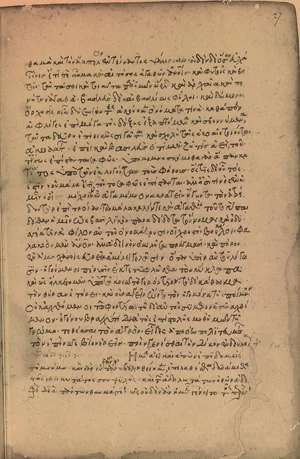
Years after leaving Alexandria, Synesius continued to address Hypatia with exceptional respect. In one of his final letters, dictated while seriously ill, he called her his mother, sister, teacher and benefactress. Elsewhere he sought her advice and referred to people connected with their former intellectual community.
The correspondence suggests that studying with Hypatia was not simply a period of attending lectures. Her students formed an intellectual network that survived geographical separation. They entered government, local elite society and the Christian church while continuing to remember their teacher as an important source of philosophical authority.
Synesius himself became bishop of Ptolemais.
His Christian identity should not be used to suggest that religious differences between him and Hypatia were insignificant. Before accepting the bishopric, Synesius expressed reservations about doctrines he found philosophically difficult, and his writings reveal a complicated relationship between Platonic thought and Christian belief.
What his career demonstrates more securely is that a Christian could study with Hypatia, maintain profound respect for her and continue to seek her intellectual friendship.
Hypatia's school cannot therefore be described simply as a centre of pagan resistance to Christianity. It was a philosophical community operating in a society where religious identities were changing and where intellectual relationships did not always follow the political divisions that later became attached to Hypatia's story.
Mathematical Scholarship and the Problem of Lost Works
None of Hypatia's independent mathematical works survives securely under her own name. This is the central difficulty in assessing her precise contribution to the history of mathematics.
The Suda, a Byzantine encyclopaedia compiled centuries after her death but drawing upon earlier sources, attributes several works to Hypatia. These include a commentary on the Arithmetica of Diophantus, a commentary on the Conics of Apollonius and a work usually described as an Astronomical Canon.
Each attribution connects her with technically demanding material.
Diophantus's Arithmetica examined numerical problems through procedures that later historians have connected with the history of algebra. Apollonius's Conics analysed the mathematical properties of curves produced by intersecting a cone with a plane. The astronomical tradition inherited from Ptolemy required extensive geometrical reasoning and numerical calculation.
A useful commentary on such works demanded substantial expertise.
The difficulty is determining what Hypatia actually wrote. The commentary on Apollonius is lost. Claims that Hypatia preserved particular books of the Conics or introduced identifiable mathematical discoveries cannot currently be demonstrated from surviving evidence.
Her connection with Diophantus has produced more extensive debate. Hypatia is the only ancient commentator on the Arithmetica known by name. Some scholars have proposed that explanatory additions or particular features preserved within the later manuscript tradition may derive from her commentary or editorial work. The possibility is important, but identifying an individual passage as unquestionably Hypatia's remains difficult.
Her association with Ptolemy's Almagest provides a more direct textual connection.
A heading associated with Theon's commentary on Book III of the Almagest describes the work using language referring to an edition or recension by Hypatia, "the philosopher, my daughter." The exact interpretation of the wording has been debated. Scholars have asked whether it refers to Hypatia revising Theon's commentary or preparing a corrected edition of the underlying Ptolemaic text used within the commentary.
The existence of the attribution is significant. The precise extent of her contribution is harder to establish.
This uncertainty has encouraged two opposite exaggerations. One presents Hypatia as a mathematical genius whose revolutionary discoveries were almost entirely destroyed after her death. The other reduces her to a minor assistant who merely copied or edited her father's work.
The surviving evidence supports neither conclusion confidently.
Ancient mathematical scholarship depended upon the transmission, correction and explanation of difficult texts. A corrupt diagram, missing calculation or misunderstood notation could make an argument inaccessible to later students. The scholar who restored, clarified or reorganised such material participated actively in the continued life of mathematical knowledge.
Texts survived because people copied them, but difficult texts remained intellectually usable because scholars interpreted them.
Hypatia belonged to this culture of commentary and teaching. The titles associated with her work and the technical interests of her students support her advanced mathematical competence. What has been lost is the evidence required to measure her originality according to modern expectations of mathematical discovery.
That absence should limit claims about particular innovations. It should not be used to deny the level of scholarship required by the work ancient sources associate with her.
Astronomy and Scientific Instruments
Astronomy in Hypatia's intellectual world was deeply mathematical. The movements of the sun, moon, planets and stars were studied through geometrical models and numerical tables. Ptolemy's Almagest, one of the central works of ancient mathematical astronomy, represented precisely the kind of difficult text associated with Theon and Hypatia's scholarly environment.
Synesius's writings provide evidence that his education included this mathematical approach to the heavens.
One of the best-known objects connected with Hypatia is the plane astrolabe. The instrument used a geometrical projection of the celestial sphere onto a flat surface and could assist with astronomical calculations and the representation of the positions of celestial bodies.
Hypatia is sometimes described as the inventor of the astrolabe. The claim is not supported by the history of the instrument. The mathematical principles and earlier forms of the plane astrolabe pre-date her lifetime.
Synesius's discussion of an astrolabe is important for a different reason. His account connects the knowledge required to understand the instrument with the philosophical and mathematical education he had received. Hypatia appears within the intellectual background that allowed him to discuss its construction and improvement.
The evidence therefore supports her expertise in mathematical astronomy and the principles underlying astronomical instruments. It does not establish that she invented the astrolabe.
A second instrument appears in one of Synesius's letters to Hypatia. While ill, he asked her to obtain or arrange the construction of a device he called a hydroscope. His detailed description refers to a cylindrical instrument with notches used in relation to liquids and is generally associated with the type of instrument later called a hydrometer.
The request has sometimes been transformed into another invention story.
Synesius does not say that Hypatia invented the device. Indeed, the detail with which he describes it may indicate that he was explaining an instrument she did not already know. The more secure conclusion concerns his confidence in her abilities.
When Synesius wanted a technical instrument understood and produced, Hypatia was someone he believed capable of acting upon a detailed description.
The astrolabe and hydroscope therefore reveal something more historically useful than a list of inventions. They place technical and mathematical competence within the relationship between Hypatia and her students.
A Teacher with Public Authority
Hypatia's reputation extended beyond a private circle of mathematical specialists.
Socrates Scholasticus states that because of the self-possession and ease of manner she had acquired through the cultivation of her mind, she appeared publicly before civic officials and was respected by those who encountered her. Damascius similarly describes her wearing the philosopher's cloak and explaining philosophy publicly to those who wished to hear her.
Damascius wrote more than a century after Hypatia's death and shaped his account according to his own Neoplatonic ideals. His details should therefore be treated cautiously. The broader picture of Hypatia as a publicly recognised teacher is supported by Socrates and by the social position of students associated with her.
Her gender formed part of the way ancient writers described this authority.
Educated and influential women were not unknown in the Roman world. Elite women could control property, support religious institutions, act as patrons and influence political networks. Women also appear within earlier philosophical traditions.
Hypatia's position was nevertheless unusual. She was publicly recognised as a professional philosophical teacher in one of the Roman Empire's greatest cities. Her authority was not derived principally from marriage to an official or membership of the imperial family. No husband is securely recorded, and ancient traditions consistently present her as unmarried.
Her reputation rested upon learning and teaching.
Later sources associated her with philosophical chastity and self-discipline. Damascius preserves a famous story in which Hypatia responds to the sexual interest of a student by confronting him with the physical realities of menstruation. The anecdote has often been repeated as a direct glimpse of her personality.
Its historical value is uncertain.
Ancient philosophical biography frequently used stories to demonstrate the virtues or character of a philosopher. Damascius's account presents Hypatia as someone who places rational control above bodily desire. The story may preserve an earlier tradition, but it cannot be treated as a securely documented private encounter.
The broader association between Hypatia and philosophical self-discipline is more firmly embedded in the surviving literary tradition.
Her public reputation also brought her into contact with political figures. The most important of these was Orestes, the imperial prefect of Egypt.
Socrates states that Hypatia met frequently with him. The content of their conversations is unknown, and there is no surviving record of formal political office or an appointment as Orestes's adviser. Her access to the prefect nevertheless indicates the social reach of her intellectual reputation.
In the political environment of Alexandria, that access eventually became dangerous.
Cyril, Orestes and the Alexandrian Conflict
Cyril became bishop of Alexandria in 412 CE following the death of his uncle Theophilus.
The succession itself was contested, and Cyril inherited a bishopric that had developed considerable institutional and political influence. The bishops of Alexandria commanded clergy, controlled significant resources and possessed the ability to mobilise supporters within the city.
Orestes represented imperial authority. As prefect of Egypt, he was responsible for civil administration on behalf of the emperor. The prefect and bishop therefore represented different institutions whose areas of influence could overlap.
Relations between Cyril and Orestes deteriorated rapidly.
One crisis developed amid violence involving Alexandria's Jewish and Christian populations. Socrates Scholasticus describes a sequence of accusations, street violence and killings that culminated in Cyril taking action against the city's Jewish community and seizing synagogues.
Orestes objected.
From the prefect's perspective, the bishop had intruded into matters of civil administration. The conflict was not simply a theological disagreement. It concerned who possessed authority to act within Alexandria and how far episcopal power could extend into civic government.
The confrontation became more violent when monks from Nitria entered Alexandria in support of Cyril. They surrounded Orestes and accused him of paganism, despite his Christian baptism. During the confrontation, a monk named Ammonius struck the prefect with a stone and wounded him.
Orestes had Ammonius arrested, tortured and executed.
Cyril initially attempted to honour Ammonius as a martyr, but the effort appears to have encountered resistance among Christians who recognised that he had died after attacking an imperial official. The episode deepened the hostility surrounding the prefect and bishop.
Attempts at reconciliation failed. It was within this political environment that Hypatia became the subject of rumour.
Socrates states that because she met frequently with Orestes, Christians began to claim that Hypatia was preventing the prefect from reconciling with Cyril. He explicitly describes the report as a calumny.
There is no surviving evidence that Hypatia controlled Orestes's policies or deliberately blocked negotiations with the bishop.
The accusation was nevertheless plausible to those already hostile to the prefect. Hypatia was publicly visible, associated with traditional philosophical culture and known to have access to Orestes. Her position allowed political opponents to imagine influence being exercised through private conversations that left no administrative record.
Later writers expanded the accusation. John of Nikiu, writing centuries afterwards from a strongly hostile Christian perspective, described Hypatia as a magician who deceived Orestes through satanic arts. Damascius, writing from the opposite religious position, portrayed Cyril as jealous of Hypatia's popularity and philosophical reputation.
These accounts reveal how quickly the political circumstances of Hypatia's death became absorbed into competing religious narratives.
The near-contemporary account of Socrates is more restrained. Hypatia met with Orestes. A rumour claimed she prevented reconciliation. A group of Christians believed the accusation strongly enough to act against her.
The accusation did not need to be true to become dangerous.
The Murder of Hypatia
In March 415, during Lent, Hypatia was attacked as she travelled through Alexandria.
According to Socrates Scholasticus, a group led by a reader named Peter intercepted her as she returned home. They pulled her from her carriage and took her to the Caesareum.
There she was stripped and killed.
The precise implement used in the murder remains affected by difficulties of translation. The Greek word ostraka can refer to pieces of pottery or similar hard fragments, and English accounts have variously described tiles, potsherds or roof tiles. The exact object cannot be reconstructed with certainty from the terminology alone.
After killing Hypatia, the attackers dismembered her body. Her remains were carried to a place called Cinaron and burned.
Socrates condemned the killing in unusually direct terms. He stated that it brought considerable reproach upon Cyril and the church of Alexandria because murder, violence and similar acts were entirely foreign to those who claimed the Christian name.
His judgement matters because Socrates was himself a Christian church historian. He did not present Hypatia's death as a victory over paganism. Nor did he claim that her philosophical or mathematical work justified hostility towards her. He placed the murder within the conflict surrounding Orestes and Cyril and connected it directly with the rumour concerning Hypatia's influence over the prefect.
The question of Cyril's personal responsibility remains more difficult.
Socrates does not state that Cyril ordered the murder.
Damascius, writing later as a pagan philosopher, places greater personal blame upon the bishop and claims that Cyril became jealous after witnessing the crowds associated with Hypatia's house. John of Nikiu, writing from a very different Christian tradition, portrays Hypatia as a dangerous pagan influence and praises the restoration of Cyril's authority after her death.
No surviving contemporary document records an order from Cyril to kill Hypatia. This limits what can be claimed.
There is strong evidence that Hypatia was murdered by Christians who believed she was obstructing reconciliation between Orestes and Cyril. There is also strong evidence that the political and religious conflict surrounding Cyril's episcopate created the immediate circumstances in which the accusation became dangerous.
Whether Cyril instructed the killers, encouraged action indirectly, knew of a plan or failed to control supporters acting within the atmosphere of the dispute cannot be established securely.
Distinguishing these possibilities is not an attempt to remove the bishop from the historical context of the murder. It is a recognition that political responsibility, institutional responsibility and evidence for a direct command are different historical questions.
Hypatia's killers are described by Socrates as a group led by Peter the reader. Popular retellings frequently identify them specifically as parabalani, members of a Christian body associated with the care of the sick and with the Alexandrian bishop. The parabalani were certainly involved in the wider political tensions of Alexandria and became sufficiently controversial for imperial legislation to restrict their numbers and activities.
Socrates, however, does not explicitly identify Hypatia's killers as parabalani.
The distinction is important because a plausible reconstruction should not be presented as a statement preserved by the principal source.
What Socrates does establish is sufficiently serious without embellishment. Hypatia was targeted by a Christian group during a conflict involving the city's bishop and imperial prefect because a rumour portrayed her as a political obstacle.
Sources and Historical Evidence
Hypatia's life presents an unusual evidential problem.
The broad outline of her career is comparatively secure. Her existence, relationship to Theon, reputation as a philosopher, connection with Synesius, access to Orestes and murder in 415 are supported by substantial ancient evidence.
The details of her intellectual work are much harder to recover.
The closest personal evidence comes from Synesius of Cyrene. His letters are invaluable because he knew Hypatia and had studied with her. They demonstrate the depth of his respect, reveal continuing relationships among members of her intellectual circle and provide evidence for the mathematical and technical interests associated with their education.
They are not a biography of Hypatia.
Synesius wrote for particular purposes: to request assistance, maintain friendships, discuss personal difficulties or communicate with former associates. He had no reason to describe Hypatia's childhood, record the structure of her lectures or explain philosophical teachings already familiar to his correspondents.
The correspondence therefore gives us glimpses of Hypatia through the concerns of a former student.
Socrates Scholasticus provides the most important narrative account. Writing within several decades of the murder, he was much closer to Hypatia's lifetime than Damascius or John of Nikiu. His Christian identity makes his condemnation of the killers particularly significant, but it does not make him a neutral observer.
Socrates was interested in the behaviour of bishops and in the consequences of ecclesiastical involvement in civic conflict. His account of Hypatia forms part of a larger history concerned with the Christian church.
Damascius wrote more than a century after Hypatia's death. His Life of Isidore, also known as the Philosophical History, preserves traditions concerning Hypatia and other philosophers. Damascius belonged to a pagan Neoplatonic culture that had experienced increasing pressure within a Christian empire. His hostile portrayal of Cyril and admiration for Hypatia reflect that intellectual environment.
John of Nikiu wrote still later and from almost the opposite perspective. His account transforms Hypatia into a practitioner of magic who used astrolabes and other instruments to deceive Orestes. The hostility of his portrayal makes it unreliable as a straightforward account of Hypatia's life, but it is valuable evidence for the later development of a Christian tradition that justified or celebrated her removal.
The Suda, compiled in the Byzantine period, preserves important biographical and bibliographical traditions, including titles associated with Hypatia's mathematical work. Its chronological distance and use of earlier sources require careful analysis of individual claims.
The mathematical evidence presents a different problem. Hypatia's named commentaries do not survive independently. Historians must therefore examine manuscript traditions, headings attached to works associated with Theon and later references to identify possible traces of her scholarship.
This creates an imbalance in the archive.
The words of men who studied with Hypatia, admired her, criticised her or wrote about her death survive. Her own works do not survive securely enough for her intellectual voice to be reconstructed directly.
There is no evidence that all of her writings were deliberately destroyed because she was a woman or because she was murdered. The transmission of ancient technical literature was highly selective, and many works by male and female scholars disappeared through changes in educational priorities, manuscript loss, the difficulty of copying specialist texts and the ordinary passage of centuries.
The consequence is nevertheless significant. Hypatia is one of the most famous intellectuals of late antiquity, yet historians know her thoughts largely through people who wrote to her or wrote about her.
Historical Interpretation: The Many Hypatias
Competing versions of Hypatia appeared within centuries of her death.
Socrates Scholasticus presented a respected philosopher murdered during a political and ecclesiastical conflict. Damascius remembered a pagan intellectual destroyed through Cyril's jealousy. John of Nikiu portrayed a dangerous practitioner of magic whose influence over Orestes had to be removed.
Later generations continued to reshape her.
During the Enlightenment, writers used Hypatia's murder in debates concerning clerical power and religious intolerance. John Toland's early eighteenth-century account presented her as a virtuous and learned woman destroyed by ecclesiastical violence. Christian polemicists responded by challenging his interpretation and defending Cyril.
Nineteenth-century writers and artists increasingly romanticised Hypatia. Charles Kingsley's novel Hypatia placed her within a Victorian narrative of religious and cultural conflict. Paintings often presented her as a young, beautiful and vulnerable woman at the moment of danger, emphasising her body and murder more strongly than her mathematical or philosophical career.
Modern popular culture has frequently transformed her into a martyr for science.
The description identifies a genuine scholar of mathematics and astronomy but misstates the immediate reason she was targeted. No surviving ancient source says that Hypatia was killed because she proposed a scientific theory, challenged a Christian doctrine through astronomical observation or defended an experiment against religious authorities.
The accusation against her was political. She was believed to be preventing Orestes from reconciling with Cyril.
Her pagan philosophical identity mattered because it helped hostile Christians interpret her influence as suspicious or dangerous. Her scientific knowledge later made her particularly attractive as a symbol in modern conflicts between science and religion. These are related parts of her historical memory, but they should not be collapsed into a single fifth-century dispute over scientific truth.
The Library of Alexandria has become another powerful part of the legend.
No ancient source describes Hypatia as the librarian of the famous Ptolemaic Library or places her in a final defence of its books. The Serapeum was destroyed in 391, approximately twenty-four years before her murder. The image of Hypatia dying while attempting to preserve the library combines separate episodes of Alexandrian history.
She was also not the last philosopher of antiquity. Neoplatonic teaching continued in Alexandria and Athens. Philosophers including Hierocles, Hermias, Ammonius and others worked after Hypatia's death, while Christian intellectuals continued to engage with Platonic and Aristotelian philosophy.
Correcting these stories does not require replacing a heroic Hypatia with an insignificant one.
Her historical importance rests upon evidence that is less dramatic but more substantial. She became a recognised philosophical teacher, maintained an influential network of students, worked within advanced mathematical and astronomical traditions and achieved public authority in late Roman Alexandria.
Her murder became symbolic because later generations could attach their own conflicts to it. The historical task is to recognise those later interpretations without allowing them to replace the person around whom they formed.
What We Know — and What We Do Not
What We Know — and What We Do Not
Firmly Supported
- Hypatia lived and taught in Alexandria during the late fourth and early fifth centuries CE.
- She was the daughter of Theon of Alexandria, a mathematician and astronomical scholar.
- Hypatia became a prominent philosopher and teacher.
- Ancient sources associate her with the Platonic philosophical tradition now generally described as Neoplatonism.
- Her reputation attracted students, including Synesius of Cyrene.
- Synesius continued to correspond with Hypatia after leaving Alexandria and addressed her with exceptional respect.
- Hypatia possessed advanced knowledge of mathematics and mathematical astronomy.
- Ancient tradition attributes works to her concerning Diophantus, Apollonius and astronomical calculation.
- A textual heading associated with Theon's commentary on Book III of Ptolemy's Almagest connects Hypatia with an edition or recension of the work.
- Hypatia possessed public visibility and interacted with civic officials.
- She met frequently with Orestes, the imperial prefect of Egypt.
- Orestes entered a serious political conflict with Cyril, bishop of Alexandria.
- A rumour circulated among Christians that Hypatia was preventing reconciliation between Orestes and Cyril.
- In March 415, Hypatia was seized by a group led, according to Socrates Scholasticus, by a reader named Peter.
- She was taken to the Caesareum, stripped, killed and dismembered. Her remains were carried to Cinaron and burned.
- Socrates Scholasticus condemned the murder and stated that it brought disgrace upon Cyril and the Alexandrian church.
Strongly Supported but Requiring Interpretation
- Hypatia probably received much of her mathematical and astronomical education through Theon and the Alexandrian scholarly environment in which he worked.
- Her philosophical teaching incorporated mathematical and astronomical study.
- Her intellectual circle included people who later occupied positions in civic government and the Christian church.
- She participated in the editing, commentary or teaching of advanced mathematical and astronomical texts.
- Her public reputation gave her access to members of Alexandria's governing elite.
- Her association with Orestes contributed directly to the rumours that made her a political target.
- Hostility towards her pagan philosophical identity formed part of the environment in which accusations against her became credible to some Christians.
- The conflict between Cyril and Orestes created the immediate political circumstances surrounding her death.
Uncertain or Unknown
- Hypatia's exact year of birth.
- Her age at the time of her death.
- The identity of her mother.
- The full circumstances of her childhood and education.
- Whether Theon had other children and, if so, their precise relationship to Hypatia.
- The exact institutional structure of Hypatia's school.
- The complete content of her philosophical teaching.
- Whether any surviving mathematical passage can be identified definitively as Hypatia's own writing.
- The exact nature and extent of her commentary on Diophantus's Arithmetica.
- The exact nature and extent of her commentary on Apollonius's Conics.
- The precise meaning and content of the Astronomical Canon attributed to her.
- The exact extent of her contribution to the text associated with Theon's commentary on Book III of the Almagest.
- Whether Hypatia personally constructed astronomical instruments.
- Hypatia's private religious practices.
- The precise nature of her political conversations with Orestes.
- Whether she actively opposed Cyril or was simply perceived as an obstacle by his supporters.
- Whether Cyril directly ordered, encouraged or possessed prior knowledge of the plot to kill her.
- Whether the men who murdered Hypatia were members of the parabalani.
- Hypatia's own thoughts about the political conflict that led to her death.
Historical Confidence
Historical Confidence
Existence, Identity and Relationship to Theon: ★★★★★
Hypatia's existence and identity as the daughter of Theon are securely supported by multiple ancient sources. There is no serious historical doubt that she lived and taught in Alexandria.
Career as a Philosopher and Teacher: ★★★★★
Synesius's correspondence and the accounts of Socrates and later writers strongly establish Hypatia's position as a respected philosophical teacher. Her influence upon students is among the best documented aspects of her life.
Mathematical and Astronomical Expertise: ★★★★★
The ancient attribution of advanced mathematical and astronomical works, her association with Theon and the technical interests visible in Synesius's correspondence provide strong evidence of substantial expertise. The uncertainty concerns the precise extent of individual contributions rather than her competence.
Authorship of Specific Surviving Mathematical Material: ★★
Works are attributed to Hypatia, but none survives securely as an independent manuscript under her name. Attempts to identify her exact contribution within surviving textual traditions remain debated.
Birth Chronology: ★★
No surviving contemporary source gives Hypatia's year of birth or age. Proposed dates between approximately 350 and 370 depend upon indirect reconstruction and later descriptions.
Date and Broad Circumstances of Her Death: ★★★★★
Socrates places the murder during Lent in the consulship corresponding to 415 CE and provides a detailed narrative of the attack. The event can therefore be dated much more confidently than Hypatia's birth.
Relationship with Orestes: ★★★★★
Socrates explicitly states that Hypatia met frequently with Orestes and connects those meetings with the rumour surrounding her. The relationship itself is secure, although the content of their discussions is unknown.
Political Influence over Orestes: ★★★
Hypatia had access to the prefect and was clearly respected. Claims that she directed his policies or deliberately prevented reconciliation with Cyril depend upon hostile rumour rather than evidence of her actions.
Cyril's Direct Responsibility for Ordering the Murder: ★★
Cyril's conflict with Orestes and the hostility of his supporters formed the political environment surrounding Hypatia's death. Later sources assign him greater personal responsibility, but no surviving contemporary evidence proves that he issued a direct order for her murder.
Hypatia as a Martyr for Science: ★★
Hypatia was a genuine mathematical and astronomical scholar, but the immediate accusation leading to her murder concerned her perceived political influence over Orestes rather than opposition to a specific scientific theory or discovery.
Key Contributions
Key Contributions
- Became one of the most prominent philosophical teachers of late fourth- and early fifth-century Alexandria.
- Developed an influential intellectual circle that included Synesius of Cyrene and people who later entered civic and ecclesiastical life.
- Participated in the Alexandrian tradition of advanced mathematical and astronomical scholarship associated with Theon.
- Was credited in ancient tradition with works concerning Diophantus's Arithmetica, Apollonius's Conics and astronomical calculation.
- Contributed to the interpretation, teaching and transmission of difficult mathematical and astronomical texts.
- Demonstrated the close relationship between philosophy, mathematics and astronomy in late antique education.
- Possessed sufficient technical reputation for Synesius to seek her assistance concerning scientific instruments.
- Exercised public intellectual authority and maintained access to important civic officials in Alexandria.
- Provides important evidence for women's participation in ancient philosophical and mathematical traditions.
- Became a major subject in the later historical memory of religious violence, intellectual authority and the transition from the classical to the late antique world.
Key Dates
Hypatia is born, probably in Alexandria. Her exact birth year remains unknown.
Hypatia is educated within the mathematical, astronomical and philosophical environment associated with her father, Theon of Alexandria.
Hypatia develops a reputation as a philosophical teacher in Alexandria.
Synesius of Cyrene studies with Hypatia and becomes part of the intellectual circle surrounding her.
The Serapeum of Alexandria is destroyed during conflict associated with the suppression of traditional cults. No reliable evidence places Hypatia at the event.
Hypatia teaches philosophy and subjects connected with mathematics and astronomy. Works concerning Diophantus, Apollonius and astronomical calculation are attributed to her.
Synesius's surviving correspondence provides evidence of his continuing intellectual and personal respect for Hypatia.
Cyril succeeds Theophilus as bishop of Alexandria.
Conflict intensifies between Cyril and Orestes, the imperial prefect of Egypt.
A rumour circulates among Christians that Hypatia is preventing reconciliation between Orestes and Cyril.
During Lent, Hypatia is seized and murdered by a group led, according to Socrates Scholasticus, by Peter the reader.
Philosophical teaching continues in Alexandria after Hypatia's death.
Socrates Scholasticus completes his Ecclesiastical History, preserving the most important near-contemporary account of Hypatia's murder.
Damascius writes about Hypatia in his Life of Isidore, preserving a later pagan Neoplatonic interpretation of her life and death.
John of Nikiu preserves a hostile Christian tradition portraying Hypatia as a practitioner of magic.
The Suda preserves later biographical and bibliographical traditions concerning Hypatia and the works attributed to her.
Did You Know?
Did You Know?
- Hypatia's proposed birth dates vary by approximately twenty years because no surviving source records her age or year of birth.
- Her death can be dated much more closely because Socrates Scholasticus places the murder during Lent in the consulship corresponding to 415 CE.
- Ancient narrative sources most consistently describe Hypatia as a philosopher rather than simply as a mathematician.
- Synesius of Cyrene, one of her students, later became a Christian bishop and continued to address Hypatia with profound respect.
- No independent work written by Hypatia survives securely under her own name.
- Hypatia is the only ancient commentator on Diophantus's Arithmetica known by name.
- She did not invent the astrolabe, although the surviving evidence connects her teaching with the mathematical knowledge required to understand such instruments.
- Synesius asked Hypatia for assistance concerning a device associated with measuring liquids, demonstrating his confidence in her technical abilities.
- There is no reliable evidence that Hypatia was librarian of the Library of Alexandria or died defending its books.
- The Serapeum was destroyed in 391, approximately twenty-four years before Hypatia's murder.
- Socrates Scholasticus, the principal near-contemporary source for her murder, was a Christian historian who strongly condemned the killing.
- Hypatia was not the last Neoplatonic philosopher. Philosophical schools continued in Alexandria and Athens after her death.
Further Reading
- Maria Dzielska, Hypatia of Alexandria
- Edward J. Watts, Hypatia: The Life and Legend of an Ancient Philosopher
- Michael A. B. Deakin, Hypatia of Alexandria: Mathematician and Martyr
- Edward J. Watts, City and School in Late Antique Athens and Alexandria
- Socrates Scholasticus, Ecclesiastical History, Book VII
- Synesius of Cyrene, Letters
- Synesius of Cyrene, writings concerning the astrolabe
- Damascius, Life of Isidore / Philosophical History
- John of Nikiu, Chronicle
- The Suda, entry concerning Hypatia
- Alan Cameron, studies of late antique philosophy and mathematical textual transmission
- Studies of Theon of Alexandria and the late antique mathematical commentary tradition
- Research on Diophantus's Arithmetica and the transmission of ancient mathematical texts
- Studies of Neoplatonism in late antique Alexandria
- Research on Cyril of Alexandria, Orestes and civic conflict in fifth-century Egypt
- Studies of women philosophers and intellectual networks in the ancient Mediterranean
- Modern historiographical studies of Hypatia's representation in Enlightenment, nineteenth-century and modern culture
Legacy and Historical Significance
Hypatia's historical importance is unusually difficult to separate from the history of her reputation. Her murder ensured that later writers repeatedly returned to her, but the meanings attached to her death have often changed according to the religious, political and intellectual concerns of those retelling the story.
The evidence for her life presents a different picture from the most familiar legends.
Hypatia belonged to a scholarly tradition in which philosophy, mathematics and astronomy were closely connected. Her intellectual world did not divide knowledge into modern academic departments. Mathematical study could form part of philosophical education, while astronomical calculation depended upon geometry and numerical reasoning. The difficult texts associated with her career were studied through traditions of commentary, correction and explanation.
Within this environment, Hypatia achieved substantial authority.
Synesius's correspondence provides the clearest surviving indication of her influence. He continued to seek her intellectual friendship after leaving Alexandria and eventually entering the Christian episcopate. His description of Hypatia as mother, sister, teacher and benefactress suggests a relationship that extended beyond formal instruction and formed part of an intellectual community whose members remained connected after their studies.
Her mathematical work is harder to recover because the writings attributed to her have not survived independently. This prevents historians from measuring her originality or reconstructing her methods with the confidence possible for mathematicians whose works remain intact.
The subjects associated with her nevertheless required advanced knowledge. Diophantus, Apollonius and Ptolemaic astronomy belonged to demanding mathematical traditions. Hypatia's ancient reputation, the works attributed to her and the technical interests of Synesius support the conclusion that she was an accomplished mathematical scholar even where the precise boundaries of her contribution remain uncertain.
Her public authority extended beyond scholarship.
Socrates describes a philosopher respected by civic officials, while her frequent meetings with Orestes demonstrate access to the highest representative of imperial government in Egypt. There is no evidence that Hypatia held formal political office or controlled the prefect's policies. Her visibility was nevertheless sufficient for opponents of Orestes to imagine that she exercised hidden influence over him.
That perception became fatal during the conflict between Orestes and Cyril.
Hypatia was not murdered because she defended a scientific theory or attempted to save the Library of Alexandria. She was targeted after a rumour identified her as an obstacle to political reconciliation. Her pagan philosophical identity and unusual public position helped make the accusation credible to people already hostile to the prefect and suspicious of those around him.
The surviving evidence does not prove that Cyril personally ordered her death. It does show that the murder emerged from a political and religious conflict in which his supporters were deeply involved and that Socrates believed the killing brought disgrace upon the bishop and his church.
Hypatia's death did not end ancient philosophy or mathematical scholarship. Neoplatonic teaching continued, and the intellectual traditions of antiquity were transmitted, transformed and debated by pagan, Christian, Jewish and later Islamic scholars.
Her significance therefore lies neither in being the final representative of a vanished intellectual world nor in serving as a simple martyr for modern science.
She was a prominent philosopher in late Roman Alexandria, an influential teacher whose students remained loyal to her across distance and religious difference, and a scholar associated with some of the most demanding mathematical and astronomical texts inherited from antiquity. Her intellectual authority gave her a public position unusual enough to be admired by contemporaries and politically significant enough to become the subject of dangerous rumours.
Hypatia's murder transformed her into a symbol, but her life explains why she had become visible enough to be targeted. She had acquired authority through teaching, scholarship and reputation in a city where intellectual relationships could reach into civic government. The works through which she might have spoken most directly have largely disappeared, leaving her to be reconstructed from the writings of students, historians, admirers and opponents.
What survives is incomplete, but it is sufficient to establish that Hypatia was historically important before March 415 made her death more famous than the work that had earned her reputation.
Image Credits
Hypatia by Julius Kronberg: Julius Kronberg, Hypatia (1889), via Wikimedia Commons. Public domain. A nineteenth-century artistic interpretation rather than a contemporary or authenticated likeness of Hypatia.
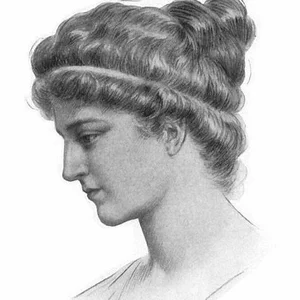
Imagined portrait of Hypatia: Jules Maurice Gaspard, published in Elbert Hubbard's Little Journeys to the Homes of Great Teachers (1908), via Wikimedia Commons. Public domain. Created almost fifteen centuries after Hypatia's death and not a historical likeness.
Historical map of ancient Alexandria: Historical reconstruction of ancient Alexandria, via Wikimedia Commons. Public domain. The map represents the ancient city broadly and should not be treated as an exact reconstruction of Alexandria in 415 CE.
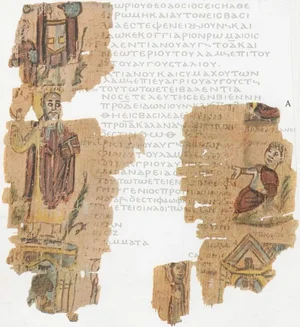
Alexandrian World Chronicle: Illustrated manuscript page from the Alexandrian World Chronicle, via Wikimedia Commons. Public domain. The manuscript belongs to a later chronicle tradition and does not depict Hypatia or provide contemporary evidence for her life.
Letters of Synesius of Cyrene: Greek manuscript containing the letters of Synesius of Cyrene, Bibliothèque nationale de France, Paris, Grec 1040, via Wikimedia Commons. Public domain reproduction. The manuscript was copied long after Synesius and Hypatia lived and is not an original fifth-century document.
Explore Related Profiles
Help Keep These Stories Alive
If you enjoyed reading this profile and believe more overlooked voices deserve to be heard, you can help fund future research, writing, and free educational resources.
Every contribution—whether a one-off donation or monthly support—helps create new historical profiles, downloadable materials, and articles that remain freely available to everyone.
Thank you for helping keep independent historical research and educational resources freely available.
