

Murasaki Shikibu
Historical Profile
The Writer Behind The Tale of Genji
Introduction
More than a thousand years after Murasaki Shikibu lived, The Tale of Genji remains one of the most important works in Japanese literature. Its fifty-four chapters follow the life, relationships and changing fortunes of Hikaru Genji, the "Shining Prince," before continuing into the experiences of a younger generation whose world appears increasingly marked by uncertainty. Nearly eight hundred poems are embedded within the prose, while characters age, relationships alter and decisions made early in the narrative continue to shape events many chapters later. People misunderstand one another, remember the same experiences differently and attempt to interpret feelings that are rarely stated directly.
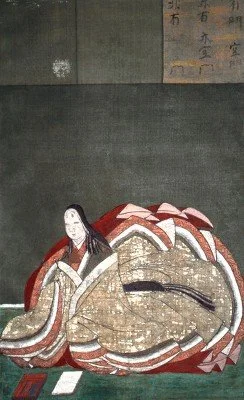
The work emerged from the aristocratic society of Heian Japan. Its author belonged to a scholarly but politically secondary branch of the Fujiwara clan, received an unusually substantial education in Chinese literature and later entered the household of Shōshi, daughter of the powerful statesman Fujiwara no Michinaga and consort of Emperor Ichijō. Within Shōshi's court, Murasaki observed a society in which marriage, childbirth, poetry, clothing, handwriting and family connections could all possess political as well as personal significance.
Alongside The Tale of Genji, a diary associated with Murasaki records events surrounding the birth of an imperial heir in 1008 and provides detailed observations of the women and men of the court. A collection of her poetry also survives. These writings preserve an unusually substantial body of work for a woman who lived approximately a thousand years ago, yet the basic outline of her biography remains incomplete. The name by which she is remembered was not her securely known personal name, while neither her birth nor her death can be dated precisely.
The central historical question is therefore not whether Murasaki should be assigned a modern literary title or presented simply as a woman born ahead of her time. It is how the particular conditions of Heian court society allowed a woman from an educated but politically secondary family to acquire the experience, learning and literary position from which one of the most enduring works of Japanese literature emerged.
The Heian Court and Fujiwara Power
Murasaki lived during the Heian period, traditionally dated from 794 to 1185. The period takes its name from Heian-kyō, the imperial capital established in 794 on the site of modern Kyoto. The city became the centre of an aristocratic political culture organised around the emperor, the imperial household and a relatively small number of elite families whose influence depended upon court office, marriage and access to the throne.
By Murasaki's lifetime, the Fujiwara clan had become particularly powerful. Leading members of the family did not usually attempt to replace the imperial dynasty. Instead, their influence developed through regencies, court appointments and marriage alliances in which Fujiwara daughters became imperial consorts. Sons born from these relationships could later become emperors whose maternal relatives occupied positions close to the centre of government.
Fujiwara no Michinaga became the dominant political figure of Murasaki's adult life. He arranged marriages connecting several of his daughters with the imperial family, and the position of those women depended partly upon their ability to attract imperial favour and produce sons. A daughter's household could therefore become an important political institution in its own right, attracting attendants whose poetry, music, calligraphy and literary ability enhanced the prestige surrounding an imperial consort.
Court culture formed part of this competition. Waka poems were exchanged during courtship, after meetings, during periods of separation and in response to seasonal events. A successful poem required more than emotional expression because its meaning could depend upon earlier poetry, established images and the precise circumstances in which it was sent. Handwriting, paper and even the choice of messenger contributed to the impression created by an exchange.
Clothing also communicated rank, season and taste. The combinations of colours visible in layered robes could be noticed and judged, while incense, musical performance and knowledge of literature formed part of the social language through which aristocratic people assessed one another. Refinement was not merely decorative; it could influence reputation, relationships and a household's standing within the court.
This was a highly literate society, but education was shaped by gender. Classical Chinese possessed enormous prestige and was associated with government, scholarship and the formal education of elite men. Male officials trained in Chinese texts and used forms of written Chinese within administration, while women of the court increasingly wrote in Japanese using kana, a phonetic writing system capable of representing the Japanese language more directly.
The division was never absolute. Men wrote Japanese poetry, and educated women could acquire knowledge of Chinese literature. Nevertheless, the association of Chinese learning with male education influenced which forms of knowledge women were expected to display publicly. Within this environment, vernacular Japanese writing developed with extraordinary sophistication. Works including The Kagerō Diary, The Pillow Book, the Sarashina Diary and The Tale of Genji emerged from a literary culture in which women wrote poetry, memoir, observation and fiction in Japanese.
Heian aristocratic women did not possess social equality with men. Their security could depend heavily upon family position, marriage and relationships with powerful male relatives, while many elite women spent substantial periods within enclosed domestic spaces and communicated through screens, curtains, letters and intermediaries. Yet imperial and aristocratic women's households also brought educated women together and created networks in which literature circulated, poetry was exchanged and reputation could be built through writing. Murasaki's career developed within this combination of restriction, elite opportunity and intense literary culture.
Family and Education
Murasaki was born into the northern Fujiwara clan, probably around 973. The date is conventional rather than certain because no surviving contemporary record states her year of birth or age. Modern chronologies are reconstructed from her marriage, family relationships, court service and later references.
Although Murasaki shared the Fujiwara clan name with Michinaga, her immediate family did not belong to the dominant political line controlling the highest offices of the court. Her branch possessed aristocratic status and access to education but depended more heavily upon government appointments and provincial service. This position placed Murasaki close enough to elite culture to understand it while leaving her family outside the centre of Fujiwara political power.
Her father, Fujiwara no Tametoki, was known for his learning in Chinese literature. He held court positions and later received provincial appointments. His official career was less distinguished than those of the most powerful Fujiwara statesmen, but his scholarly education created an intellectual environment within the household in which Murasaki grew up.
Murasaki's mother appears to have died while she was young, although the surviving evidence provides little detail about her childhood or the domestic circumstances of the family after her mother's death. Most of what can be said about her education comes from Murasaki's own later writing.
In her diary, she recalled listening while her brother studied Chinese texts and claimed that she often understood passages more quickly than he did. According to Murasaki, her father regretted that she had not been born male. The episode was written retrospectively rather than recorded at the time, but the wider evidence strongly supports her substantial knowledge of Chinese literary traditions.
Chinese historical and poetic allusions appear throughout her writing. The poetry of Bai Juyi was particularly influential in Heian Japan and formed part of the literary world available to Murasaki, while Chinese histories and literary texts supplied references that educated readers could recognise within The Tale of Genji. Her education therefore gave her access to material associated strongly with male scholarship.
The social difficulty lay not simply in acquiring such knowledge but in displaying it. Murasaki later described deliberately concealing the extent of her Chinese learning and claimed that she avoided writing even simple Chinese characters in front of other women because she feared criticism for appearing eager to show knowledge considered pretentious or inappropriate in a court woman.
Her account should not be interpreted as proof that every Heian woman was forbidden to learn Chinese. Women could encounter Chinese literature through family education, religious texts and court culture, and Murasaki's own life demonstrates that substantial learning was possible. What her diary reveals more clearly is the difference between possessing knowledge and being socially free to advertise it. Her education became one of the foundations of her literary career, but she appears to have managed carefully the way that education was perceived by others.
A Name We Do Not Know
"Murasaki Shikibu" was not the writer's securely known personal name. This was not unusual among women of the Heian court, who were often identified through titles, court positions or the offices and ranks of male relatives. Several important Heian women writers are therefore remembered by designations that do not function like modern personal names and surnames.
"Shikibu" derives from the Shikibu-shō, the Ministry of Ceremonial Affairs, with which Murasaki's father was associated. The origin of "Murasaki" is less certain but is commonly connected with Murasaki no Ue, one of the principal women in The Tale of Genji. Murasaki's diary records Fujiwara no Kintō asking whether "young Murasaki" was present, apparently making a playful reference to the fictional character and to the writer associated with the tale.
This suggests that the name of one of Murasaki's own characters became attached to its author. Another possibility concerns a woman recorded in Michinaga's diary in 1007 as Fujiwara no Kaoruko, whose name may also be read Kyōshi. Some scholars have proposed that this woman was Murasaki Shikibu, but the identification remains uncertain because no surviving evidence conclusively connects that personal name with the author of The Tale of Genji.
The loss of Murasaki's personal name does not demonstrate deliberate historical erasure. It reflects the naming and record-keeping practices of the society in which she lived. Official records were particularly concerned with the ranks, offices and careers of men serving within government, while women often appeared through family relationships or household positions without the personal names by which they may have been known privately being preserved consistently.
In Murasaki's case, the designation associated with her court identity and literary reputation survived, while her personal name did not.
Echizen, Marriage and Widowhood
In 996, Fujiwara no Tametoki received an appointment as governor of Echizen Province, on the coast of the Sea of Japan in what is now Fukui Prefecture. Murasaki appears to have accompanied him, and her poetry contains material associated with the journey and her time away from the capital, although the exact length of her stay remains uncertain.
The movement from Heian-kyō to Echizen represented one of the few securely traceable geographical changes in Murasaki's life. The lives of aristocratic court women were generally centred upon the capital and elite households, while provincial appointments placed officials within social and administrative environments that differed considerably from the imperial court.
Later readers have sometimes searched The Tale of Genji for landscapes or episodes supposedly derived from Murasaki's provincial experience. Such influences are possible, but the surviving evidence does not allow particular fictional scenes to be traced confidently to specific places she encountered in Echizen. The biographical importance of the journey does not depend upon proving a direct literary connection. It demonstrates that Murasaki had experienced life beyond the immediate court environment before becoming one of its most attentive observers.
She returned to the capital and married Fujiwara no Nobutaka, probably around 998. Nobutaka was considerably older and had children from other relationships. He belonged to the wider Fujiwara aristocracy and had held official appointments.
Their daughter was born around 999 and later became known as Daini no Sanmi. Like her mother, she is remembered primarily through a court designation rather than a securely preserved personal name in the modern sense. She became an accomplished poet whose work was included in imperial collections and developed a literary reputation independent of Murasaki.
Murasaki's marriage was brief because Nobutaka died in 1001. Some accounts connect his death with an epidemic affecting the capital, although the precise circumstances remain uncertain. Murasaki's poetry from the period after his death contains expressions of grief, loneliness and uncertainty, while a later passage associated with her widowhood describes time passing in a state of listlessness.
These writings provide valuable evidence for her response to the period, but Heian poetry also possessed established conventions for expressing grief and separation. The poems should therefore neither be dismissed as empty literary formulae nor treated as an unedited record of private feeling.
At some point around these years, Murasaki began composing The Tale of Genji. The precise date cannot be recovered. She may have started the work before Nobutaka's death, during her widowhood or through a process in which earlier stories and chapters gradually developed into a larger narrative. Her diary confirms that Genji was already known at court by 1008, but it does not explain how or when the tale began.
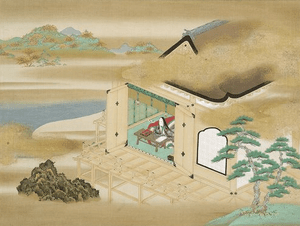
A later tradition placed the moment of inspiration at Ishiyama-dera, a Buddhist temple overlooking Lake Biwa. According to the story, Murasaki looked towards the moon and began writing The Tale of Genji. The scene became one of the most enduring artistic images associated with her, but no contemporary evidence establishes that the tale began in this way. The Ishiyama tradition belongs more securely to Murasaki's later cultural memory than to her documented biography.
The composition of a work extending across fifty-four chapters was almost certainly a longer and more complex process.
The Tale of Genji
The Tale of Genji, or Genji Monogatari, begins with the birth of Hikaru Genji, a son of an emperor and a lower-ranking consort. His mother's limited family support makes his position politically vulnerable, and he is eventually removed from the line of imperial succession and assigned to the Minamoto clan.
The narrative follows Genji through the aristocratic world of the court. He is exceptionally handsome, talented in poetry and music and skilled in the forms of behaviour admired within Heian elite society. These accomplishments contribute to the attraction he exercises over others, but Murasaki does not present him as morally uncomplicated.
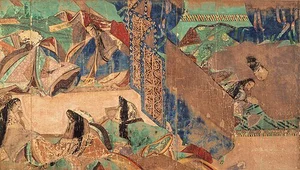
His relationships with women form a large part of the narrative. Some of those women possess powerful families and secure households, while others are isolated or depend upon relatives whose support is limited. Their circumstances affect their ability to respond to Genji, and the tale repeatedly reveals how differences in family position and social protection shape personal relationships.
The narrative includes relationships that modern readers may find deeply troubling, including coercive behaviour and Genji's involvement with women whose age or position creates substantial inequalities of power. Murasaki does not offer a modern legal or political analysis of these relationships, but she repeatedly shows their consequences. Women experience fear, jealousy, abandonment and insecurity, while encounters remembered nostalgically by Genji may have been experienced very differently by the women involved. His grief and emotional sensitivity coexist with actions that cause suffering.
The tale rarely reduces a character to one quality. Genji changes as he ages, and the women around him develop their own emotional histories. Earlier relationships influence later decisions, while memories of dead or absent people continue to shape the living. Murasaki's characters are formed not only by what happens to them but by the ways in which they remember, conceal or reinterpret what has happened.
Communication is frequently incomplete. Men and women exchange poems whose meaning depends upon literary allusion and shared context, while curtains, screens and darkness restrict what characters can see. Letters can be delayed, intercepted or misunderstood. People interpret one another through fragments of information, and readers are often allowed to understand anxieties or motives that remain hidden from the other characters.
Murasaki uses these conventions as part of the structure of the narrative. Misunderstandings arise not simply because individuals are foolish but because their society requires them to communicate indirectly and to protect reputation through concealment.
The work also changes across its long chronology. Genji does not remain permanently young, and his political position, relationships and understanding of himself develop over time. People who once dominated the narrative disappear, while earlier choices continue to affect the next generation.
After Genji's death, the tale continues through the lives of Kaoru and Niou. The final ten chapters, commonly known as the Uji chapters, possess a darker and more uncertain atmosphere and end without complete resolution.
The Tale of Genji is frequently described as the world's first novel or as one of the earliest novels in world literature. The description is based particularly upon the scale of the work, its sustained fictional world, the development of characters across time and its close attention to memory and changing relationships.
Earlier societies had already produced long prose narratives and sophisticated works of fiction, while Murasaki herself wrote within the Japanese tradition of monogatari, or tales, rather than a literary category equivalent to the modern novel. The classification therefore depends partly upon how the term is defined.
What the surviving work demonstrates more directly is the extent to which Murasaki expanded the possibilities of extended Japanese prose fiction. She followed characters across decades and generations while allowing previous events and emotional histories to continue shaping later lives.
Writing Among the Women of the Heian Court
Murasaki belonged to an extraordinary literary culture rather than writing in isolation. The woman known as the Mother of Michitsuna wrote The Kagerō Diary, an account shaped by marriage, disappointment and the instability of a relationship with a powerful Fujiwara man. Sei Shōnagon produced The Pillow Book, a collection of observations, anecdotes and lists associated with the household of Empress Teishi. The author of the Sarashina Diary later described a life strongly influenced by her desire to read tales, including The Tale of Genji.
These women did not belong to a formal literary movement and wrote within different households and circumstances. Their works also differed substantially in form, tone and purpose. Nevertheless, together they demonstrate the extraordinary range of writing produced by aristocratic women within Heian court culture.
The comparison between Murasaki and Sei Shōnagon has attracted particular attention. Murasaki's diary contains a sharply critical description of Sei Shōnagon, accusing her of self-satisfaction and suggesting that her display of Chinese learning was careless. The passage is genuine evidence for Murasaki's opinion but does not establish the dramatic personal rivalry often created in later popular accounts.
Sei Shōnagon had served Empress Teishi, whose court had declined before Murasaki became established in Shōshi's household. Their different affiliations were politically meaningful because Teishi and Shōshi were connected with competing branches of Fujiwara power, while literary accomplishment contributed to the cultural reputation of each woman's court.
Murasaki's criticism also reveals something about her own concerns. She disapproved of another woman displaying Chinese knowledge too confidently while presenting herself as someone who deliberately concealed similar learning. The contrast suggests that the social presentation of education mattered to Murasaki almost as much as education itself.
Women's writing in Japanese developed partly within these court environments. Kana allowed writers to represent Japanese more directly, and prose works could incorporate the rhythms, vocabulary and social conventions of spoken and poetic communication. It would be too simple to describe kana as a women's language from which men were excluded, because men used it and read vernacular literature.
The historical importance of Heian women's writing lies instead in the concentration of surviving major works produced by women whose court households gave them access to literary networks while gendered education directed much formal Chinese scholarship towards men. Murasaki's career formed part of this wider culture, and placing her within it makes her achievement more historically understandable without diminishing its scale.
Entering Shōshi's Court
Murasaki entered the service of Shōshi during the first decade of the eleventh century, probably around 1005 or 1006. The exact circumstances of her appointment are unknown.
Shōshi was a daughter of Fujiwara no Michinaga and a consort of Emperor Ichijō. Michinaga's political position depended heavily upon the success of his daughters within the imperial household, and a consort's court could enhance its reputation through the presence of accomplished attendants.
Murasaki's growing literary reputation may have contributed to her recruitment. By 1008, The Tale of Genji was sufficiently well known for people at court to refer to its characters and associate Murasaki with the work. It is therefore reasonable to suggest that her writing made her valuable within a household where literary accomplishment supported political and cultural prestige, although no surviving document records Michinaga explaining why she was appointed.
Murasaki's diary suggests that she initially found court service uncomfortable. She described herself as reserved and sometimes withdrew from social interaction, while worrying that other women might regard her as excessively learned. At the same time, she observed those around her with considerable severity and judged their clothing, conversation, handwriting and literary knowledge.
These passages have often encouraged modern readers to construct a detailed personality for Murasaki, but the diary permits more cautious conclusions. She chose to present herself as a woman conscious of social judgement and aware that her own behaviour was being observed. Whether every description reflects spontaneous private feeling cannot be established because the diary is a shaped literary text rather than a complete daily record.
Her observations nevertheless reveal a close understanding of court society. Literary ability, Chinese learning and association with Genji had made her visible within a world where reputation was created through repeated acts of interpretation. Murasaki was not observing this society from outside, and the same attentiveness she directed towards others could be directed towards her.
Shōshi and the Birth of an Imperial Heir
The central datable event in Murasaki's diary is the birth of Shōshi's son Atsuhira in 1008. The child later became Emperor Go-Ichijō, and for Michinaga the birth possessed enormous political significance because a male imperial grandson strengthened his family's position and increased the likelihood that he would exercise influence as maternal grandfather to a future emperor.
Murasaki recorded the events surrounding the pregnancy and birth from within Shōshi's household. Her account describes prayers, ceremonies, attendants and the atmosphere of expectation surrounding the consort. Buddhist monks and other religious specialists performed rites intended to protect Shōshi and assist the safe delivery of the child.
Childbirth was physically dangerous, while the political future of one of Japan's most powerful families depended partly upon its outcome. Murasaki's position allowed her to observe both realities simultaneously.
Male court diaries and political records also preserve information concerning the birth, establishing dates, ceremonies and the activities of important officials. Murasaki's diary records the environment within the women's quarters, including attendants, clothing, movement through the household and the immediate reactions of those present.
Her account demonstrates that dynastic politics did not occur only in government offices. The Fujiwara system of influence depended upon marriages between imperial men and Fujiwara women, but it also depended upon pregnancy, childbirth and the survival of children. Shōshi's body therefore occupied a political position even while the experience of childbirth took place within a predominantly female space.
Murasaki did not need to write a formal political argument for her diary to become politically valuable evidence. Her account preserves activities and perspectives that official administrative records often approached from another position or recorded only briefly.
Chinese Learning and the "Lady of the Chronicles"
Murasaki's knowledge of Chinese remained visible despite her attempts to control how openly she displayed it. Her diary records an episode in which The Tale of Genji was read aloud in the presence of Emperor Ichijō. According to Murasaki, the emperor remarked that the author appeared to have read the Chronicles of Japan, after which another court woman referred to Murasaki as the "Lady of the Chronicles."
The nickname was not necessarily intended as praise, and Murasaki responded defensively by insisting that she avoided displaying her learning. She claimed that she hesitated to reveal knowledge even among women in her own household and would hardly choose to flaunt it publicly at court.
The episode provides direct evidence for the social tension surrounding her education. The knowledge visible in Murasaki's writing contributed to the reputation of Genji, yet the same learning could be interpreted as pretentious if displayed too openly by a woman.
Murasaki later described reading Chinese literature privately with Shōshi, referring particularly to works associated with Bai Juyi. The lessons were conducted discreetly during moments when other people were not present, and Murasaki did not present them as formal public instruction.
The evidence does not support portraying her as a campaigner demanding general educational equality for women. Her actions were more specific and cautious. She possessed knowledge that social expectations encouraged her to conceal, used that knowledge throughout her writing and shared part of it with one of the most politically important women in Japan.
The historical significance lies in the contrast between intellectual ability and acceptable public display. A woman whose father reportedly regretted that her learning had not belonged to a son later used that education in a major literary career and quietly transmitted part of it to an imperial consort.
The Diary and Murasaki's Literary Self
The Diary of Murasaki Shikibu is one of the most important sources for her life, although its modern title can create the expectation of a continuous daily record. The surviving work concentrates particularly upon events from around 1008 to 1010 and combines detailed descriptions of court ceremonies with personal reflections and passages that may have developed from letters or memoir.
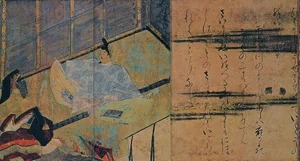
A substantial part concerns Shōshi and the births of her sons, while Murasaki also writes about Michinaga, other court women and her own position within the household. The result is an unusual source that records identifiable historical events while also presenting a carefully shaped literary voice.
Murasaki can appear melancholy, withdrawn and highly critical of others. She worries about how she is judged while judging those around her in return. These passages provide evidence for the way she represented herself, but they do not allow every aspect of her personality to be recovered directly.
She was an experienced writer whose fiction demonstrates a sophisticated understanding of perspective, indirect communication and the difference between private thought and public behaviour. Her diary must therefore be read as the work of someone capable of shaping a narrative identity rather than as an unfiltered record of emotion.
This does not make the diary historically unreliable. It records people and events that can sometimes be compared with other court sources, while its descriptions of Shōshi's household provide information unavailable in equivalent detail elsewhere. The methodological distinction concerns personal interpretation.
When Murasaki describes herself as reserved, historians can establish that she chose to present herself in that way. Whether the description explains her behaviour in every circumstance cannot be known. Her criticism of Sei Shōnagon likewise securely records Murasaki's judgement but does not provide a complete account of the other writer's personality.
The diary is therefore both evidence for Heian court society and evidence for Murasaki's literary self-presentation. Its value increases when those functions are distinguished rather than treated as identical.
Authorship, Manuscripts and Transmission
No manuscript of The Tale of Genji written in Murasaki's own hand survives. The work reached later centuries through handwritten copying, a process in which errors, omissions and differences in wording could enter between versions.
Murasaki's diary demonstrates that Genji was already circulating during her lifetime. She described manuscript production connected with the tale, including material copied by skilled calligraphers, while courtiers discussed characters from the work. The tale was therefore not a private manuscript discovered only after her death but had already entered the literary life of the court.
The Sarashina Diary provides further evidence of its early reputation. Its author described her intense desire to read tales and her delight when she obtained an extensive copy of The Tale of Genji. Her account refers to more than fifty chapters and to characters from late in the narrative, demonstrating that the work was already known in a form approaching the large tale familiar to later readers.
The exact process through which all fifty-four chapters reached their surviving form remains debated. Some scholars have proposed that chapters or groups of chapters circulated before the entire work was assembled, while differences in chronology, tone and narrative emphasis have produced long-standing questions about composition.
The Uji chapters have received particular attention because their darker atmosphere and concentration upon Kaoru and Niou differ from much of the earlier narrative. Murasaki's daughter has sometimes been proposed as a possible contributor, but no second author has been securely identified.
Changes in style do not by themselves prove multiple authorship. A long work composed over an extended period can develop substantially, and manuscript transmission introduces further uncertainty. The surviving evidence strongly supports Murasaki as the principal author of The Tale of Genji, while leaving the precise compositional history of individual chapters less certain.

Later scholars played an important role in preserving the text. Fujiwara no Teika, the thirteenth-century poet and textual scholar, became particularly influential in the manuscript tradition. The versions available to modern readers therefore preserve Murasaki's literary creation through centuries of copying, comparison and editorial work.
Poetry and Writing Beyond Genji
Murasaki's reputation is dominated by The Tale of Genji, but it was not her only writing. A poetic collection associated with her survives, and her waka belong to the broader culture of Heian court poetry in which short poems formed part of personal communication and literary reputation.
Waka generally followed a thirty-one-syllable pattern, but their limited length did not require simple expression. Poems could depend upon wordplay, seasonal imagery and references to earlier writing, while a reader's ability to recognise an allusion could transform the meaning of an exchange.
Poetry also appears throughout The Tale of Genji, which contains nearly eight hundred waka embedded within the narrative. Characters use poems during courtship, separation and mourning, and a verse may continue a conversation begun during an earlier meeting or respond indirectly to language used by another character.
The poems are therefore not decorative interruptions. They are actions performed by characters within a society where literary ability influenced relationships and where direct emotional expression was often limited by social convention.
This creates particular difficulties for translation. Modern readers outside Japan may not recognise references that an educated Heian audience would have understood immediately, while wordplay based upon Japanese vocabulary may have no exact equivalent in another language.
Different translators have consequently made different choices concerning names, court titles, notes, poetic form and cultural explanation. Murasaki's international reputation has developed partly through these acts of interpretation, meaning that readers in different languages may encounter substantially different experiences of the same work.
The Later Years
The details of Murasaki's life become increasingly difficult to reconstruct after the period covered by her diary. Emperor Ichijō died in 1011, after which Shōshi's political and household circumstances changed, although she remained an important imperial woman and the mother of future emperors.
Murasaki appears in evidence associated with Shōshi in the following years, but scholars disagree over how long she lived. The conventional date of her death is often given as around 1014, though this is not supported by a surviving death record. Some chronologies connect the date with changes in her father's career and with Murasaki's disappearance from securely identifiable records, while others argue that references to a woman serving Shōshi may indicate that she lived into the 1020s.
The disagreement depends partly upon identification. Court records do not always name women in a way that allows every reference to be connected securely with the writer known as Murasaki Shikibu. A later designation may describe Murasaki or another woman occupying a similar household role.
The evidence therefore supports an early eleventh-century death but does not establish a precise year. No detailed contemporary account records her final illness, circumstances or last years, and the surviving record simply becomes increasingly quiet.
Her daughter's later career is better documented. Daini no Sanmi entered court service and became known as a poet whose work appeared in imperial collections. There is no secure evidence that she completed The Tale of Genji or inherited a formal literary project from her mother, but her career demonstrates that female literary activity continued within the family into another generation.
Historical Interpretation and the Many Images of Murasaki
Murasaki's reputation developed rapidly. The Tale of Genji was known during her lifetime and circulated beyond her immediate court environment within the early eleventh century. Later writers, commentators and artists increasingly treated the work as a central part of Japanese literary culture.
The tale inspired extensive visual traditions. Scenes from Genji appeared in handscrolls, paintings, screens and decorative arts, while artists developed conventions through which characters and episodes could be recognised.
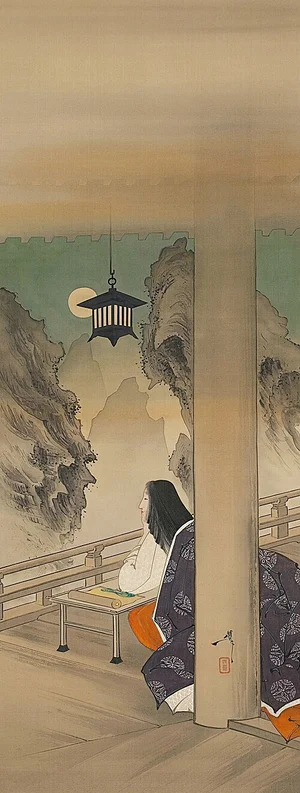
Murasaki herself also became an artistic subject. The Ishiyama-dera tradition was particularly influential, and paintings repeatedly depicted her seated at a writing desk while looking towards the moon at the moment she supposedly received inspiration for The Tale of Genji.
The image transformed a complex and poorly documented process of composition into a single recognisable scene. It is valuable evidence for Murasaki's later cultural memory but cannot be treated as a contemporary record of how Genji began.
Modern interpretations have created additional versions of her. She is frequently described as the world's first novelist, an early female genius or a woman who overcame the restrictions of her society through writing. Each description emphasises genuine aspects of her historical importance but also applies modern categories to a writer whose life belonged to a very different social structure.
Murasaki was an exceptionally accomplished author whose gender affected the educational and social expectations surrounding her. Her diary provides direct evidence that she worried about criticism connected with displaying Chinese learning, while her fiction pays sustained attention to women whose security depended upon family support and relationships with men.
These observations do not establish a modern political programme. Murasaki did not leave writings demanding legal equality or general reform of women's education, and she remained a member of the aristocratic society she described.
Her work is especially valuable because it does not reduce that society to a single verdict. The court of Genji can be beautiful, refined and intellectually sophisticated while also leaving people isolated and vulnerable. Murasaki represented both qualities without forcing them into a simple moral argument.
Sources and Historical Evidence
Murasaki Shikibu is unusually well documented for a woman who lived approximately a thousand years ago, but the surviving evidence remains uneven. The most important sources are the writings associated directly with her.
The Tale of Genji establishes her literary career and provides extensive evidence for her knowledge of court society, Chinese literary traditions and vernacular Japanese writing. It is nevertheless fiction, and its characters and events cannot automatically be treated as disguised autobiography. The social structures represented in the tale may reflect Murasaki's observations without individual episodes reproducing specific events from her own life.
The Diary of Murasaki Shikibu is more directly biographical because it records events within Shōshi's household and contains Murasaki's comments about her education, other court women and her own behaviour. The diary is also selective and literary, meaning that her presentation of herself was shaped through writing rather than preserved as an independent observation.
Her poetic collection provides additional evidence for relationships, emotional expression and events from different periods of her life. Poetic convention influences how directly individual statements can be translated into biography, but the poems remain important witnesses to her social and literary world.
Contemporary court records provide valuable comparison. Fujiwara no Michinaga and other male courtiers recorded ceremonies, appointments and political events that sometimes overlap with those described by Murasaki. An official diary may present the birth of an imperial child through ceremonies and political consequences, while Murasaki records activity within the women's household where the birth occurred. Neither perspective is complete, but together they permit a fuller reconstruction of court life.
Later biographies and artistic traditions require greater caution. The Ishiyama-dera inspiration story and subsequent portraits demonstrate how Murasaki was remembered but cannot supply missing contemporary evidence for her life.
The manuscript history of The Tale of Genji creates a separate difficulty. Murasaki's autograph is lost, and the surviving text reached later readers through centuries of copying and editorial transmission. Historians and literary scholars can therefore establish her authorship and the early reputation of Genji with considerable confidence while remaining less certain about the precise sequence of composition and the textual history of individual chapters.
The surviving evidence is extensive enough to reconstruct Murasaki's intellectual and court environment, but it is not complete enough to restore her personal name, exact chronology or private motives.
What We Know — and What We Do Not
What We Know — and What We Do Not
Firmly Supported
- Murasaki Shikibu lived during the late tenth and early eleventh centuries and belonged to a branch of the Fujiwara clan.
- Her father was Fujiwara no Tametoki, an official and scholar of Chinese literature.
- Murasaki possessed substantial knowledge of Chinese literary traditions.
- She married Fujiwara no Nobutaka and had a daughter.
- Nobutaka died in 1001.
- Murasaki's daughter later became known as Daini no Sanmi and developed her own reputation as a poet.
- Murasaki entered the household of Shōshi, daughter of Fujiwara no Michinaga and consort of Emperor Ichijō.
- She was present within Shōshi's court during the events surrounding the birth of Prince Atsuhira in 1008.
- Murasaki wrote The Tale of Genji.
- She also wrote poetry and a diary or memoir concerning her court experience.
- The Tale of Genji was known and discussed at court during Murasaki's lifetime.
- The work was circulating beyond her immediate household by the early eleventh century.
Strongly Supported but Requiring Interpretation
- Murasaki was probably born around 973.
- She appears to have accompanied her father to Echizen following his appointment in 996.
- Her Chinese education developed substantially within her father's scholarly household.
- Her literary reputation probably contributed to her appointment within Shōshi's household.
- Murasaki composed The Tale of Genji over an extended period.
- Her experience of Heian aristocratic society informed the social structures represented in the tale.
- Murasaki deliberately managed how openly she displayed her Chinese learning at court.
- Her writing demonstrates sustained awareness of the vulnerability experienced by women whose security depended upon family position and relationships with powerful men.
Uncertain or Unknown
- Murasaki's personal name.
- Whether she was the Fujiwara no Kaoruko or Kyōshi recorded in Michinaga's diary.
- Her exact year of birth.
- The full circumstances of her childhood.
- The complete process through which she acquired her education.
- The precise date on which she began writing The Tale of Genji.
- Whether Genji began before or after the death of her husband.
- Whether Murasaki visited Ishiyama-dera while beginning the tale.
- The exact order in which the chapters of Genji were composed.
- Whether another writer contributed to any part of the surviving work.
- The precise reason Murasaki was recruited into Shōshi's household.
- The full nature of her relationship with Michinaga.
- The extent to which particular characters or episodes in Genji were influenced by identifiable historical people.
- Murasaki's private political views.
- The exact year and circumstances of her death.
Historical Confidence
Historical Confidence
Existence, Family and Court Career: ★★★★★
Murasaki's family connections, marriage, daughter and service within Shōshi's household are supported by contemporary and near-contemporary evidence. The writer known as Murasaki Shikibu is securely historical even though her personal name remains uncertain.
Authorship of The Tale of Genji: ★★★★★
Murasaki's association with The Tale of Genji is established by evidence from her own lifetime and the early eleventh century. The broad attribution of the work to her is exceptionally strong.
Chinese Learning and Literary Education: ★★★★★
Murasaki discusses her knowledge of Chinese in her own diary, while her surviving writings demonstrate extensive engagement with Chinese literary traditions. The precise stages of her education are less well documented.
Court Service under Shōshi: ★★★★★
Murasaki's diary provides detailed evidence for her presence within Shōshi's household and her observation of major court events, particularly the birth of Atsuhira in 1008.
Personal Name: ★★
"Murasaki Shikibu" is a court and literary designation. Identification with Fujiwara no Kaoruko or Kyōshi remains possible but cannot currently be established confidently.
Birth and Death Chronology: ★★
Murasaki's birth is conventionally placed around 973, but no contemporary record gives her age or birth year. Her death is often dated around 1014, although disputed identifications have led some scholars to propose that she lived into the 1020s.
Composition of Individual Genji Chapters: ★★★
The work is securely associated with Murasaki, but the absence of an autograph manuscript and uncertainty surrounding the sequence of composition prevent the history of every chapter from being reconstructed with equal confidence.
Personality and Private Motives: ★★★
Murasaki's diary and poetry provide substantial first-person evidence, but both are literary works shaped by convention and deliberate self-presentation. They permit careful interpretation rather than unrestricted psychological reconstruction.
The Ishiyama-dera Inspiration Tradition: ★
The story that Murasaki began The Tale of Genji while looking at the moon at Ishiyama-dera became a major part of her later cultural image but is not established by contemporary evidence.
Key Contributions
Key Contributions
- The Tale of Genji: Murasaki created one of the most extensive and influential works of premodern Japanese fiction. Its sustained narrative follows characters across decades and generations while examining the continuing consequences of earlier relationships and decisions.
- Development of Extended Prose Fiction: Working within the monogatari tradition, Murasaki expanded the scale and complexity through which fictional lives could be represented in Japanese prose.
- Character and Psychological Development: Her writing explores memory, changing relationships and the difference between how characters understand themselves and how their behaviour affects others.
- Integration of Poetry and Prose: The Tale of Genji incorporates nearly eight hundred waka poems as part of its characters' communication and relationships.
- Record of Heian Court Culture: Murasaki's diary preserves detailed evidence concerning Shōshi's household and the events surrounding the birth of an imperial heir in 1008.
- Women's Literary History: Her career forms part of the extraordinary body of vernacular literature produced by women within Heian court society.
- Chinese and Japanese Literary Traditions: Murasaki's writing demonstrates extensive engagement with Chinese literature while developing Japanese prose through kana and the monogatari tradition.
- Long-Term Literary Influence: The Tale of Genji has been copied, commented upon, illustrated and translated for approximately a thousand years, becoming one of the central works of Japanese literary culture.
Key Dates
Conventional approximate date for Murasaki's birth. The exact year is unknown.
Murasaki receives an education that includes substantial exposure to Chinese literature within her father's scholarly household.
Fujiwara no Tametoki is appointed governor of Echizen Province. Murasaki appears to accompany him.
Murasaki marries Fujiwara no Nobutaka.
Their daughter, later known as Daini no Sanmi, is born.
Fujiwara no Nobutaka dies.
Murasaki composes The Tale of Genji. The precise date on which she began the work is unknown.
Murasaki probably enters the household of Shōshi.
Shōshi gives birth to Prince Atsuhira, the future Emperor Go-Ichijō. Murasaki records events surrounding the birth.
Murasaki's diary confirms that The Tale of Genji is already known and discussed at court.
The principal datable events described in The Diary of Murasaki Shikibu occur.
Murasaki privately reads Chinese literature with Shōshi.
Emperor Ichijō dies.
Evidence for Murasaki's later life becomes increasingly uncertain.
Traditional approximate period for Murasaki's death. Some scholarly reconstructions allow her to have lived into the 1020s.
The author of the Sarashina Diary describes obtaining an extensive copy of The Tale of Genji, demonstrating the work's early circulation and reputation.
The Genji Monogatari Emaki and related illustrated traditions demonstrate the growing visual interpretation of the tale.
Fujiwara no Teika and other scholars contribute to the textual transmission and study of The Tale of Genji.
Murasaki becomes a recurring subject in Japanese art, particularly through the tradition depicting her at Ishiyama-dera.
Translations and new editions bring The Tale of Genji to increasingly international audiences.
Did You Know?
Did You Know?
- Murasaki Shikibu was almost certainly not the writer's personal name.
- "Shikibu" refers to the Ministry of Ceremonial Affairs, with which her father was associated.
- "Murasaki" may have become attached to the writer through Murasaki no Ue, a major character in The Tale of Genji.
- Murasaki recalled that her father regretted she had not been born male because she understood Chinese texts more quickly than her brother.
- She later described concealing much of her Chinese learning because displaying it openly could attract criticism.
- Murasaki privately read Chinese literature with Shōshi.
- Her daughter, Daini no Sanmi, became a recognised poet.
- No manuscript of The Tale of Genji written in Murasaki's own hand survives.
- The work contains fifty-four chapters and nearly eight hundred waka poems.
- The Tale of Genji was already known and discussed at court during Murasaki's lifetime.
- The famous story that Murasaki began writing Genji while looking at the moon at Ishiyama-dera belongs to later tradition.
- Murasaki criticised Sei Shōnagon in her diary, but the evidence does not establish the sustained personal rivalry often imagined between them.
Further Reading
- Murasaki Shikibu, The Tale of Genji, translated by Royall Tyler
- Murasaki Shikibu, The Tale of Genji, translated by Edward G. Seidensticker
- Murasaki Shikibu, The Tale of Genji, translated by Dennis Washburn
- Richard Bowring, The Diary of Lady Murasaki
- Richard Bowring, Murasaki Shikibu: Her Diary and Poetic Memoirs
- Haruo Shirane, The Bridge of Dreams: The Poetics of The Tale of Genji
- Haruo Shirane, ed., Traditional Japanese Literature: An Anthology, Beginnings to 1600
- Haruo Shirane, ed., Reading The Tale of Genji: Sources from the First Millennium
- Doris G. Bargen, A Woman's Weapon: Spirit Possession in The Tale of Genji
- Norma Field, The Splendor of Longing in The Tale of Genji
- Edith Sarra, Fictions of Femininity: Literary Inventions of Gender in Japanese Court Women's Memoirs
- Tomiko Yoda, Gender and National Literature: Heian Texts in the Constructions of Japanese Modernity
- Melissa McCormick, The Tale of Genji: A Visual Companion
- Studies of Fujiwara no Michinaga and political culture in the Heian court
- Research on kana and vernacular writing in Heian Japan
- Studies of Heian women's diaries and court literature
- Research on the manuscript transmission of The Tale of Genji
- Studies of the Genji Monogatari Emaki and the visual reception of Murasaki Shikibu
Legacy and Historical Significance
Murasaki Shikibu's historical importance rests first upon the surviving body of writing associated with her. The Tale of Genji created an extended fictional world in which characters develop across decades, relationships established early in the narrative continue to influence later events, and memory affects the ways in which people understand both themselves and one another.
She did not create Japanese prose fiction from nothing. Earlier monogatari existed, and Heian women had already produced sophisticated poetry and autobiographical writing. Murasaki belonged to a wider literary culture that included the Mother of Michitsuna, Sei Shōnagon and other women whose works survive.
Her contribution was to develop those possibilities on an exceptional scale. The sustained chronology of Genji, its changing perspectives and its attention to the consequences of relationships allowed fictional characters to acquire histories that continued to shape them as they aged.
The social world represented in the tale was one Murasaki understood closely. She belonged to the aristocracy but not to its most powerful political line. Her father's household gave her access to Chinese literature, while her later service to Shōshi placed her within a court central to Fujiwara dynastic politics.
These experiences cannot be used as a simple key through which every fictional character or event can be identified with a historical equivalent. They did, however, give Murasaki detailed knowledge of the structures within which her fiction operated. She understood a society in which poetry could continue a conversation, handwriting could influence reputation and women might possess substantial education while remaining dependent upon family position and relationships with powerful men.
Her diary demonstrates the care with which she navigated those expectations herself. Murasaki's Chinese learning contributed to her writing, but she described concealing it to avoid criticism. She privately read Chinese literature with Shōshi while presenting those lessons as discreet rather than public instruction. Her experience reveals the difference between possessing education and being socially free to display it.
The diary also extends Murasaki's historical importance beyond literature. Her account of Shōshi's household during the birth of Atsuhira preserves a perspective on Fujiwara politics different from that of male officials. The birth of an imperial son was a major dynastic event, yet its physical experience and immediate organisation took place within women's quarters. Murasaki recorded that environment and thereby preserved part of the political process that formal records approached from another direction.
The survival of her work depended upon later readers. No autograph manuscript of The Tale of Genji remains, and the text was copied, compared and transmitted across centuries. Scholars such as Fujiwara no Teika played important roles in preserving textual traditions, while artists transformed scenes from the tale into handscrolls, paintings and screens.
Each stage of transmission also produced interpretation. The later image of Murasaki looking towards the moon at Ishiyama-dera became one of the most recognisable scenes associated with her, even though contemporary evidence does not establish that the tale began there. Modern descriptions of her as the world's first novelist likewise draw attention to important qualities of Genji while applying a later literary category to an eleventh-century Japanese monogatari.
Murasaki's historical position lies within these complexities. She was neither completely excluded from learning nor free from gendered expectations. She acquired substantial Chinese education within her father's household, used it throughout her writing and shared part of it privately with Shōshi, while remaining aware that displaying such knowledge too openly could damage her reputation.
Although the surviving evidence cannot restore her personal name, exact dates or the complete chronology of her later life, it establishes the scale of her literary contribution with unusual clarity. Through The Tale of Genji, her diary and her poetry, Murasaki recorded the social intelligence, political pressures and emotional complexity of the Heian court in forms that continued to shape Japanese literature long after the society she described had changed.
Image Credits
Portrait of Murasaki Shikibu: Later traditional portrait of Murasaki Shikibu, via Wikimedia Commons. Public domain. No contemporary portrait of Murasaki survives.
Genji Monogatari Emaki: Scene from the illustrated Tale of Genji handscroll tradition, via Wikimedia Commons. Public domain. Created after Murasaki's lifetime and representing the later visual interpretation of her work.
Fujiwara no Teika's Meigetsuki: Manuscript page written by Fujiwara no Teika, Tokyo National Museum, via Wikimedia Commons. Public domain. The manuscript is not a copy of The Tale of Genji; it is included in connection with Teika's later importance to Japanese textual scholarship and the transmission of Genji.
Murasaki Shikibu at Ishiyama-dera: Later Japanese depiction of Murasaki Shikibu at Ishiyama-dera, via Wikimedia Commons. Public domain. The image represents the later inspiration tradition rather than a documented event from Murasaki's life.
The Diary of Murasaki Shikibu manuscript: Manuscript from the later textual tradition of Murasaki Shikibu's diary, via Wikimedia Commons. Public domain. No autograph manuscript in Murasaki's own hand survives.
Murasaki Shikibu at Ishiyama-dera by Tsukioka Yoshitoshi: Tsukioka Yoshitoshi, nineteenth-century depiction of Murasaki Shikibu at Ishiyama-dera, via Wikimedia Commons / The Metropolitan Museum of Art. Public domain.
Explore Related Profiles
Help Keep These Stories Alive
If you enjoyed reading this profile and believe more overlooked voices deserve to be heard, you can help fund future research, writing, and free educational resources.
Every contribution—whether a one-off donation or monthly support—helps create new historical profiles, downloadable materials, and articles that remain freely available to everyone.
Thank you for helping keep independent historical research and educational resources freely available.
