

Julia Domna
Historical Profile
The Syrian Empress at the Centre of Rome
Introduction
Julia Domna was born in Emesa, in Roman Syria, and died more than fifty years later as one of the most prominent women in the Roman Empire. She married Septimius Severus before his rise to imperial power, became empress after the civil wars of 193 CE, travelled with the imperial court, appeared widely on coinage and official monuments, received extraordinary titles, became associated with philosophers and writers, and remained close to imperial administration under her son Caracalla.
She was the wife of one emperor and the mother of two more. Those relationships were central to her political importance, but they should not reduce her to a place in a dynastic family tree. Roman imperial government depended not only upon formal office, but also upon proximity, access, patronage, family networks and the practical operation of the court. Julia stood where many of those systems met.
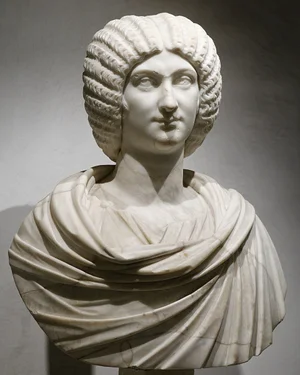
Her image circulated across the empire. Cities honoured her. Petitioners and embassies sought her assistance. Intellectuals entered her circle. Under Caracalla, ancient evidence associates her with correspondence and administrative business while the emperor concentrated increasingly upon military affairs. Julia possessed none of the constitutional powers attached to the imperial office. Her authority operated differently: through dynasty, visibility, mediation, administration and personal access to the emperor.
This distinction matters because Roman history often struggles to describe women who exercised influence without holding the offices through which power was formally defined. Julia Domna does not fit comfortably into either of the familiar extremes of powerless imperial wife or hidden ruler behind the throne.
Her position was more complex. She was a Syrian-born empress whose family helped reshape the Roman imperial centre. She stood beside power, travelled with it, mediated access to it and became part of the way the Severan dynasty represented itself to the world.
Emesa and the Roman Syrian World
Julia was born around 160 CE in Emesa, the city now known as Homs in Syria. By the second century CE, Syria had long been incorporated into the Roman Empire. The region was politically Roman, culturally diverse and deeply connected with the wider eastern Mediterranean. Greek was widely used in education, administration and elite intellectual life, while local languages, religious traditions and family identities remained important.
Emesa was not an isolated provincial town. It stood within trade and political networks linking Syria with the Mediterranean, Mesopotamia and Arabia. Julia's family belonged to the city's elite. Her father, Julius Bassianus, was associated with the priesthood of the local deity Elagabal. The family's religious position carried status, influence and access to resources.
The name Julius also reflected Roman citizenship and participation in imperial society. Julia should therefore not be imagined as a foreign outsider entering a civilisation wholly unfamiliar to her. She was born inside the Roman Empire, into a prominent family already connected with Roman political structures. At the same time, her Emesene identity mattered. Her wider family remained rooted in Syria, and those connections would later prove decisive in the survival of the Severan dynasty.
The imperial family that emerged from Julia's marriage was strikingly provincial in origin. Septimius Severus was born at Lepcis Magna in North Africa, while Julia came from Emesa in Syria. Their sons would rule from Rome, but their family embodied an empire whose political elite was no longer drawn only from Italy. Julia did not represent the east entering Rome from outside. She represented the empire's provinces moving towards its centre.
Marriage to Septimius Severus
Julia married Septimius Severus in 187 CE. Severus had already pursued a successful senatorial and administrative career and had previously been married. His first wife, Paccia Marciana, had died. Later accounts connect his decision to marry Julia with astrology. According to the Historia Augusta, Severus discovered that Julia's horoscope predicted she would marry a king and sought her as his wife.
The story suited later events perfectly. Severus was known for his interest in astrology, and Julia did indeed marry a future emperor. Yet the source was written much later and frequently mixes historical information with literary embellishment. Julia's prominent family background may have made the marriage socially or politically attractive. Beyond that, the surviving evidence does not allow us to reconstruct Severus's motives or Julia's role in the arrangement.
Their first son, Lucius Septimius Bassianus, was born in 188 CE. He would later be known as Caracalla. A second son, Publius Septimius Geta, followed in 189. Within a few years, Julia's family would be drawn into a struggle for control of the Roman Empire.
The Crisis of 193 CE
The emperor Commodus was assassinated at the end of 192 CE. His death triggered a rapid collapse of political stability. Pertinax briefly became emperor before members of the Praetorian Guard murdered him. Didius Julianus then obtained imperial recognition in Rome, while powerful provincial commanders advanced their own claims.
Septimius Severus was proclaimed emperor by troops in Pannonia. Pescennius Niger received support in the eastern provinces. Clodius Albinus controlled forces in Britain and western Europe. The resulting conflict is often described as the Year of the Five Emperors.
Severus acted quickly. He marched on Rome, removed Julianus and then defeated the rival commanders who threatened his position. Julia became empress. Her elevation was not the result of a peaceful succession. Severus had secured power through military support and civil war. His immediate problem was therefore not merely governing the empire, but convincing the Roman world that his victory represented the beginning of legitimate and stable rule. Julia and their sons became central to that project.
Building the Severan Dynasty
Septimius Severus had won the empire, but military victory alone could not guarantee succession. The new regime needed to present itself as a dynasty rather than as the temporary rule of another successful general.
Julia, Caracalla and Geta became essential to Severan political imagery. Coins, inscriptions and portraits distributed the image of the imperial family across the empire. Julia's portrait appeared repeatedly, often with the elaborate waved hairstyle that became one of her most recognisable visual features.
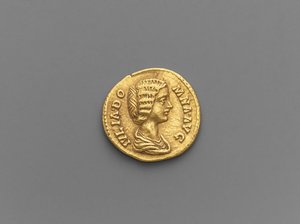
Her role as mother was not politically passive. In a hereditary imperial system, motherhood represented continuity. Julia had produced sons who could succeed Severus, and the regime used that fact publicly. Caracalla was linked symbolically with the preceding Antonine dynasty and raised progressively through imperial ranks. Geta also received honours designed to place him within the future of Severan rule.
Julia's image was associated with deities and ideals connected with fertility, harmony, protection and maternal authority. Such imagery did not merely celebrate family life. It offered the empire a political message: Severan rule had heirs, order and a future. The emperor stood at the centre of the state, Julia represented dynastic continuity, and the sons embodied succession. Together they formed the political family through which Severus attempted to transform military victory into lasting legitimacy.
Empress and the Travelling Court
Roman emperors did not govern only from Rome. Military campaigns, provincial crises and political obligations repeatedly drew Septimius Severus away from the capital. Julia travelled with the imperial court through several parts of the empire.
Her presence on campaign helped make her publicly visible as part of the ruling household. She accompanied an imperial government that moved between Rome, the eastern provinces, North Africa and eventually Britain. This mattered because Roman government was intensely personal.
Formal institutions existed, but access to the emperor could determine whether a petition was heard, an appointment secured or a city received favour. Members of the imperial family could act as intermediaries between the ruler and those seeking assistance. Julia appears to have occupied such a position.
Cities honoured her. Embassies approached her. Individuals treated access to her as politically useful because she was close to Severus and therefore close to the person whose decisions mattered most. Influence of this kind is difficult to measure. It rarely appears as a clear decree stating that Julia decided a particular policy. Yet the willingness of communities to honour and approach her shows that contemporaries believed her intervention could have consequences.
In a political system organised around proximity, Julia's position beside the emperor created a real form of authority.
Mother of the Camps
In 195 CE, Julia received the title Mater Castrorum, Mother of the Camps. The title had previously been used for Faustina the Younger, wife of Marcus Aurelius. It connected an imperial woman symbolically with the Roman army.
Julia accompanied Severus during military campaigns, but the title was not a military rank. It did not mean that she commanded legions or directed battlefield operations. Its importance was ideological. Septimius Severus owed his throne to soldiers. The Severan regime depended heavily upon military loyalty, and the imperial family needed to present itself as closely connected with the army.
Maternal language offered one way to describe that relationship. Julia could be portrayed as the symbolic mother of the soldiers and the military communities upon whom the emperor relied. The title placed Julia within the bond between the dynasty and the army while preserving the emperor's formal military authority. It also illustrates how Roman political language could transform motherhood into a public and dynastic role.
Court Rivalry and Plautianus
Julia's status did not protect her from political danger. Gaius Fulvius Plautianus, a relative and long-standing associate of Severus, rose to enormous influence as Praetorian prefect. His daughter Plautilla married Caracalla, placing Plautianus's family close to the succession.
Ancient sources describe hostility between Plautianus and Julia. Cassius Dio claims that Plautianus attempted to gather accusations against her, including rumours concerning sexual conduct. Such claims belong to a familiar Roman political pattern in which women close to power were attacked through allegations of immorality.
The precise details are difficult to establish, but the wider rivalry is plausible. Plautianus had become one of the most powerful men in the empire, and his family connection through Plautilla threatened Julia's influence within the dynasty. The episode reveals the limits of Julia's position. She remained empress, but she held no independent office that placed her beyond the reach of court competition. Her influence depended upon relationships, access and the continuing favour of Severus.
Plautianus eventually fell in 205 CE. He was killed after accusations that he had plotted against Severus and Caracalla. Julia survived the crisis, but proximity to power could be as dangerous as it was advantageous.
Intellectual Patronage
Julia's association with philosophers, rhetoricians and writers became one of the most distinctive features of her public life. Cassius Dio connects her with philosophical study, while Philostratus describes her as part of an intellectual circle and identifies her as the patron behind his Life of Apollonius of Tyana.
Roman elite households often attracted scholars and writers. Patronage could provide money, status, introductions and protection. Julia's position near the emperor made her circle especially significant because it brought Greek intellectual culture into direct contact with imperial power. Her Syrian background also placed her within the eastern, largely Greek-speaking cultural world of the empire, where philosophy, rhetoric and literary culture flourished.
The evidence does not support the later image of Julia founding a university or formal academy. It does, however, support substantial intellectual patronage. Julia gathered learned people around her, participated in elite intellectual culture and commissioned an important literary work.
Philostratus and Apollonius of Tyana
Philostratus's Life of Apollonius of Tyana survives partly because of Julia's patronage. Apollonius had been a first-century philosopher and religious figure associated with Pythagorean ideas. By Julia's time, stories about his travels, teachings and extraordinary actions had accumulated.
Philostratus states that Julia encouraged him to write a literary life of Apollonius and provided material associated with an earlier memoir. The resulting work presented Apollonius as a travelling philosopher who debated rulers, discussed religious practice and confronted political authority.
Julia died before Philostratus completed the work, but her role in commissioning it remained part of its literary history. Later writers sometimes claimed that she wanted to create a pagan alternative to Christianity or a deliberate rival to Jesus. The evidence does not securely establish such a motive. Those interpretations reflect later religious controversies more clearly than Julia's documented intentions.
The more securely supported conclusion is significant enough: an empress from Syria helped shape the preservation of Greek philosophical and religious literature within the Roman Empire. A book survived because Julia wanted it written.
Britain and the Death of Severus
In 208 CE, Septimius Severus travelled to Britain to conduct military operations in the north. Julia accompanied the imperial family. Caracalla and Geta were also present. The Severan court had moved to the edge of the Roman world, and the campaign became the final major episode of Severus's reign.
The emperor was ageing and in poor health. He died at Eboracum, modern York, in February 211. Later tradition attributes to him final advice urging his sons to remain united, enrich the soldiers and disregard everyone else. Whether those were his exact words is uncertain.
The central political problem was real. Caracalla and Geta had inherited together, and they despised one another. Julia had spent years helping to embody a dynasty built around the promise of orderly succession. Now succession had arrived, and the two heirs threatened to destroy the family from within.
Two Emperors, One Family
After Severus's death, Caracalla and Geta became joint emperors. Their hostility quickly became impossible to conceal. Ancient accounts describe separate households, guarded spaces and deep suspicion. Herodian reports that a division of the empire was considered, with one brother ruling the west and the other controlling the east.
He also gives Julia a dramatic speech opposing the proposal. Ancient historians frequently composed speeches suitable to the occasion, so the words should not be treated as a direct transcript. The political logic is credible. A territorial division would have shattered the dynastic unity Julia had publicly represented for nearly two decades.
The brothers remained joint emperors. Their rivalry continued. In December 211 CE, Caracalla arranged a meeting with Geta in Julia's apartments. According to Cassius Dio, armed men attacked Geta there. He died while clinging to his mother, and Julia was wounded in the hand.
The details may have been shaped for emotional effect, but Geta's murder on Caracalla's orders is securely established. The political family promoted so carefully by the Severan regime had collapsed into fratricide.
The Erased Family Portrait
One surviving painted portrait from Roman Egypt captures the destruction of the Severan family more powerfully than any later retelling. The circular panel shows Septimius Severus, Julia Domna, Caracalla and Geta. Severus and Julia remain visible. Caracalla remains visible.
Geta's face has been deliberately erased. After his murder, Caracalla imposed a condemnation of Geta's memory. His name was removed from inscriptions, his portraits were attacked and public references to him were suppressed.

Julia's maternal identity had been central to Severan political imagery. She was publicly presented as the mother of the dynasty's future. The damaged portrait reveals what happened when that future became politically impossible. The image survived. The united family it advertised did not.
After Geta's Murder
Ancient writers describe Julia's grief after Geta's death, but they do not give us reliable access to her private emotions. Cassius Dio states that she was forbidden to mourn publicly. In a regime committed to destroying Geta's memory, visible grief could be interpreted as political opposition to Caracalla.
Julia remained at court. This has sometimes been portrayed as evidence that ambition mattered more to her than maternal loss. That conclusion goes beyond the evidence. Julia's position, safety and entire adult life were tied to the imperial household. Her surviving son was emperor. Open resistance could have led to exile or death, and leaving the court would not have restored Geta.
Remaining tells us what she did. It does not reveal what she felt. Julia stayed within Caracalla's regime, and under him her administrative responsibilities appear to have increased.
Administration Under Caracalla
Caracalla spent much of his reign travelling with the army and pursuing military ambitions. Cassius Dio associates Julia with imperial correspondence and petitions during this period. He states that she dealt with letters in Greek and Latin, except in especially important cases, and handled requests reaching the imperial court.
This is strong evidence of practical involvement in government. Julia was not merely appearing on coins or receiving ceremonial honours. She participated in the administrative work through which imperial decisions were organised and communicated.
Her role still depended upon Caracalla's authority, but reducing her to a ceremonial mother would be misleading. The Roman Empire generated an enormous volume of correspondence, petitions and administrative business, and Julia helped manage part of that work. Her titles expanded further. She was described as mother of the emperor, the camps, the Senate and the fatherland. Such language symbolically connected her with the institutions and people of the Roman state.
She had no senate seat and no imperial magistracy. Yet the political community was repeatedly described through maternal language centred upon her. This was a highly visible form of imperial authority, even if it remained structurally different from the power of the emperor.
What Kind of Power Did Julia Possess?
Julia's power cannot be measured only by asking whether she issued laws or commanded armies. Her influence operated through several overlapping systems. She stood within the imperial family and helped provide dynastic legitimacy. Her access made her useful to cities, embassies and petitioners. She travelled with the court, participated in correspondence and administrative work, patronised writers and intellectuals, and became one of the most visible members of the imperial household.
She also depended upon the emperor. Her position was strongest when her relationship with Severus or Caracalla gave her access to the centre of decision-making. She lacked the formal powers that would have allowed her to act wholly independently.
This combination of prominence and dependence was part of imperial court politics. Rome officially reserved supreme office for men, but the emperor's family could still become deeply involved in how power was represented and exercised. Julia's life reveals the distance between formal authority and practical influence.
The Syrian Empress of Rome
Julia's Syrian identity remained important throughout her life, but it should not be treated as the opposite of Roman identity. She belonged to both. She participated in Roman imperial religion and dynastic representation. Her public portraits followed Roman conventions, while her intellectual life belonged substantially to the Greek cultural world of the eastern empire.
Her wider family remained rooted in Emesa and its priestly elite. This should not be confused with the later religious programme of the emperor Elagabalus, who would attempt to place the Emesene god Elagabal at the centre of Roman public religion. There is no comparable evidence that Julia pursued such a policy. Her Emesene family connections nevertheless remained politically important.
After Julia and Caracalla died, her sister Julia Maesa used wealth, family networks and military support in the east to restore Severan rule. The emperors Elagabalus and Severus Alexander emerged through Julia's extended Syrian family.
Julia's provincial origins were therefore not a decorative detail in her biography. They were structurally important to the survival of the dynasty. Her life demonstrates that Roman identity was no longer confined to Italy. The empire had created political and cultural networks through which provincial elites could move towards the imperial centre. Julia's family moved all the way to the imperial household.
Caracalla's Assassination
In 217 CE, Caracalla was campaigning in the eastern provinces. Julia was at Antioch. On 8 April, Caracalla was assassinated near Carrhae. The Praetorian prefect Macrinus became emperor. Julia had now lost both sons and the political structure within which she had lived for approximately twenty-four years.
Cassius Dio claims that she attempted to starve herself after hearing of Caracalla's death. He interprets her actions as grief not for her son, but for the loss of imperial status. That explanation should be treated cautiously.
Dio could record political events and perhaps reports of her behaviour. He could not know the precise balance between maternal grief, illness, fear, ambition and despair within her mind. Julia was also suffering from a serious breast condition, commonly interpreted as cancer.
Her husband was dead. One son had murdered the other. The surviving son had been assassinated. Macrinus had taken power, and the dynasty appeared to have ended. Julia died later in 217 CE. The precise role of illness, deliberate starvation and political collapse in her death remains uncertain.
The Dynasty Continues Through Syria
Macrinus's rule did not last. Julia's sister, Julia Maesa, retained enormous wealth and influence. From Syria, Maesa promoted her grandson Elagabalus as a Severan claimant and helped secure military support for his cause.
Macrinus was defeated. The Severan family returned to power. Julia Domna herself was later deified, and honours to her continued under later Severan rulers. This continuation reveals the importance of the Emesene family network.
Septimius Severus had founded the dynasty through military victory. Its later survival depended heavily upon Julia's female relatives. Julia Maesa, Julia Soaemias and Julia Mamaea became central to imperial succession and court politics.
Roman historians often regarded the prominence of these women with suspicion, but the political facts remain. The Severan line continued through Julia Domna's Syrian family.
Coins, Portraits and Public Image
Most inhabitants of the Roman Empire would never have met Julia. Many could still recognise her public image. Her portrait appeared on coins distributed across provinces, military communities and cities. Her elaborate hairstyle became part of the visual vocabulary of Severan rule.
Coin reverses associated her with deities such as Venus, Juno, Vesta and Cybele, as well as with ideals of fertility, harmony and maternal protection. These images do not reveal Julia's private beliefs.

They reveal how the regime wanted her to be understood. The public Julia was carefully constructed as empress, mother, protector and dynastic centre. Her visibility matters because it challenges the familiar idea that an influential Roman woman must have operated secretly behind a male ruler.
Julia was not hidden. Her image circulated through the empire's official media. Her titles were inscribed publicly. Cities honoured her. Writers named her as a patron. Ancient historians discussed her involvement in imperial affairs. The debate concerns the nature of her authority, not whether she was visible.
Roman Historians and Powerful Women
Much of the narrative evidence for Julia's life comes from Roman historians. Cassius Dio was a senator and contemporary of the Severan period. His account is invaluable because he knew the political world he described.
He was also shaped by senatorial assumptions about proper government, imperial behaviour and the role of women. Herodian offers another near-contemporary account, while the later Historia Augusta mixes useful information with invention and literary embellishment.
None of these sources should simply be accepted or rejected as a whole. When literary accounts correspond with inscriptions, coins or material evidence, historical confidence grows. Philostratus's acknowledgement of Julia's patronage supports her intellectual role. Coinage and inscriptions support her exceptional public prominence. The erased family portrait confirms the official attack on Geta's memory.
Where sources claim to know her private motives, greater caution is needed. Ancient historians did not merely record Julia. They interpreted her. The task is to distinguish the two.
Was Julia Domna a Philosopher?
Julia is sometimes called the Philosopher Empress. The title is understandable but imprecise. She associated with intellectuals, encouraged philosophical and literary discussion and commissioned Philostratus's work on Apollonius of Tyana. No philosophical treatise written by Julia survives, however, and we cannot reconstruct a distinct system of thought that belonged to her.
The clearest description is intellectual patron and participant. Julia's importance to intellectual history does not depend upon making her an original philosopher. She helped create the circumstances in which writers could work, ideas could circulate and a major literary text could be produced.
What We Know — and What We Do Not
What We Know — and What We Do Not
Firmly supported
- Julia Domna was born in Emesa in Roman Syria around the middle of the second century CE.
- She came from a prominent family associated with the priesthood of Elagabal.
- She married Septimius Severus in 187 CE.
- She was the mother of Caracalla and Geta.
- She became Roman empress when Severus secured imperial power in 193 CE.
- Her image and titles circulated widely through coinage, inscriptions and portraiture.
- She received the title Mater Castrorum.
- She travelled with the imperial court and accompanied Severus during campaigns.
- She travelled to Britain with the imperial family.
- She was associated with writers and philosophers, including Philostratus.
- Philostratus states that she encouraged the writing of the Life of Apollonius of Tyana.
- Geta was murdered on Caracalla's orders in 211 CE.
- Julia remained at Caracalla's court.
- Ancient evidence connects her with correspondence, petitions and administrative work during Caracalla's reign.
- She died in 217 CE after Caracalla's assassination.
- She was later deified.
Strongly supported but requiring interpretation
- Julia exercised substantial political influence under Severus and Caracalla.
- She acted as an intermediary between petitioners, cities and the emperor.
- Her public image was central to Severan dynastic legitimacy.
- Her administrative responsibilities increased during Caracalla's reign.
- Her intellectual circle was an important centre of elite Greek literary and philosophical culture.
- Her Syrian family connections were essential to the later restoration and continuation of the Severan dynasty.
Uncertain or unknown
- Julia's exact date of birth.
- The full nature of her education.
- Why Septimius Severus chose to marry her.
- Whether astrology played a significant role in the marriage.
- The precise extent of her influence over Severus's policies.
- Her private relationship with Severus.
- Her feelings after Geta's murder.
- The exact words spoken during the conflict between Caracalla and Geta.
- Whether she regarded herself as a philosopher.
- The formal structure of her intellectual circle.
- The precise limits of her administrative authority under Caracalla.
- Her motives after Caracalla's death.
- The relative roles of illness, starvation and political despair in her death.
Historical Confidence
Historical Confidence
Existence, family and imperial status: ★★★★★
Julia is abundantly documented through contemporary inscriptions, coinage, portraits and literary evidence.
Dynastic importance: ★★★★★
Her role as empress, mother of Caracalla and Geta, and central figure within Severan public imagery is exceptionally secure.
Political influence: ★★★★☆
The evidence supports substantial influence through mediation, access, administration and dynastic status. The precise boundaries of that influence remain difficult to define.
Administrative role under Caracalla: ★★★★☆
Cassius Dio directly associates Julia with imperial correspondence and petitions. Participation in administration is well supported, although independent rule is not.
Intellectual patronage: ★★★★★
Philostratus directly acknowledges Julia's role in commissioning the Life of Apollonius of Tyana and associates her with an intellectual circle.
Julia as an original philosopher: ★★☆☆☆
Her philosophical interests are clear, but no surviving writings allow us to reconstruct her own philosophical system.
Private motives and emotions: ★★☆☆☆
Ancient writers make confident claims about ambition, grief and family relationships, but Julia's own voice is largely absent.
Why Julia Domna Matters
Julia Domna matters because her life exposes the limits of a simple distinction between ruling and not ruling. She stood within the imperial family and helped provide dynastic legitimacy. Her presence on campaign linked the dynasty symbolically with the army. Her access made her useful to cities, petitioners and embassies. Her administrative work helped sustain government under Caracalla, while her patronage influenced literature and intellectual culture.
After her death, her Syrian family restored the Severan dynasty. Her importance did not need to be hidden. The regime placed her face on coins, awarded her exceptional titles and presented her as mother of the imperial household and political community.
Julia's story therefore asks a more useful question than whether she was the real ruler behind the throne. How much authority can someone exercise without holding the office through which authority is formally defined? In Julia Domna's case, the evidence suggests: a substantial amount.
Key Achievements
Key Achievements
- Became the first empress of the Severan dynasty after Septimius Severus secured imperial power in 193 CE.
- Served as a central figure in Severan dynastic representation and legitimacy.
- Received the title Mater Castrorum, linking her symbolically with the armies upon which Severan power depended.
- Travelled extensively with the imperial court, including to Britain during Severus’s final campaign.
- Acted as an intermediary for cities, petitioners and others seeking access to the imperial centre.
- Handled petitions and imperial correspondence under Caracalla.
- Patronised philosophers and writers and encouraged Philostratus to compose the Life of Apollonius of Tyana.
- Became one of the most visible imperial women in Roman public imagery.
Key Dates
Julia Domna is born at Emesa in Roman Syria into the family of Julius Bassianus, associated with the priesthood of Elagabal.
Julia marries Septimius Severus.
Their first son, the future emperor Caracalla, is born.
Their second son, Geta, is born.
Septimius Severus is proclaimed emperor during the political crisis following the death of Commodus. Julia becomes empress.
Julia receives the title Mater Castrorum, Mother of the Camps.
Julia travels with the imperial court and becomes increasingly prominent in Severan dynastic imagery.
Ancient sources associate Julia with philosophical study and an intellectual circle during the rise of Plautianus.
Plautianus is killed following accusations that he plotted against Severus and Caracalla.
Julia accompanies the imperial family to Britain.
Septimius Severus dies at Eboracum, modern York. Caracalla and Geta become joint emperors.
Geta is murdered on Caracalla's orders. Ancient sources place the killing in Julia's presence.
Julia remains at Caracalla's court and is associated with imperial correspondence, petitions and administrative work.
Julia encourages Philostratus to write the Life of Apollonius of Tyana.
Caracalla is assassinated near Carrhae.
Julia dies at Antioch while suffering from illness and facing the collapse of Caracalla's regime.
Julia's sister Julia Maesa helps restore the Severan family to imperial power through her grandson Elagabalus.
Julia Domna is deified and continues to receive honours under later Severan rulers.
Did You Know?
Did You Know?
- Julia Domna was born in Emesa, modern Homs in Syria.
- Her husband Septimius Severus was born at Lepcis Magna in modern Libya.
- Their marriage joined prominent families from two different provinces of the Roman Empire.
- Julia received the title Mater Castrorum, Mother of the Camps, but this was a dynastic and ideological honour rather than a military command.
- She travelled with Septimius Severus during campaigns and accompanied the imperial family to Britain.
- Julia was in Britain when Severus died at York in 211 CE.
- Her portraits were widely copied and distributed across the Roman Empire.
- A surviving painted family portrait shows Julia, Severus, Caracalla and Geta, but Geta's face was later deliberately erased.
- Ancient sources report that Geta was killed in Julia's presence.
- Julia remained at the court of Caracalla after he murdered his brother.
- Cassius Dio connects her with imperial correspondence and petitions.
- Philostratus states that Julia encouraged him to write the Life of Apollonius of Tyana.
- Julia is sometimes called the Philosopher Empress, although no philosophical text written by her survives.
- Her sister Julia Maesa helped restore the Severan dynasty after Caracalla's death.
- The Severan line continued through Julia's Syrian female relatives.
- Julia Domna was later deified.
Further Reading
- Barbara Levick, Julia Domna: Syrian Empress
- Julie Langford, Maternal Megalomania: Julia Domna and the Imperial Politics of Motherhood
- Clare Rowan, studies of the public image of Severan women
- David Potter, The Roman Empire at Bay, AD 180–395
- Anthony R. Birley, Septimius Severus: The African Emperor
- Cassius Dio, Roman History, Books 75–79
- Herodian, History of the Roman Empire
- Philostratus, Life of Apollonius of Tyana
- The Metropolitan Museum of Art, collection material concerning Julia Domna
- The British Museum, collection material concerning Julia Domna and the Severan dynasty
- Legacy and Historical Significance
- For almost a quarter of a century, Julia Domna remained remarkably close to the centre of Roman government.
- She helped represent the dynasty Septimius Severus had created through civil war. Her image carried the promise of succession. Her title linked the imperial family with the army. Her presence at court made her an intermediary for those seeking access to the emperor.
- She travelled across the empire, from Syria to Rome and from North Africa to Britain. She patronised writers and philosophers, survived dangerous court rivalries and watched her husband die at York.
- Then the dynasty built around her sons collapsed into murder.
- Caracalla killed Geta, and the state attempted to erase the dead emperor's memory. Julia remained within the regime and took on visible administrative responsibilities while Caracalla pursued military campaigns.
- When Caracalla was assassinated, Julia lost not only her surviving son but the political world that had defined most of her adult life.
- Her own voice does not survive to explain what those events meant to her.
- Roman historians supplied motives. They described ambition, grief and fear as though the balance between them were knowable.
- It is not.
- What can be reconstructed is the structure of her authority.
- Julia was not hidden behind Rome's throne.
- Her face appeared on its currency. Her titles were written across its provinces. Cities sought her favour. Writers named her as their patron. The emperor relied upon her administrative work. After her death, her Syrian family restored the dynasty.
- Julia Domna's life shows that power is not exercised only through offices, laws and armies. It can also move through access, family, administration, patronage and public representation.
- She did not need to be emperor to stand at the centre of Rome.
Image Credits
Bust of Julia Domna: Marble Roman portrait, late second to early third century CE, Museum of Fine Arts of Lyon. Photograph by Marie-Lan Nguyen, 2010, CC BY 3.0 via Wikimedia Commons.
Severan Tondo: Painted family portrait, c. 200 CE, Antikensammlung Berlin. Confirm the current Commons credit and licence before publication.
Beryl intaglio portrait: Confirm the holding collection, photographer and current reuse terms attached to the source image before publication.
Gold aureus: Confirm the precise coin type, collection and current image reuse terms attached to the source file before publication.
Explore Related Profiles
Help Keep These Stories Alive
If you enjoyed reading this profile and believe more overlooked voices deserve to be heard, you can help fund future research, writing, and free educational resources.
Every contribution—whether a one-off donation or monthly support—helps create new historical profiles, downloadable materials, and articles that remain freely available to everyone.
Thank you for helping history reach more people.
