

Hildegard of Bingen
Historical Profile
The Woman Who Made Vision an Authority
Introduction
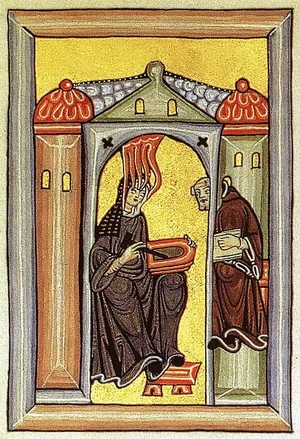
In 1141, Hildegard of Bingen was approximately forty-two years old and had spent most of her life within a female religious community attached to the Benedictine monastery of Disibodenberg. According to her own account, she had experienced unusual visions since childhood but had rarely spoken openly about them. In the forty-third year of her life, she described receiving a divine command to write what she saw and heard.
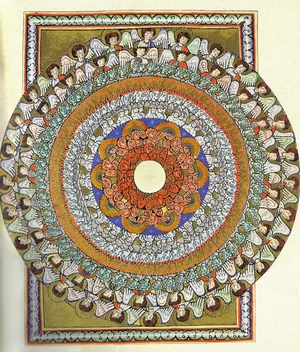
The result was Scivias, usually translated as Know the Ways, the first of three major visionary works associated with Hildegard. Its twenty-six visions contain mountains, stars, fire, buildings, human figures and complex images of creation, the Church and salvation. Hildegard did not present these images as imaginative literature. She claimed that their source was divine and that her responsibility was to record and interpret what had been revealed to her.
By the time Hildegard began Scivias, she was already the recognised leader of the women at Disibodenberg. During the decades that followed, however, the public reach of her authority expanded considerably. Her visionary writings received attention from senior church figures, she established a separate religious community at Rupertsberg and later another at Eibingen, composed a substantial body of liturgical music, maintained an extensive correspondence and travelled to address religious audiences.
Her surviving works also include writings concerned with the natural world, illness and the human body. Modern descriptions frequently divide these activities into separate categories and identify Hildegard as a composer, theologian, physician, scientist or philosopher. Such categories can help describe the range of her work, but they do not correspond neatly to the intellectual world in which she lived. Hildegard understood creation, the body, music, morality and divine order as connected subjects within a Christian universe.
The central historical question is therefore how a woman living within the religious structures of the twelfth century acquired sufficient authority to write theology, lead communities of women, correspond with powerful men and speak publicly within a Church whose formal hierarchy was overwhelmingly male.
Hildegard’s career developed through several forms of authority that can be traced in the surviving evidence: her position within a Benedictine religious community, her election as its leader, her claim to visionary revelation, the ecclesiastical recognition given to her writings and the reputation that subsequently developed around her work.
The Rhineland and the Twelfth-Century Church
Hildegard was born in 1098 in the Rhineland, a region of towns, monasteries, episcopal centres and noble territories within the Holy Roman Empire. Her lifetime coincided with political conflict, religious reform and institutional growth across western Europe.
The Latin Church occupied a central position within this society. Bishops possessed religious authority but could also exercise political and territorial power, while monasteries controlled land, maintained networks of patronage and participated in intellectual life. Kings and emperors depended upon relationships with senior clergy, and disputes concerning ecclesiastical appointments, papal authority and the proper relationship between secular and religious power could become major political conflicts.
The consequences of the eleventh-century reform movements remained important during Hildegard’s lifetime. Church leaders debated clerical discipline and the authority of popes and secular rulers, while monastic reformers sought stricter observance of religious rules. New communities and forms of religious devotion developed across Europe.
Women participated in this expansion of religious life, although their opportunities differed from those available to men. A woman could not become a priest, bishop or pope and could not exercise sacramental authority within the formal hierarchy of the Church. Religious communities nevertheless gave some women access to literacy, liturgical practice, books and networks extending beyond their families.
The circumstances of female religious life varied considerably. Some convents possessed substantial wealth and noble patronage, while other communities remained closely dependent upon male monasteries or bishops. Women entered religious life at different ages and under different circumstances, and surviving sources do not always reveal the degree of personal choice involved.
Visionary experience could provide another form of religious authority. Hildegard was not the only medieval Christian to report visions, dreams or revelations. Claims of supernatural experience belonged to Christian religious culture but could also attract suspicion. Recognition depended partly upon the reputation of the visionary and upon whether church authorities considered the message compatible with accepted belief.
A recognised visionary could speak with an authority that did not depend upon ordination. Hildegard repeatedly presented herself as a weak and insufficiently educated woman who had not produced her teaching through independent scholarly ambition. The knowledge, she insisted, came from the divine “Living Light.”
Modern readers may interpret this language as humility, strategy, sincere religious conviction or some combination of these. Hildegard’s private calculations cannot be reconstructed with certainty. What can be established is that she consistently presented her authority as derived from divine revelation and that senior church figures eventually accepted her as a credible visionary.
Childhood, Jutta and Disibodenberg
Hildegard was born in 1098, probably at Bermersheim in the Rhineland, although some details concerning her birthplace and family depend upon later medieval sources rather than contemporary birth records. Her parents are usually identified as Hildebert and Mechthild and appear to have belonged to the local nobility or landholding elite.
Hildegard is traditionally described as the tenth child of her family. Modern biographies frequently add that her parents offered her to the Church as a “tithe” because she was their tenth child. The image is memorable, but the surviving evidence does not provide a contemporary family record explaining their decision in these terms. The association between the tenth child and a religious tithe belongs more securely to later interpretation of her early life than to documented parental intention.
Hildegard later wrote that she experienced visions from childhood. In autobiographical material incorporated into her medieval Vita, she described seeing a light unlike ordinary physical light and stated that she remained awake and conscious of her surroundings during these experiences.
The evidence for these early visions comes principally from Hildegard’s own later account. Historians cannot independently observe the experiences or establish their physical cause. Migraine with visual aura, epilepsy and other neurological explanations have been proposed by modern writers, but all remain retrospective hypotheses based upon medieval descriptions produced within a theological context. The historically secure point is that Hildegard understood the experiences as visions and later made that interpretation central to her public religious authority.
Her family placed her under the religious guidance of Jutta of Sponheim. The chronology is not completely clear. Hildegard’s Vita associates her religious dedication with the age of eight, while Jutta’s formal enclosure at Disibodenberg is generally dated to 1112, when Hildegard was approximately fourteen. Some historians therefore distinguish between Hildegard entering Jutta’s care during childhood and her later formal association with the enclosed community. The surviving sources do not allow every stage of this transition to be dated precisely.
Jutta came from a noble family and had chosen a religious life associated with enclosure and ascetic devotion. In 1112 she became enclosed at Disibodenberg, a male Benedictine monastery, where a small community of women developed around her. Hildegard belonged to this community.
The women did not initially form a completely independent convent. Their religious life remained closely connected with Disibodenberg and with the authority and resources of the male monastery. Jutta taught Hildegard to read the Psalms and introduced her to the practices of religious life.
Hildegard later described herself as indocta, or unlearned. She did not receive the advanced Latin education available to some male clerics trained in cathedral schools or major monastic centres, and the production of her later Latin works involved scribal assistance. Her description should not, however, be taken to mean that she lacked education.
Decades of monastic life exposed Hildegard to Scripture, liturgy, chant and the religious writings used within Benedictine communities. The Psalms were repeatedly sung and recited, while the annual liturgical cycle returned to biblical texts and theological themes. Her later writings demonstrate extensive familiarity with this religious world.
The monk Volmar became particularly important in Hildegard’s literary work. He served for many years as her secretary and assisted with Latin and the preparation of texts. The precise boundaries of scribal correction cannot be reconstructed in every passage, but the surviving evidence consistently associates the visionary material and intellectual content of Hildegard’s major works with Hildegard herself.
Medieval textual production often involved dictation, scribal copying and correction. Such assistance did not necessarily conflict with contemporary understandings of authorship, particularly when a writer openly acknowledged the role of a secretary.
Jutta died in 1136. The women of the community then chose Hildegard as their magistra, a title meaning teacher or female leader. Hildegard is commonly described as an abbess, but her precise canonical position was complicated by the continuing relationship between the women and the abbots of Disibodenberg. The title magistra is securely associated with her leadership at this stage.
The surviving evidence does not provide a detailed record of Hildegard’s daily administrative responsibilities after 1136. It does establish that she had become the recognised leader of the women several years before she began Scivias. The community continued to grow, and by the late 1140s Hildegard was seeking to establish the women at a separate site. Her institutional leadership therefore preceded the wider recognition of her visionary writings.
The Command to Write
Hildegard dated a decisive development in her visionary life to 1141. In the opening of Scivias, she described receiving a vision in the forty-third year of her life in which a heavenly voice commanded her to write what she saw and heard.
According to Hildegard, she initially resisted because of doubt and fear concerning her ability. She also associated her refusal with illness and stated that her physical condition improved when she began writing.
The relationship between illness and obedience appears repeatedly in accounts of Hildegard’s life. Medieval biographical sources interpreted such episodes within a religious framework in which bodily suffering could confirm a divine calling. Modern readers have proposed psychological or physiological explanations, but the surviving evidence establishes Hildegard’s own interpretation more clearly than the physical cause of her symptoms.
She believed that she had been commanded to write.
Hildegard turned to Volmar for assistance and also received support from Richardis of Stade, a woman in the religious community who became closely associated with her. Work on Scivias continued for approximately a decade.
The title derives from Sci vias Domini — “Know the Ways of the Lord.” The work contains twenty-six visions divided into three parts. Hildegard describes what she sees and then presents extensive interpretations concerned with creation, the fall of humanity, salvation, the Church and moral behaviour.
Her visionary images include an iron-coloured mountain, blazing light, stars, towers, cosmic forms and female personifications including Ecclesia, the Church, and Sapientia, Wisdom. The images are not presented as independent works of fantasy. Their meaning develops through the theological interpretation accompanying each vision.
The illuminated manuscript tradition associated with Scivias has become central to Hildegard’s modern visual reputation. The original Rupertsberg manuscript disappeared during the twentieth century, although a carefully produced facsimile preserves its visual programme.
The precise extent of Hildegard’s involvement in designing or supervising individual illuminations remains debated. The images should not automatically be described as paintings made by Hildegard herself. They are more securely understood as visual representations associated with the transmission of her visionary work.
Recognition at Trier
Writing Scivias did not automatically establish Hildegard as a recognised religious authority. Her claims attracted attention beyond Disibodenberg and eventually reached senior church figures.
Hildegard wrote to Bernard of Clairvaux, one of the most influential religious leaders of the twelfth century, describing her visionary experiences and asking for guidance. Bernard’s surviving response offered encouragement, although the correspondence does not establish the close spiritual relationship sometimes described in later accounts.
More important was the involvement of Pope Eugenius III. During the synod held at Trier in 1147–1148, material from Hildegard’s unfinished Scivias was examined. Medieval accounts differ in some details, but the broad development is well supported: Hildegard’s visionary claims received ecclesiastical attention, portions of her work reached Eugenius and she was encouraged to continue writing.
The pope did not appoint Hildegard to a formal office within the Church hierarchy or grant her sacramental authority. The importance of the episode lay in the recognition of her visionary writing by senior church authorities.
This strengthened a form of authority Hildegard had already begun to construct through her claim to revelation. Her correspondence expanded, and people increasingly approached her for spiritual advice, prayers and interpretation. Her surviving letters include communications with abbots, bishops, popes and rulers as well as religious communities and individuals whose positions were less prominent.
Hildegard continued to describe herself through the language of weakness and limited education, but the public position from which she wrote had changed substantially. By the middle of the twelfth century, she was no longer known only within the women’s community at Disibodenberg.
Rupertsberg and Female Religious Leadership
As the women’s community at Disibodenberg grew, Hildegard sought to move it to Rupertsberg, near Bingen on the Rhine. The proposed transfer created conflict with Abbot Kuno of Disibodenberg.
The women were connected to the monastery institutionally and economically. A community of noble religious women could bring land, donations and prestige, and their departure had consequences for Disibodenberg. Hildegard claimed that the command to move came through divine revelation, while the abbot initially resisted the transfer.
According to Hildegard’s medieval biographical tradition, she became seriously ill and physically immobile during the dispute. The narrative interprets her condition as the consequence of being prevented from obeying a divine command. The abbot eventually accepted the move.
The surviving evidence establishes the institutional dispute and Hildegard’s determination to establish the women elsewhere. The precise role played by her illness in changing Kuno’s decision cannot be independently reconstructed from the hagiographic account.
Around 1150, Hildegard and approximately twenty women moved to Rupertsberg. The new site required construction and resources, and the transition appears to have been difficult. Some members of the community questioned the move, while Hildegard had exchanged the established surroundings of Disibodenberg for a new institution whose practical arrangements had to be developed.
Rupertsberg gave the women a distinct communal centre increasingly associated with Hildegard’s leadership. Questions of jurisdiction did not disappear, and the community continued to exist within the ecclesiastical structures of the Church. Hildegard nevertheless exercised greater control over the religious house than had been possible while the women remained physically attached to Disibodenberg.
The significance of Rupertsberg is visible in Hildegard’s later career. The community became the principal setting in which her visionary works, music and correspondence developed. Manuscripts were produced and preserved there, while the women of the community participated in the liturgical culture for which Hildegard composed.
Around 1165, Hildegard established a second community at Eibingen, across the Rhine. The two foundations demonstrate the institutional scale her leadership had reached by the later decades of her life.
Richardis of Stade and the Limits of Authority
Richardis of Stade had assisted Hildegard during the production of Scivias and appears to have occupied an important position within the Rupertsberg community. In 1151, Richardis was selected to become abbess of Bassum, a religious house far from Rupertsberg.
Hildegard opposed the appointment and attempted to prevent Richardis from leaving. She wrote to senior church figures and members of Richardis’s family, arguing that the transfer was motivated by worldly advancement and that Richardis should remain at Rupertsberg.
The surviving letters provide unusually direct evidence for Hildegard’s response to the dispute. Her language is urgent and personal, and she repeatedly presents Richardis’s departure as contrary to the spiritual work with which the younger woman had been associated.
Hildegard’s efforts failed. Richardis left Rupertsberg and became abbess at Bassum. She died in 1152, only a short time later.
The correspondence following Richardis’s death records Hildegard’s grief and the importance she had attached to their relationship. It does not provide a complete account of Richardis’s own wishes or the discussions surrounding her appointment, and the emotional nature of the relationship between the two women cannot be reconstructed beyond the surviving letters.
The episode demonstrates the limits of Hildegard’s institutional authority. Her reputation allowed her to appeal to senior church figures and challenge the appointment, but she could not prevent Richardis’s departure. It also preserves a rare view of Hildegard during a dispute in which her visionary confidence, institutional interests and personal attachment were closely connected.
Music and Ordo Virtutum
Music occupied a central place in Hildegard’s religious thought and in the liturgical life of her communities. More surviving chants are attributed to her than to any other named composer of the Middle Ages.
Her musical works include antiphons, responsories, sequences and hymns, many of which were collected within the Symphonia armonie celestium revelationum, the Symphony of the Harmony of Celestial Revelations. Hildegard composed both the texts and music associated with these works.
The chants were written for religious use and frequently honour the Virgin Mary, saints, angels and sacred figures connected with Hildegard’s communities. O viridissima virga, addressed to the Virgin Mary, develops the imagery of greenness and flourishing that appears elsewhere in Hildegard’s writings. O vis aeternitatis addresses divine eternity, while sequences and responsories associated with Saint Ursula and her companions form part of Hildegard’s extensive engagement with female sanctity.
Hildegard’s melodies are often characterised by wide ranges and extended melodic movement. Comparison with other medieval chant traditions requires caution because liturgical music was varied, but the surviving compositions possess identifiable textual and musical characteristics that have allowed scholars to study Hildegard as a named medieval composer.
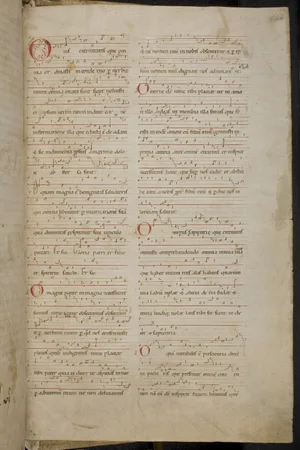
The music survives principally through manuscript sources including the Riesencodex and the Dendermonde Codex. These manuscripts connect the compositions with the communities in which Hildegard’s religious works were preserved.
For Hildegard, musical harmony possessed theological meaning. Humanity had lost the perfection associated with creation, while sacred song participated in the praise offered by angels and saints. The concept of viriditas, often translated through ideas of greenness, vitality or flourishing, also appears within her musical language. The term does not possess one fixed modern equivalent and can describe physical growth, spiritual vitality and the life-giving power present within creation.
Her most unusual musical work is Ordo Virtutum, the Play of the Virtues, which reached its developed form around the early 1150s. The drama presents the struggle for a human soul through personified Virtues and the Devil.
The Virtues sing. The Devil does not participate in their musical harmony and instead speaks or shouts. The distinction is part of the theological structure of the work rather than a purely theatrical effect.
Ordo Virtutum is frequently described as one of the earliest surviving morality plays and as an early substantial musical drama whose author and composer are known. It has occasionally been presented as an ancestor of opera, but the work emerged from twelfth-century religious culture and should be understood within that setting.
The music of Hildegard was not separate from the community she led. Her compositions formed part of a religious environment in which women sang texts shaped by the same theological language that appeared in her visionary works.
The Visionary Trilogy
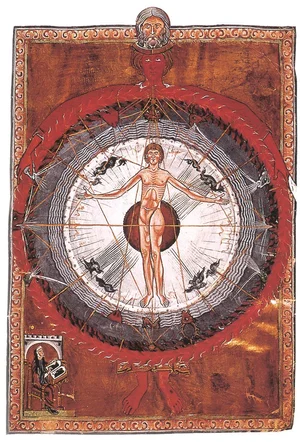
Scivias was the first of Hildegard’s three major visionary works. Together, the three books developed an extensive account of creation, moral life, the Church and the relationship between humanity and God.
Scivias, completed around 1151, presents twenty-six visions concerned with creation, the fall of humanity, salvation and the Church. Its structure moves from the origins of the created world through Christian history towards an account of divine order and final fulfilment. Female personifications, particularly Ecclesia, occupy important positions within the work.
Hildegard’s second major visionary text, Liber Vitae Meritorum, the Book of Life’s Merits, was composed during the late 1150s and early 1160s. Its principal concern is moral choice. Vices and virtues are personified and speak, allowing Hildegard to examine patterns of human behaviour, sin, correction and the consequences of moral action.
Her final major visionary work, Liber Divinorum Operum, the Book of Divine Works, developed a broader cosmological account of creation. The relationship between the human being and the cosmos becomes particularly prominent, and one of the work’s best-known images presents a human figure within a vast cosmic structure.
The three works are connected by Hildegard’s Christian understanding of divine order but are not repetitions of the same visionary programme. Scivias is concerned substantially with salvation history and the Church; Liber Vitae Meritorum concentrates upon moral action and the opposition between vice and virtue; Liber Divinorum Operum places humanity within a wider account of creation and cosmic order.
Hildegard’s cosmology drew upon biblical interpretation, inherited natural philosophy and medieval understandings of the elements and the human body. Her work does not correspond to modern scientific cosmology, but neither was it intended to do so. The intellectual significance of the visionary trilogy lies in the extensive theological system Hildegard constructed through the interaction of visual description, biblical interpretation and the religious knowledge available within her society.
Nature, Medicine and the Human Body
Two major works associated with Hildegard concern the natural world and medicine: Physica, sometimes called the Book of Simple Medicines, and Causae et Curae, or Causes and Cures.
Physica discusses plants, trees, animals, stones, metals and other parts of the natural world. Its entries describe qualities attributed to different substances and the ways in which they might be used. Causae et Curae examines the human body, illness, sexuality and reproduction within a broader account of creation and human nature.
The works belong to medieval traditions of natural and medical knowledge. Hildegard’s understanding of health drew upon humoral ideas, inherited learning and Christian theology, while physical and spiritual conditions could be treated as connected. Some remedies involve plants or practices that continued within later herbal traditions, while others depend upon assumptions not accepted by modern medicine.
The textual history of these works requires particular caution. Hildegard’s engagement with natural and medical subjects is strongly supported, and substantial material preserved in Physica and Causae et Curae is associated with her intellectual activity. The surviving manuscripts, however, do not preserve autograph copies written in Hildegard’s own hand.
Scholars have examined the possibility that material was compiled, reorganised or altered during transmission. The exact wording and arrangement of every surviving passage therefore cannot be attributed to Hildegard with the same confidence as the broad authorship of her visionary trilogy. This distinction does not require removing the natural and medical works from her corpus, but it does make claims concerning individual remedies or sentences more cautious.
Hildegard’s discussions of the female body are particularly notable. She wrote about menstruation, conception, pregnancy and sexual desire and described female sexual experience in greater detail than many surviving medieval writers.
Her treatment of these subjects remained within medieval Christian understandings of creation, marriage, virginity and sexual morality. She did not write a modern study of reproductive medicine or gender. Her works nevertheless provide historically important evidence for the ways in which a medieval religious woman could discuss female physiology and sexuality.
Hildegard’s theological writings also use female personifications extensively. Wisdom and the Church appear as powerful female figures, while the Virgin Mary and female saints occupy important positions within her music.
Modern scholars have examined whether these patterns constitute a distinctive theology of the feminine. The evidence supports close attention to Hildegard’s use of female imagery, but it does not establish a modern programme of gender equality. She accepted many of the hierarchical assumptions of her society while creating works in which female figures could carry substantial cosmic and spiritual meaning.
Letters, Preaching and Political Authority
Hundreds of letters are associated with Hildegard’s correspondence. They connect her with popes, bishops, abbots, abbesses, rulers, clergy and people seeking spiritual advice.
The surviving collections were shaped through medieval copying and compilation, and some letters may preserve edited forms rather than exact transcripts of the messages originally dictated or sent. The correspondence nevertheless provides extensive evidence for the reach of Hildegard’s reputation.
People approached her concerning religious uncertainty, illness and spiritual concerns. Hildegard’s responses could offer reassurance, but many of her letters use prophetic language to criticise corruption and failures of religious leadership.
Her authority did not depend upon claiming a clerical office. Hildegard presented herself as communicating a divine warning. Within this framework, she could address bishops and abbots whose formal ecclesiastical powers were unavailable to her.
Her correspondence with Frederick Barbarossa is particularly well known. Frederick became king of the Romans in 1152 and emperor in 1155. After 1159, a major schism divided the western Church, and Frederick supported rival papal claimants against Pope Alexander III.
Hildegard criticised his involvement in the schism. Her surviving letters use prophetic language to warn Frederick about the consequences of his actions.
Later accounts sometimes present the relationship as a confrontation between a lone nun and an emperor. The surviving evidence supports a more precise conclusion. Hildegard possessed sufficient religious reputation to address one of the most powerful rulers in Europe in severe terms, but Frederick did not abandon imperial policy in response to her warnings.
During the later decades of her life, Hildegard also travelled beyond Rupertsberg and delivered religious addresses. Several preaching journeys are reconstructed from her writings and correspondence, with visits to religious communities and urban centres along the Rhine and Main.
Hildegard was not ordained and did not exercise the priestly office of preaching within the liturgy. Her public speech rested upon her recognised prophetic and visionary status. The surviving material associated with these journeys concentrates heavily upon reform, particularly the responsibilities of clergy and the consequences of religious negligence.
Her language frequently draws upon images of vitality and dryness. Viriditas could describe flourishing life, while spiritual failure could be represented through loss of vitality. Modern environmental interpretations have found these images attractive, but within Hildegard’s writings they belong principally to a theological vocabulary concerned with creation and divine life.
The letters and preaching journeys demonstrate the extent to which Hildegard’s authority had moved beyond the institutions she directly led. Her reputation allowed her to participate in religious debate without occupying a position within the ordained hierarchy.
The Lingua ignota
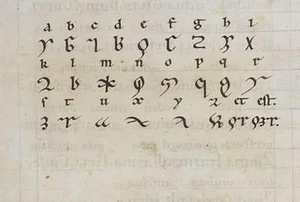
Among Hildegard’s most unusual surviving works are the Lingua ignota, or “Unknown Language,” and the Litterae ignotae, the “Unknown Letters.”
The Lingua ignota preserves a list of invented words, largely accompanied by Latin or German explanations. The vocabulary includes terms for human beings, religious concepts, plants and other parts of the created world. The Litterae ignotae present an unfamiliar alphabet.
The purpose of these systems remains uncertain.
The Lingua ignota has been described as a secret language, mystical language and constructed language. Modern discussions sometimes identify Hildegard as the creator of the earliest known constructed language, although the description depends upon how that category is defined.
The surviving vocabulary does not demonstrate a complete independent language with a fully preserved grammar. Some invented words appear within otherwise Latin texts.
Hildegard did not leave a clear explanation of the system’s purpose. It may have possessed devotional or symbolic significance, may have been connected with ideas of naming and creation, or may have served a function within her community that the surviving evidence no longer preserves.
The originality of the surviving material can be recognised without assigning it a purpose the evidence does not establish.
The Interdict and Final Years
Near the end of Hildegard’s life, a dispute with church authorities at Mainz threatened the religious life of Rupertsberg.
Around 1178, a man was buried in the community’s cemetery. The Mainz authorities claimed that he had died excommunicated and ordered Hildegard to have the body removed from consecrated ground.
Hildegard refused. She maintained that the man had been reconciled with the Church before his death and had received absolution.
The authorities imposed an interdict upon the community. Restrictions were placed upon liturgical worship, including the use of sacred music.
Hildegard responded in correspondence with the Mainz prelates. Her defence of the community included an extended explanation of the religious significance of music. She argued that singing belonged to the divine order and that restricting sacred music carried serious spiritual consequences.
She also refused to exhume the body.
The interdict was eventually lifted after the dispute was reconsidered. Hildegard’s actions should not be interpreted as a rejection of ecclesiastical authority in principle. Her argument was that the authorities had made an incorrect judgement concerning the buried man and that obeying the order would violate what she understood to be divine justice.
The episode is consistent with the form of authority visible elsewhere in her career. Hildegard accepted the Church as a divinely ordered institution while maintaining that individual churchmen could fail in their responsibilities and could therefore be challenged.
Hildegard died at Rupertsberg on 17 September 1179 at approximately eighty-one years of age.
Her medieval Vita describes signs in the sky at the time of her death. Such reports belong to the hagiographic framework through which medieval holy lives were written and cannot be independently verified. The date of Hildegard’s death is much more securely established.
She left communities at Rupertsberg and Eibingen and an extensive body of writings and music. Rupertsberg was later destroyed during the Thirty Years’ War in the seventeenth century, and the community’s physical connection with Hildegard’s principal foundation became fragmented.
The Riesencodex, a large manuscript produced around the end of Hildegard’s life or shortly after her death, became one of the most important witnesses to her work. It preserves her visionary trilogy, musical compositions, letters, the Lingua ignota, homiletic material and biographical writing.
The original illustrated Rupertsberg manuscript of Scivias survived into the twentieth century but disappeared during the upheavals surrounding the Second World War. A hand-produced facsimile created before its loss preserves the famous visual programme.
Hildegard’s surviving corpus therefore depends upon medieval copying, compilation and later manuscript preservation. The texts and music available today reached modern readers through a long history of transmission.
Sources and Historical Evidence
The evidence for Hildegard’s life is unusually extensive for a medieval woman, although the surviving sources differ considerably in purpose and textual history.
Her three major visionary works provide the principal evidence for her theology and her own account of visionary experience. Scivias, Liber Vitae Meritorum and Liber Divinorum Operum preserve extensive bodies of material securely associated with Hildegard’s authorship and religious authority.
The surviving correspondence provides evidence for the development of her public reputation and her relationships with religious and political figures. The letters were copied and organised within medieval collections, and scholars have examined the degree to which individual texts may have been edited during transmission. The existence and broad scale of Hildegard’s correspondence network are nevertheless securely established.
Hildegard’s music survives principally through the Riesencodex and the Dendermonde Codex. The attribution of a substantial body of liturgical composition to her is exceptionally strong.
The natural and medical works present greater textual difficulties. Physica and Causae et Curae are strongly associated with Hildegard’s intellectual activity, but their manuscript histories do not allow every surviving passage to be treated as a direct transcription of her original wording. The distinction between Hildegard’s authorship of material and the later textual form in which that material survives remains important.
The Vita Sanctae Hildegardis is essential for reconstructing her life. It developed through the work of several contributors, including Gottfried of Disibodenberg and Theoderic of Echternach, and incorporates autobiographical material attributed to Hildegard.
The Vita is also hagiography. Its purpose was to present the life of a holy woman rather than to produce a modern critical biography. Miracles, bodily suffering and divine signs are interpreted within a religious framework intended to demonstrate Hildegard’s sanctity.
This does not make the work historically useless. It requires its claims to be distinguished according to the type of evidence they provide.
The same principle applies to Hildegard’s descriptions of her visions. Historians can establish what she reported, how she interpreted the experiences and how her claims were received. Historical method cannot establish or reject the supernatural source she attributed to them.
Historical Interpretation: The Many Hildegards
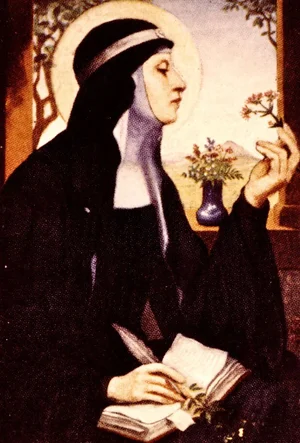
Modern interest in Hildegard has produced several different versions of her.
She has been described as a composer, scientist, physician, herbalist, environmentalist, feminist, philosopher and linguist. Each description begins with surviving evidence. Hildegard composed music, wrote about the natural world and the body, created unusual vocabulary, led communities of women and addressed powerful men.
The difficulty arises when these activities are separated from the intellectual framework that connected them.
Hildegard did not divide theology, music, medicine and nature into independent modern disciplines. Her understanding of creation runs through much of her work. Music reflected divine harmony. The natural world possessed meaning as part of creation. The human body belonged within a wider account of moral and cosmic order.
Modern categories can therefore describe parts of her work without necessarily explaining the whole.
The description of Hildegard as a feminist requires particular caution. She established and led communities of women, developed an influential female public voice and repeatedly used female imagery within her theology. Her career provides substantial evidence for forms of female intellectual and institutional authority within medieval religious society.
She did not argue for equal political or ecclesiastical rights between men and women and accepted many of the hierarchical assumptions of her society. Hildegard frequently emphasised her own female weakness while claiming that the divine voice speaking through her possessed authority.
Whether this language was strategic, sincerely believed or both cannot be established conclusively. The surviving evidence demonstrates that it became a central part of the way Hildegard presented her visionary role.
Similar caution applies to descriptions of her as a scientist or environmental thinker. Her observations of the natural world and her language of vitality are historically significant, but they developed within medieval Christian understandings of creation rather than modern scientific or environmental movements.
The historical Hildegard does not become less important when these later identities are treated cautiously. Her surviving works demonstrate the breadth of intellectual activity possible within twelfth-century religious culture and the unusual scale upon which one woman was able to participate in it.
What We Know — and What We Do Not
What We Know — and What We Do Not
Firmly Supported
- Hildegard was born in 1098 in the Rhineland and died on 17 September 1179.
- She belonged to the female religious community associated with Jutta of Sponheim at Disibodenberg.
- After Jutta’s death in 1136, Hildegard became magistra of the women’s community.
- The monk Volmar assisted Hildegard for many years with the written preparation of her works.
- Hildegard began Scivias in the early 1140s and produced three major visionary works.
- Her writings received attention from senior church authorities, and Pope Eugenius III encouraged her to continue writing.
- Hildegard established the women’s community at Rupertsberg around 1150 and later founded another community at Eibingen.
- A substantial body of liturgical music and Ordo Virtutum is securely attributed to her.
- Hildegard maintained an extensive correspondence and travelled to deliver religious addresses.
- Natural and medical writings are strongly associated with her intellectual activity.
- Near the end of her life, Hildegard resisted an order to exhume a man buried at Rupertsberg, and the community was placed under interdict.
Strongly Supported but Requiring Interpretation
- Hildegard experienced unusual visual or perceptual phenomena that she sincerely understood as divine visions.
- Her monastic education gave her substantial knowledge of Scripture and liturgy despite her limited formal training in Latin.
- Volmar assisted with grammar, correction and textual preparation without replacing Hildegard as the principal intellectual author of her major visionary works.
- Hildegard’s recognised visionary status provided a form of religious authority through which she could address people occupying positions formally unavailable to women.
- Material preserved in Physica and Causae et Curae derives substantially from Hildegard’s natural and medical interests, although the surviving textual form may reflect later compilation or rearrangement.
Uncertain or Unknown
- Whether Hildegard was literally the tenth child of her parents and whether they understood her religious dedication as a form of tithing.
- The precise age at which she first entered Jutta’s care.
- The physical or neurological processes associated with her visions.
- The precise boundaries of scribal intervention in every surviving Hildegardian text.
- The extent to which Hildegard personally directed individual Scivias illuminations.
- The exact original form of Physica and Causae et Curae.
- The purpose of the Lingua ignota and Litterae ignotae.
- The complete emotional nature of Hildegard’s relationship with Richardis of Stade.
- Whether every surviving letter preserves the exact wording of the original message.
- The supernatural origin of Hildegard’s visions, which cannot be established or rejected through historical method.
Historical Confidence
Historical Confidence
Existence, Chronology and Religious Career: ⭐⭐⭐⭐⭐
Hildegard’s life is documented through her own writings, correspondence, medieval biography and institutional evidence. Her leadership, foundations and death in 1179 are securely established.
Visionary Writings: ⭐⭐⭐⭐⭐
The attribution of Scivias, Liber Vitae Meritorum and Liber Divinorum Operum to Hildegard is exceptionally strong.
Musical Composition: ⭐⭐⭐⭐⭐
A large body of liturgical music and Ordo Virtutum is securely associated with Hildegard. Manuscript evidence strongly supports her role as both textual and musical composer.
Correspondence and Public Reputation: ⭐⭐⭐⭐⭐
Extensive letter collections demonstrate Hildegard’s communication with religious and political figures. Individual texts may have undergone editorial shaping, but the broader correspondence network is securely documented.
Leadership at Rupertsberg and Eibingen: ⭐⭐⭐⭐⭐
Hildegard’s leadership of women’s religious communities and her role in establishing Rupertsberg and Eibingen are well supported. Her precise canonical title and jurisdictional relationship with Disibodenberg require more careful description than the simple use of “abbess” sometimes suggests.
Natural and Medical Writing: ⭐⭐⭐⭐
Hildegard’s connection with natural and medical material is strongly supported, but Physica and Causae et Curae possess complicated manuscript histories. The exact form of every surviving passage cannot be established with equal confidence.
Childhood and Early Visions: ⭐⭐⭐
The principal evidence comes from Hildegard’s later accounts and medieval biographical tradition. Her early visionary experiences are central to her own understanding of her life but cannot be independently documented from childhood records.
Medical Explanations for the Visions: ⭐
Migraine, epilepsy and other neurological diagnoses are retrospective modern hypotheses and cannot be established confidently from the surviving evidence.
The “Tenth Child as Tithe” Tradition: ⭐⭐
Hildegard is traditionally described as the tenth child and as having been offered to God in a symbolic act of tithing. The popular form of the story is more certain than the surviving evidence allows.
Purpose of the Lingua ignota: ⭐⭐
The invented vocabulary and alphabet survive, but Hildegard did not leave a clear explanation of their intended function.
Key Contributions
Key Contributions
- Visionary Theology: Hildegard produced three extensive works combining visionary imagery with theological interpretation and created one of the largest surviving bodies of visionary writing associated with a medieval woman.
- Leadership of Women’s Communities: She led the women associated with Disibodenberg, established Rupertsberg and later founded a second community at Eibingen.
- Liturgical Music and Ordo Virtutum: Hildegard composed a substantial surviving body of sacred music and a major musical drama combining theology, poetry and performance.
- Prophetic Correspondence and Reform: Her letters and public addresses criticised failures of religious leadership and connected her with popes, bishops, abbots, abbesses and rulers.
- Natural and Medical Writing: Works associated with Hildegard preserve extensive medieval discussions of plants, animals, illness, sexuality and the human body.
- Female Religious Authority: Her career demonstrates how visionary and prophetic status could create recognised forms of authority for a woman within the religious structures of the twelfth century.
- Linguistic Experimentation: The Lingua ignota and Litterae ignotae preserve an unusual medieval experiment in invented vocabulary and writing.
- Evidence for Women’s Monastic Life: Hildegard’s writings, music and institutional career provide unusually extensive evidence concerning the intellectual and religious activities of medieval women.
Key Dates
Hildegard is born in the Rhineland, probably at Bermersheim.
Hildegard is placed under the religious guidance of Jutta of Sponheim.
Jutta is formally enclosed at Disibodenberg. Hildegard is associated with the female religious community there.
Jutta dies. Hildegard becomes magistra of the women’s community.
Hildegard dates the divine command to begin writing her visions to this year.
Hildegard composes Scivias with scribal assistance, particularly from Volmar.
Hildegard’s visionary writings receive attention during the Synod of Trier. Pope Eugenius III encourages her to continue writing.
Hildegard and approximately twenty women move from Disibodenberg to Rupertsberg.
Richardis of Stade leaves Rupertsberg to become abbess of Bassum. Hildegard opposes the move. Richardis dies in 1152.
Ordo Virtutum reaches its developed form.
Hildegard composes Liber Vitae Meritorum.
Hildegard undertakes preaching journeys and addresses religious communities and clergy.
A major papal schism divides the western Church. Hildegard criticises Frederick Barbarossa’s support for rival papal claimants.
Hildegard develops and completes Liber Divinorum Operum.
Hildegard establishes a second community of women at Eibingen.
Volmar dies.
The Rupertsberg community is placed under interdict following Hildegard’s refusal to exhume a man whom Mainz authorities regarded as excommunicated.
The interdict is lifted.
Hildegard dies at Rupertsberg at approximately eighty-one years of age.
Pope Benedict XVI formally extends Hildegard’s liturgical veneration to the universal Catholic Church and declares her a Doctor of the Church.
Did You Know?
Did You Know?
- Hildegard described experiencing visions from childhood but did not begin her first major visionary work until she was in her early forties.
- She repeatedly described herself as “unlearned,” although decades of monastic life had given her extensive knowledge of Scripture and liturgy.
- The monk Volmar assisted Hildegard for many years with the written preparation of her works.
- More surviving chants are attributed to Hildegard than to any other named composer of the Middle Ages.
- Hildegard wrote both the words and music associated with her compositions.
- In Ordo Virtutum, the Virtues sing while the Devil speaks or shouts and does not participate in their musical harmony.
- Hildegard wrote about plants, animals, stones, illness, reproduction and sexuality.
- Modern attempts to diagnose her visions as migraine or epilepsy remain retrospective hypotheses.
- She created an invented vocabulary known as the Lingua ignota and an unfamiliar alphabet called the Litterae ignotae.
- Hildegard corresponded with religious and political figures including Frederick Barbarossa.
- She travelled to deliver religious addresses despite possessing no priestly office.
- Near the end of her life, her community was placed under interdict after she refused to remove a buried man from the Rupertsberg cemetery.
- The original illustrated Rupertsberg manuscript of Scivias disappeared during the twentieth century, but a detailed facsimile made before its loss preserves its visual programme.
Further Reading
- Hildegard of Bingen, Scivias, translated by Columba Hart and Jane Bishop
- Hildegard of Bingen, The Book of the Rewards of Life, translated by Bruce W. Hozeski
- Hildegard of Bingen, The Book of Divine Works, translated by Nathaniel M. Campbell
- Hildegard of Bingen, Physica, translated by Priscilla Throop
- Hildegard of Bingen, Causes and Cures, translated by Priscilla Throop
- Joseph L. Baird and Radd K. Ehrman, trans., The Letters of Hildegard of Bingen
- Barbara Newman, Sister of Wisdom: St. Hildegard’s Theology of the Feminine
- Barbara Newman, ed., Voice of the Living Light: Hildegard of Bingen and Her World
- Jennifer Bain, ed., The Cambridge Companion to Hildegard of Bingen
- Beverly Mayne Kienzle, Debra L. Stoudt and George Ferzoco, eds., A Companion to Hildegard of Bingen
- Sabina Flanagan, Hildegard of Bingen, 1098–1179: A Visionary Life
- Fiona Maddocks, Hildegard of Bingen: The Woman of Her Age
- Beverly Mayne Kienzle, Hildegard of Bingen and Her Gospel Homilies
- Jennifer Bain, Hildegard of Bingen and Musical Reception: The Modern Revival of a Medieval Composer
- Studies of the Riesencodex and the manuscript transmission of Hildegard’s works
- Research on Jutta of Sponheim and the women’s community at Disibodenberg
- Studies of medieval visionary authority and women’s religious writing
- Research on Hildegard’s natural and medical works
- Studies of the Rupertsberg Scivias manuscript and its illuminations
Legacy and Historical Significance
Hildegard of Bingen left one of the most extensive surviving bodies of work associated with a woman of the European Middle Ages. Her visionary books, music, correspondence and writings concerning the natural world and the human body preserve evidence for an intellectual and religious career that developed within the institutions of the twelfth-century Church.
Her authority did not begin with a formal position in the ecclesiastical hierarchy. Hildegard could not become a priest or bishop, and her education differed from the advanced scholastic training available to some male clerics. She spent decades within the female religious community at Disibodenberg, where monastic life exposed her to Scripture, liturgy and chant. After Jutta’s death in 1136, the women chose Hildegard as their magistra, placing her in a recognised position of leadership before she began Scivias.
The visionary authority Hildegard claimed from 1141 expanded the reach of that position. She presented her teaching as revelation received from the divine “Living Light,” and ecclesiastical examination during the 1140s resulted in encouragement to continue writing. Recognition did not give Hildegard priestly authority, but it established her reputation as a visionary whose words could circulate within the Church.
Rupertsberg gave that authority an institutional centre. The move from Disibodenberg created a distinct community increasingly associated with Hildegard’s leadership, and the later foundation at Eibingen extended the scale of her work with religious women. Her writings, music and correspondence developed within these communities rather than as the isolated productions of a solitary author.
The range of Hildegard’s surviving work can appear fragmented when divided into modern disciplines. Her visionary theology, liturgical music and writings on nature and the body are often discussed separately. Within Hildegard’s own intellectual world, however, these subjects belonged to a connected understanding of creation. Divine order could be expressed through cosmic imagery, sacred harmony, moral life and the properties attributed to the natural world.
This connection is especially important when assessing her natural and medical writings. Physica and Causae et Curae preserve extensive medieval material concerning plants, animals, illness, sexuality and reproduction. Their manuscript histories require greater textual caution than Hildegard’s visionary trilogy, but they remain important evidence for her engagement with natural and medical knowledge.
Her correspondence and preaching journeys demonstrate the geographical and social reach of her reputation. Hildegard addressed senior clergy and rulers through prophetic language and criticised what she regarded as failures of religious leadership. Her warnings to Frederick Barbarossa during the papal schism did not determine imperial policy, but the existence of the correspondence demonstrates that a Benedictine woman from the Rhineland had acquired sufficient religious authority to address an emperor in severe terms.
The disputes preserved in her correspondence also prevent her authority from becoming an abstract ideal. Hildegard failed to prevent Richardis of Stade from leaving Rupertsberg, and near the end of her life her refusal to exhume a man from the community’s cemetery resulted in an interdict. In both cases, the evidence shows Hildegard using the forms of authority available to her while encountering institutions and decisions she could not simply control.
Her music remains one of the clearest surviving expressions of the religious culture she created at Rupertsberg. The chants and Ordo Virtutum joined theological language with communal performance, while the manuscript tradition preserved Hildegard as one of the most extensively documented named composers of the Middle Ages.
Later centuries repeatedly reinterpreted her. Modern audiences have encountered Hildegard as a composer, scientist, healer, environmental thinker and symbol of female intellectual achievement. These descriptions reflect genuine elements of her surviving work but can obscure the Christian intellectual framework that connected them.
Hildegard’s historical significance does not depend upon demonstrating that she anticipated modern disciplines or political movements. Her surviving works establish the scale of her activity within the society in which she lived. She led communities of women, produced major theological writings, composed music, engaged with natural and medical knowledge and maintained a correspondence extending into the highest levels of religious and political society.
The preservation of her manuscripts allows these activities to be studied in unusual detail. Through them, Hildegard provides evidence for forms of female religious, intellectual and institutional authority that existed within the medieval Church even while women remained excluded from its ordained hierarchy.
Her career therefore broadens the historical record of the twelfth century. It demonstrates not that Hildegard stood outside her society, but that the structures of medieval religious life could contain forms of authority more varied than later summaries of that society sometimes suggest.
Image Credits
Hildegard receiving a vision: Medieval manuscript image associated with Scivias, via Wikimedia Commons. Public domain. It belongs to the manuscript tradition of Hildegard's work rather than serving as a contemporary portrait.
Hildegard of Bingen portrait: Devotional portrait attributed to Wilhelm Fassbinder, 1898, via Wikimedia Commons. Public domain. A much later artistic interpretation rather than an authenticated likeness.
Visionary illumination with angels: Medieval illumination associated with Hildegard's visionary works, via Wikimedia Commons. Public domain.
Litterae ignotae: Manuscript representation of Hildegard's “Unknown Letters,” via Wikimedia Commons. Public domain.
Riesencodex: Manuscript folio from the Riesencodex, via Wikimedia Commons. Public domain.
Liber Divinorum Operum: Medieval cosmic illumination associated with Hildegard's Book of Divine Works, via Wikimedia Commons. Public domain.
Explore Related Profiles
Help Keep These Stories Alive
If you enjoyed reading this profile and believe more overlooked voices deserve to be heard, you can help fund future research, writing, and free educational resources.
Every contribution—whether a one-off donation or monthly support—helps create new historical profiles, downloadable materials, and articles that remain freely available to everyone.
Thank you for helping keep independent historical research and educational resources freely available.
